

Simultaneous pitching is sending a coordinated news pitch to multiple newsrooms at once, using tailored angles and clear embargo or exclusivity terms to maximise coverage without breaching newsroom relationships.
Simultaneous pitching requires a central narrative and segmented message variants. The narrative connects event news to timely UK topics such as regulation, industry growth, or notable speakers. Segment message variants by newsroom type: national outlets, trade press, regional dailies, and trade blogs. Use embargoes or tiered exclusives to manage first-pick benefits. Track recipient lists and send times to avoid duplicate contact within the same outlet.
Why choose simultaneous pitching for a UK corporate event?
Simultaneous pitching increases reach, creates momentum, and secures diverse audience segments. It accelerates awareness across business, trade, and regional audiences while preserving control of timing and key messages.
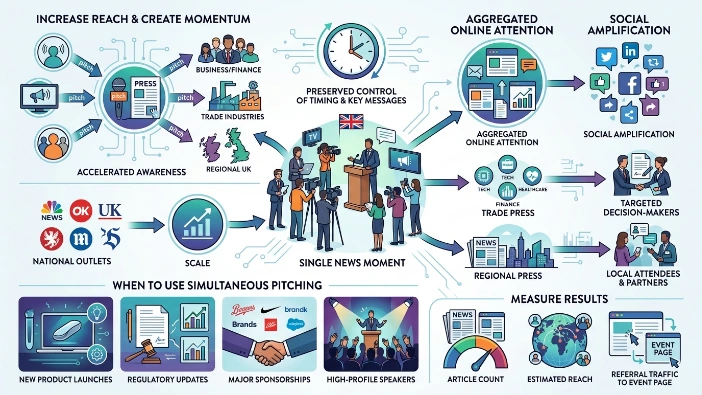
A coordinated pitch creates a single news moment. This moment produces aggregated online attention and social amplification. National outlets provide scale; trade press delivers targeted decision-makers; and regional press captures local attendees and partners. Use simultaneous pitching when the event has concrete news value: new product launches, regulatory updates, major sponsorships, or high-profile speakers. Measure results by article count, estimated reach, and referral traffic to the event page.
How do you define the newsworthy angle?
Define a newsworthy angle by identifying novelty, impact, scale, and timeliness. Tie the event to quantifiable outcomes, named stakeholders, and UK-specific relevance for stronger editorial interest.
Novelty equals new data, a first-time UK appearance, or a unique collaboration. Impact shows measurable effects: job creation numbers, investment figures, or projected market size. Scale uses specific counts: attendee target, confirmed speakers, or partner organisations. Timeliness links to local regulatory changes, market reports, or anniversary events. Document names of stakeholders such as government officials, industry chairs, or keynote speakers to strengthen credibility.
What components make a pitch effective?
An effective pitch includes a concise subject line, 40–60-word lede, three supporting facts, a clear embargo or exclusivity note, a speaker list, and press assets (images, bios, data). Offer interview access and screenshots for verification.
The subject line states the news and location. The lede explains the event’s why, when, and who. Supporting facts supply numbers and sources: attendee targets, survey results, confirmed sponsors. Embargo and exclusivity details specify date/time and outlet arrangement. Provide high-resolution images, speaker headshots, short bios, and 250–500-word backgrounders. Include contact details for press liaison and available time windows for interviews. Use a single PDF or link to a secure press kit.
How do you segment newsrooms for tailored messaging?
Segment newsrooms by audience type: national business, trade, regional, broadcast, and online outlets. Tailor ledes and supporting facts to each segment’s priorities and use different subject lines and attachments accordingly.
National business outlets prioritise market impact and executive quotes. Trade outlets prioritise technical details, demos, and procurement timelines. Regional outlets prioritise local jobs, venues, and community impact. Broadcast outlets prioritise visual elements and short, quotable lines. Online outlets prioritise SEO keywords and quick facts. For each segment, adjust the lead fact and select two supporting data points aligned to editorial focus.
How do embargoes and exclusives work in coordinated pitches?
Embargoes set a publication time when all outlets may publish. Exclusives give one outlet an early window. Use embargoes for broad simultaneous coverage and tiered exclusives to incentivise top-tier outlets.
Set embargo times in UK local time with explicit UTC offset. For tiered exclusives, offer a 24- to 48-hour exclusive to one national outlet, then release the embargo to others. Document exclusive agreements in writing and confirm acceptance before sharing assets. Keep embargoed documents on password-protected links. Use exclusives to secure headline placement while preserving wider post-exclusivity distribution.
What outreach timing and sequence produce the best results?
Send initial pitches 7–14 days before embargoed release, follow up 48–72 hours later, and issue reminders 12 hours before embargo lift. Schedule sends during UK newsroom hours for maximum attention.
Avoid Friday afternoons and bank-holiday periods. For morning attention, send between 08:00 and 09:30 UK time. For trade outlets with afternoon editorial meetings, schedule follow-ups at 10:00–11:00 UK time. Use email tracking to confirm opens and adjust follow-up priority. Maintain a single-thread email approach per outlet to preserve context and reduce clutter.
How do you craft subject lines and ledes for high open rates?
Use subject lines that state the news and include a UK location or figure. Write ledes that answer who, what, when, where, and why in 40–60 words and highlight one measurable fact.
Subject line examples: “London summit secures 2,000 delegates to discuss UK data rules — exclusive material.” Ledes open with the main news, followed by two supporting facts and an available quote. Keep subject lines under 10 words when possible. Avoid vague language and all-caps. Use UK spellings and currency where applicable.
What press assets and verification materials increase pickup?
High-resolution images, speaker headshots, verified bios, event schedules, data sources, and short video clips increase pickup. Include clear sourcing for statistics and a named press contact for verification.
Provide captioned images with photographer credit and usage terms. Supply 60–90 second B-roll for broadcast. Attach a one-page agenda with session times and speaker affiliations. Include links to cited reports or survey methodologies. Offer live or recorded spokespeople for interviews during specified UK time windows. Ensure all assets are hosted on secure, fast servers.
How do you measure success across multiple outlets?
Measure success with article count, estimated audience reach, referral traffic, social shares, number of interview requests, and downstream metrics such as registrations and qualified leads within 30 days.
Track placements and tag each article for outlet type and region. Use media value estimates for headline visibility. Monitor referral traffic to the event page and track registration sources. Count interview requests and speaker bookings. Compare registration spikes with placement timing. Attribute qualified leads by UTM parameters and CRM source fields to measure conversion within 30 days.
Explore More Expert Insights:
Pre, During, Post: The 3-Phase Media Coverage Framework for UK Events
How News Coverage Helps Charity Events Gain More Support
What are common risks and how do you mitigate them?
Risks include embargo breaches, contradictory messaging, and overloaded spokespeople. Mitigate with clear embargo rules, single-source messaging documents, limited spokesperson availability windows, and a crisis contact protocol.
Distribute a one-page messaging document to spokespeople and media contacts. Limit spokespeople to two primary contacts per topic. Confirm embargo acceptance before sharing sensitive assets. Prepare holding statements for potential negative coverage. Monitor outlets in real time and have a rapid response plan with fact corrections and follow-up materials.
Click Here to Explore More:
Events Are B2B’s Second-Highest Investment Priority in 2026: What’s Missing?
How do UK-specific factors influence pitching strategy?

UK pitching requires local time coordination, UK spelling, regional relevance, and awareness of national media cycles. Include UK data points and named UK stakeholders to increase editorial relevance.
Account for trade union schedules, Parliamentary sittings, and UK public holidays. Localise quotes from UK-based speakers or partners. Cite UK-specific statistics and regulatory references such as data protection or industry watchdog reports. Use regional press lists for London, Manchester, Birmingham, and Glasgow to capture local audiences. Tailor messaging for UK business culture and editorial norms.
Discover the Full Information:
How One UK Conference Reached 2M Readers With Multi-Site Media Coverage



