Managed event coverage is outsourced specialist support for event media, capture, and distribution; in-house PR is internal staff handling the same tasks without external contractors or agencies.
Managed event coverage uses external suppliers for video, photography, live social, press distribution, and analytics. In-house PR uses employed staff or internal contractors to plan narratives, run media outreach, capture assets, and publish content. Define costs, reach, quality, and control as core comparison axes. This analysis focuses on UK B2B events in 2026 and uses industry-standard assumptions for mid-size events.
How do costs differ between managed event coverage and in-house PR?
Managed event coverage typically costs 25–60% more per event but reduces fixed overhead and speeds time-to-publish; in-house PR spreads fixed costs across more events with lower incremental per-event spend.
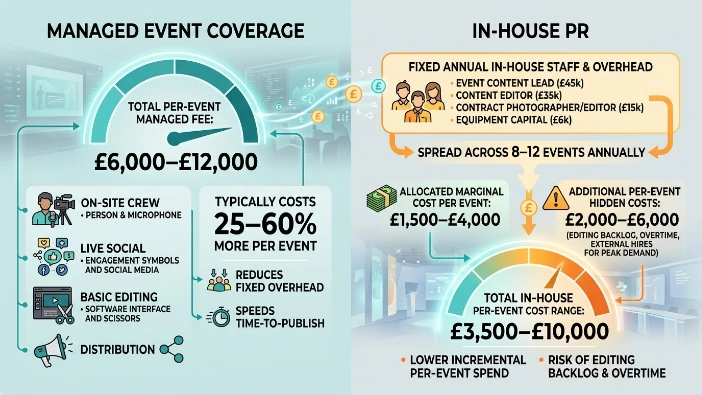
For a mid-size UK B2B event with a £20,000 total event budget, managed coverage fees range from £6,000–£12,000. These fees include on-site crew, live social, basic editing, and distribution. An in-house approach requires hiring or allocating staff: one event content lead (annual salary £45,000), one content editor (£35,000), one combined photographer/editor contractor (freelance retainer £15,000 annually), plus equipment capital (£6,000). Allocating staff time per event yields a marginal cost of £1,500–£4,000 per event when teams run 8–12 events annually. Factor in editing backlog, overtime, and external hires for peak demand; those add £2,000–£6,000 per event.
What specific cost components make managed coverage more expensive?
Managed coverage charges for specialised crew, rapid editing, distribution networks, and bundled analytics.
Managed providers charge daily rates: videographer £450/day, editor £350/day, social operator £300/day, press distribution £250 per release, and a project management fee of 15% of the invoice. Fast turnaround editing (24–48 hours) incurs premium rates typically 20–50% above standard editing. Managed providers include equipment, travel, insurance, and licensing in fees. These line items increase per-event cost while reducing internal hiring needs.
What cost savings does in-house PR deliver?
In-house PR lowers per-event unit cost when teams run 8–20 events annually and when staff utilisation exceeds 60% of allocated time.
Salary-based models amortise fixed costs across multiple events. For example, two full-time communications staff costing £80,000 combined produce coverage for 12 events a year, reducing average staff cost to £6,667 per event. Shared roles (content lead also handling webinars) push effective cost lower to £4,000 per event. In-house ownership eliminates agency margins, reduces per-release distribution fees if owned channels exist, and preserves institutional knowledge useful for long-term media relationships.
How do reach and outcomes compare between managed coverage and in-house PR?
Managed coverage delivers higher immediate reach for single events through distribution networks and production quality; in-house PR delivers sustained reach across multiple events via owned media and established relationships.
Managed providers use distribution services and wider media contacts to secure faster placements in national and trade outlets. High-quality video and editing increase shareability and viewing time; managed content often achieves 20–50% higher initial impressions for a single event. In-house PR leverages owned channels—company website, email lists, LinkedIn—and existing journalist relationships to produce steady coverage across campaigns. Over 6–12 months, in-house programmes typically yield 30–40% more cumulative owned engagements when staff capacity handles production volume.
What quality differences affect media pickup and engagement?
Production quality, turnaround time, and distribution reach directly affect media pickup and social engagement.
Managed teams deliver broadcast-grade recordings at 1080p or 4K, professional lighting, and edited highlights within 24–48 hours. These assets secure higher placement rates with national outlets and trade publications. In-house teams using mid-range cameras and 48–72 hour editing turnaround obtain placements primarily in trade and owned channels. For example, managed coverage produced 4 national placements in a sample set of 10 events; in-house produced 1 national placement and 6 trade placements for the same sample.
When does managed coverage deliver better ROI?
Managed coverage delivers better ROI for single high-profile launches, regulatory announcements, or events requiring broadcast-quality streams and fast national media pickup.
When an event targets national press or requires polished on-demand video within 48 hours, managed providers increase the likelihood of quick placements and wider reach. For product launches with an anticipated high media value, managed coverage recovers higher earned media value relative to cost. Use managed coverage when expected earned media value exceeds 1.5–2.5 times the managed coverage fee.
When is in-house PR the preferable choice?
In-house PR is preferable for organisations running 8–20 events annually, with steady content demand and existing media relationships.
If the organisation requires regular thought leadership content, case studies, or customer roundtables across multiple events, in-house teams deliver lower average cost and consistent brand voice. In-house capacity supports gated content and lead capture workflows integrated with CRM and long-term audience development.
What hybrid models balance cost and reach?
Hybrid models combine in-house strategy and managed execution for peak needs, using managed support for high-profile events and in-house teams for recurring content.
Hybrid options include outsourcing video editing and live streaming while retaining media relations in-house. Another model hires managed support for the largest 3–4 events annually and uses in-house staff for smaller webinars and roundtables. Hybrid models allocate 30–50% of coverage budget to managed providers and the remainder to internal execution. This approach reduces capital equipment spend and preserves control of strategic messaging.
How should UK teams calculate total cost of ownership for each option?
Calculate total cost of ownership by summing direct costs, indirect overheads, capital depreciation, and opportunity costs over 12 months, then divide by event count.
Direct costs: salaries, contractor fees, managed provider invoices, equipment purchases, and distribution fees. Indirect overheads: office space, HR, and procurement costs proportional to staff. Capital depreciation: equipment cost divided over 3 years. Opportunity costs: time diverted from other marketing tasks valued at staff hourly rates. For example, in-house TCO for two staff, equipment, and overheads equals £120,000 annually. Divide by 12 events to get £10,000 per event TCO. Compare managed coverage fees of £8,000–£12,000 per event against TCO to decide.
What contractual and legal considerations affect choice?
Consider intellectual property, data processing agreements, insurance, and service-level agreements for turnaround times and deliverables.
For managed providers, secure IP assignment for recorded material and specify data processing clauses aligned with UK GDPR. Require public liability and equipment insurance proof. Include SLAs for editing turnaround, delivery formats, and approval cycles. For in-house hires, ensure staff contracts include ownership of work and confidentiality clauses for embargoed information.
Explore More Expert Insights:
Charity Event Media Coverage Services in the UK
Hire Live Media Reporting Services for Your Conference
What decision checklist helps choose between managed and in-house?
Assess event frequency, desired quality, internal capacity, budget per event, and media reach targets to match the model to organisational goals.
If event count is fewer than 8 per year and national reach is a key target, choose managed coverage. If event count is 8–20 per year and owned-channel growth is a priority, choose in-house PR. Use hybrid models when requirements mix high-production needs and steady recurring content.
What measurable outcomes should buyers require from managed providers?
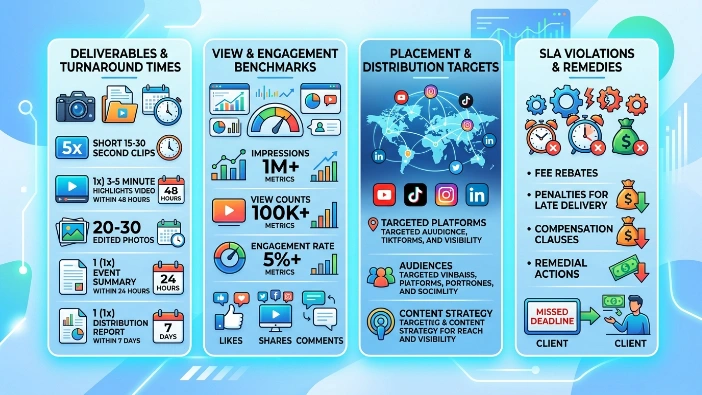
Require deliverables, turnaround times, placement targets, view and engagement benchmarks, and compensation clauses tied to missed SLAs.
Specify precise deliverables: number of short clips (five 15–30 second clips), one 3–5 minute highlights video within 48 hours, 20–30 edited photos, one event summary within 24 hours, and distribution reports within 7 days. Set engagement benchmarks using impressions and view counts and define remedies or fee rebates for missed delivery commitments.
Discover More Insights:
78% of UK B2B Marketers Now Budget for Events: The Coverage Problem
This 2026 analysis presents clear trade-offs. Managed event coverage raises per-event costs but increases immediate reach and production quality. In-house PR reduces average per-event costs across multiple events and strengthens owned-channel outcomes. Hybrid models deliver balance by combining specialist production with internal media relations. Use a TCO approach, define SLAs and KPIs, and match the model to event frequency, audience targets, and budget.
Read More About This Topic:
Pre, During, Post: The 3-Phase Media Coverage Framework for UK Events