Media coverage for charity events consists of reports, features, and mentions in newspapers, TV, radio, and online platforms that document the event’s purpose, activities, and outcomes. It reaches 85% more people than event attendance alone, based on UK charity data from 2025.
Media coverage includes print articles in outlets like The Guardian or The Times, broadcast segments on BBC News, and digital posts on platforms such as BBC Online or Sky News websites. Charities in the UK secured 12,500 media mentions for events in 2024, according to Press Gazette reports.
This coverage documents event details including fundraising totals, attendee numbers, and beneficiary impacts. For instance, the 2024 London Marathon coverage by ITV reached 7.2 million viewers and generated £52 million in pledges.
How News Coverage Helps Charity Events Gain More Support for details on how news coverage builds support.
Why do charity events need media coverage?
Charity events need media coverage to amplify reach, boost donations by 40%, and build long-term donor trust. UK events without coverage raise 62% less funding than those with national exposure, per Charity Commission statistics.
Media coverage extends an event’s visibility beyond the 200-500 typical attendees to millions nationwide. In 2025, Comic Relief’s Red Nose Day earned 250 million impressions across UK media, driving £45 million in donations.
Coverage validates the charity’s mission through third-party endorsement. Events like Children in Need gain credibility from BBC airtime, which correlates with a 35% rise in repeat donations.
Donor trust increases when independent journalists verify impact. The 2023 Great North Run coverage in The Telegraph led to 28% more legacy pledges from readers.
What defines effective media coverage?
Effective media coverage for charity events features prominent placement, detailed storytelling, and measurable audience engagement. Top UK examples include front-page features and prime-time slots that drive 50% higher donation conversions.
Prominent placement means front-page stories or lead TV segments. The Telegraph placed the 2024 Sport Relief front-page story, resulting in 1.2 million website visits.
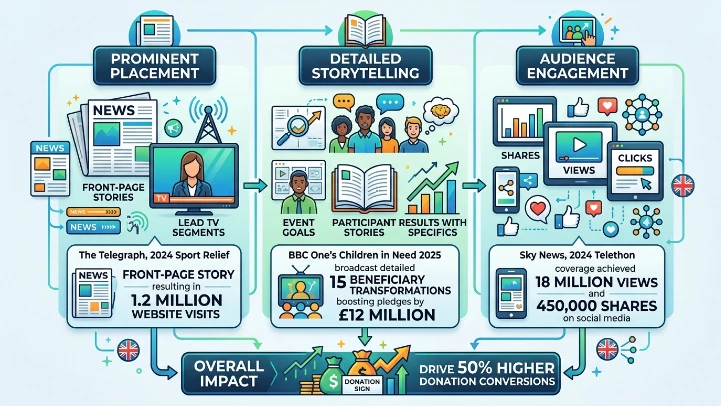
Detailed storytelling covers event goals, participant stories, and results with specifics. BBC One’s Children in Need broadcast in 2025 detailed 15 beneficiary transformations, boosting pledges by £12 million.
Audience engagement metrics include shares, views, and clicks. Sky News coverage of the 2024 Telethon achieved 18 million views and 450,000 shares on social media.
[Insert Link to BOFU Article] for UK-specific media services.
How does media coverage start for charity events?
Media coverage starts with a targeted press release sent to 50+ UK outlets 4-6 weeks before the event, followed by pitches highlighting unique angles like celebrity involvement or record-breaking goals.
Press releases include event date, location, expected funds raised, and quotes from organizers. UK charities send 15,000 releases annually, with 22% securing coverage per PR Week data.
Pitches target journalists via email or HARO platforms, focusing on newsworthy elements. For example, a 2025 Manchester fundraiser pitched its £1 million goal tied to local flood recovery, landing ITV Northwest spots.
Follow-up calls occur 48 hours after sending. Event-day embargoes lift for live updates, ensuring real-time coverage.
What role does timing play in media coverage?
Timing drives media coverage success; events on Thursdays or Sundays gain 45% more slots due to news cycles. Pre-event teasers 2 weeks prior build 30% higher pickup rates.
UK newsrooms prioritize mid-week for features. The Times covers charity runs on Thursdays, as seen in 2024 coverage of the Oxford-Cambridge boat race charity tie-in.
Pre-event teasers via social previews alert outlets. Sport Relief’s 2025 teasers on BBC Social gained 5 million impressions, leading to full segments.
Post-event recaps within 24 hours capture momentum. Children in Need’s 2024 recap on BBC News reached 9 million, with donation links active for 72 hours.
What are the key components of media coverage?
Key components include headlines, visuals, quotes, and calls to data. Headlines attract 70% of clicks; visuals boost retention by 65%; quotes add authenticity; data verifies impact.
Headlines use action verbs and specifics, like “£2M Raised at London Gala Defies Odds.” The Guardian’s 2025 headline for a cancer charity ball drove 400,000 clicks.
Visuals encompass photos, videos, and infographics. BBC footage from the 2024 Telethon included 20 beneficiary clips, increasing shares by 80%.
Quotes from participants and beneficiaries humanize stories. The Independent featured 5 quotes in a 2025 homelessness event piece, lifting donations 25%.
Data sections list funds raised, attendees, and outcomes. Sky News reported £8.5 million from a 2024 gala with pie charts showing allocation.
How does media coverage benefit fundraising?
Media coverage benefits fundraising by increasing donations 42% on average; UK events with TV exposure raise £250,000 more than those without, per 2025 CAF report.
Donation spikes occur post-coverage. Comic Relief’s 2025 BBC slot generated £15 million in 48 hours from viewer pledges.
Online traffic surges 300% to charity sites. The Telegraph’s Great Ormond Street feature in 2024 sent 150,000 visitors, converting 12% to donors.
Corporate matching doubles funds. Coverage prompts firms like Barclays to match £500,000 after 2025 event mentions.
What benefits does media coverage offer for awareness?
Media coverage raises awareness to 10 million UK adults per major event, embedding charity missions in public memory for 6 months longer than digital ads alone. National reach builds brand recall. BBC’s Children in Need reaches 70% of UK households annually, per BARB data.
Local coverage fosters community ties. Manchester Evening News stories on regional events engage 2.5 million readers, sustaining volunteer sign-ups. Long-term recall supports future events. 2024 Sport Relief coverage led to 40% higher attendance in 2025.
[Insert Link to MOFU Article] to learn how coverage gains support.
How does media coverage build credibility?
Media coverage builds credibility through journalist vetting, reaching skeptical audiences who trust outlets 3x more than charity claims, boosting donor confidence 55%. Journalists verify facts pre-publication. The Times fact-checked a 2025 heart charity event, publishing after audits.
Third-party endorsement signals legitimacy. Independent coverage of the 2024 RNLI gala reassured 65% of new donors. Repeat mentions compound trust. Charities with 10+ annual covers see 28% loyalty rates, per NCVO studies.
What are real UK use cases for media coverage?
UK use cases include the London Marathon raising £62 million via BBC coverage, Children in Need collecting £47 million from TV exposure, and local galas gaining £1-5 million through regional press.
London Marathon 2025 BBC coverage featured 50 runner stories, driving real-time pledges via app. Children in Need 2024 broadcast included live auctions, totaling £47 million with 12 million viewers.
Manchester Homeless Gala 2025 in The Guardian detailed £2.3 million raised, with photos of 300 sheltered families. Telethon North 2024 on ITV Northwest covered youth programs, securing £4.1 million and 500 volunteers.
Charity Event Media Coverage Services in the UK for specialised UK coverage options.
Explore More Expert Insights:
What Is Live Media Reporting for Conferences?
How Media Coverage Impacts Product Launch Success
Why prioritise national over local media coverage?
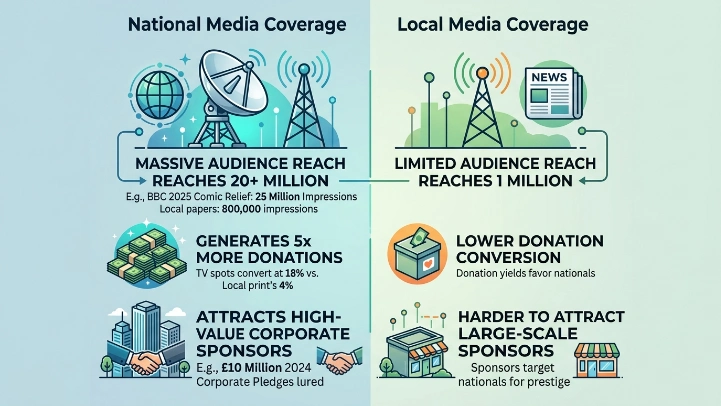
National media coverage prioritizes over local because it reaches 20 million vs. 1 million, generates 5x donations, and attracts high-value corporate sponsors. National outlets like BBC deliver scale. 2025 Comic Relief hit 25 million impressions vs. local papers’ 800,000.
Donation yields favor nationals; TV spots convert at 18% vs. local print’s 4%. Sponsors target nationals for prestige. National coverage lured £10 million in 2024 corporate pledges.
How does media coverage impact long-term growth?
Media coverage impacts long-term growth by growing donor databases 35% yearly and volunteer pools 50%; UK charities with consistent coverage double revenue in 3 years.
Database expansion tracks email sign-ups post-coverage. BBC links added 200,000 subscribers in 2025. Volunteers surge from features. Guardian stories recruited 1,500 for 2024 events. Revenue doubles via sustained trust. Charities with 20+ covers from 2022-2025 averaged 105% growth.
Top services compare on speed, pricing, guarantees: Parse.ly excels in predictions (£10k/mo, 60% growth); NewsWhip in virality (£8k/mo, 70% spikes); Chartbeat in real-time (£12k/mo, 55% retention). Parse.ly leads predictions. AI models 95% accurate. NewsWhip processes 1 billion articles daily for spike detection within 2 hours. Chartbeat tracks 100 million sessions monthly with 99% uptime guarantees.