
Entertainment retargeting ads are digital adverts that target users who already engaged with entertainment content, using tracked behaviour and audience segments to deliver tailored ads aimed at converting engagement into paid subscriptions.
Retargeting uses persistent identifiers such as cookies, mobile advertising IDs, or logged-in user IDs to recognise previous visitors. Platforms collect signals: video views, page time, click events, search queries, and partial sign-up attempts. Ad systems match those signals to specific audience lists and deliver sequenced creative through display networks, social platforms, or connected-TV endpoints. Campaigns run frequency caps, time-window rules, and bidding strategies tied to value-based goals like Cost Per Subscription (CPS) or Customer Lifetime Value (CLV).
Tracking pixels and SDKs record events, servers aggregate events into segments, demand-side platforms (DSPs) or ad managers map segments to inventory, and creative variations are served based on segment logic. Conversion events include trial starts, paid sign-ups, and payment authorisations. Attribution links impression or click IDs to these conversion events for reporting.
How do you structure retargeting campaigns for subscription conversions?
Structure campaigns by intent tier, time window, creative sequence, and conversion-based bid strategy to guide users from interest to paid sign-up.
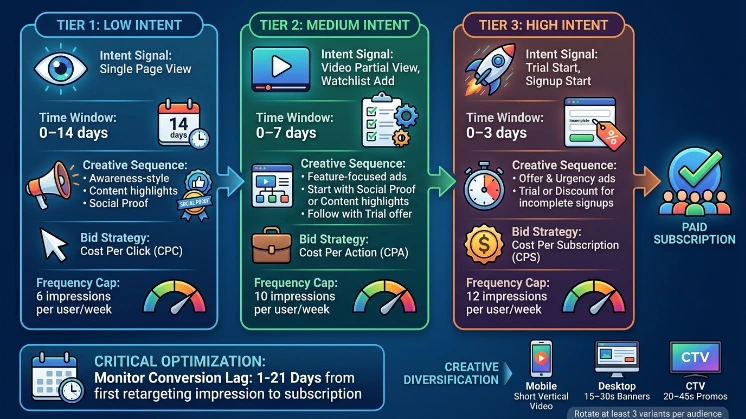
First, create three intent tiers, low (single page view), medium (video partial view, watchlist add), and high (trial start, signup start). Assign time windows: low = 0–14 days, medium = 0–7 days, high = 0–3 days. Use sequential creatives: awareness style for low, feature-focused for medium, and offer/urgency for high. Set bids by goal: cost per click (CPC) for low, cost per action (CPA) for medium, and cost per subscription (CPS) for high. Implement frequency caps: 6 impressions per user per week for low tier, 10 for medium, and 12 for high. Monitor conversion lag: expect 1–21 days from first retargeting impression to subscription.
Start with social proof or content highlights for medium-tier users; follow with a trial or discount for high-tier users who started signup but did not complete. Serve different creatives by device: shorter, vertical video for mobile; 15–30s banners for desktop and 20–45s promos for CTV. Rotate at least 3 creative variants per audience to prevent ad fatigue.
What creative elements increase subscription conversions in entertainment ads?
Effective creatives show clear subscription value, concise offers, strong calls-to-action, and evidence of relevance based on prior behaviour.
A headline referencing the show or genre watched; a subheading with a single subscription benefit (ad-free, exclusive releases, or early access); clear price or trial terms; a deadline or limited-time indicator if used and a prominent CTA button. Include social proof metrics: “2 million viewers”, numeric awards, or critic scores with source attribution. Match a creative message to prior behaviour: if a user watched a specific trailer, display that series’ hero art and a line: “Continue watching — start a 7‑day trial.” Use timestamped dynamic text for urgency, such as “Offer ends in 72 hours”, only when backed by actual offer constraints.
Use responsive display creatives for web, 6–15s vertical videos for mobile feeds, and 15–30s spots for CTV with at least 1080p resolution. Include a hashed user ID or segment token for personalisation only where privacy policies allow.
Which measurement and attribution models work for entertainment subscriptions?
Use a hybrid model combining last-click for paid conversions and multi-touch attribution for insight into the channel mix and creative paths.
Last-click attribution reports direct CPS and immediate ROI. Multi-touch models (linear or time-decay) allocate value across discovery and retargeting interactions to show contributions. Use a primary conversion window of 30 days for trial starts and 90 days for paid conversions to capture delayed activations. Reconcile platform reports with server-to-server (S2S) conversion events to reduce discrepancies caused by ad blockers and cross-device gaps. Compute incremental lift through holdout tests: create 5–10% control groups excluded from retargeting and compare subscription rates to exposed groups to measure net lift.
Track Cost Per Subscription (CPS), Trial-to-Paid conversion rate, Return on Ad Spend (ROAS), Customer Acquisition Cost (CAC), and 30/90-day retention rates. Monitor view-through conversions separately for CTV and display.
How do privacy rules affect retargeting strategies in the UK?
Privacy rules require explicit consent for most tracking, limit third-party cookie use, and mandate clear data-processing disclosures.
Under UK privacy standards aligned with the UK GDPR, advertisers need lawful basis to process personal data; consent is common for personalised ads. First-party tracking and authenticated user IDs provide resilient targeting when third-party cookies decline. Use aggregated reporting and differential privacy where possible. Maintain retention limits: delete or anonymise event logs older than 12 months unless longer retention is justified and disclosed. Support consent revocation and provide opt-out mechanisms. For behavioural targeting, document processors and controllers in data protection impact assessments (DPIAs) when profiling is systematic.
Explore More Expert Insights:
Music Platform Ads That Convert Listening Interest Into Premium Users
Ticketing Retargeting Ads That Turn Event Browsers Into Buyers
What are typical performance benchmarks for subscription retargeting?
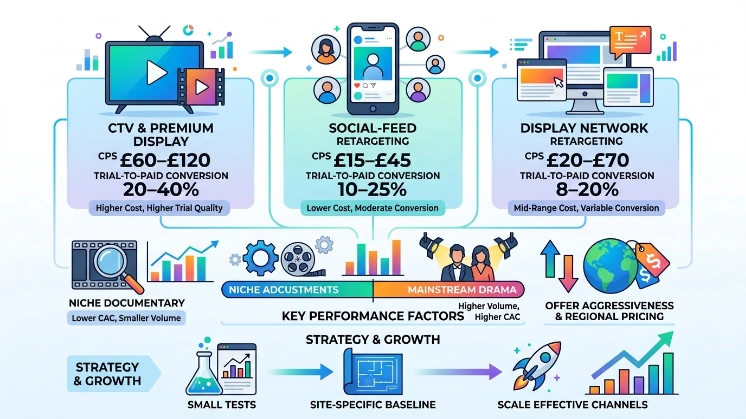
Typical benchmarks: Cost per subscription ranges from £15 to £120 depending on genre, channel, and funnel stage; trial-to-paid rates range 10% to 40%.
Narrower benchmarks: CTV and direct-inventory premium display show higher CPS (£60–£120) with 20–40% trial-to-paid conversion. Social-feed retargeting yields CPS of £15–£45 with 10–25% trial-to-paid conversion. Display network retargeting often records CPS £20–£70 with 8–20% trial-to-paid. Use genre adjustments. Niche documentary audiences generate lower CAC but smaller volume; mainstream drama yields higher volume and higher CAC. Benchmarks change with offer aggressiveness and regional pricing. Run small tests to establish site-specific baselines and scale effective channels.
Discover the Full Information:
How Entertainment Brands Grow Engagement Using Banner Advertising
How do you decide between trial, discount, or feature-led offers for retargeting?
Decide using historical cohort data: prefer trials when trial-to-paid conversion ≥ 20%, discounts when first-month churn is low, and feature-led offers when retention increases with premium features.
Analyse cohorts: calculate conversion lift for previous trial offers, discount elasticity measured as incremental subscriptions per £ discount, and retention delta when premium features were unlocked. If trials convert at 20–35% to paid within 30 days, run trial-focused retargeting. If trial conversions sit below 10% but initial paid conversion increases with price incentives, test discounted first-month offers. If added features increase average revenue per user (ARPU) by ≥ 15% and retention improves, promote feature-led upgrades in retargeting creative.
Explore More Expert Insights:
How Entertainment Brands Improve Subscription Intent Using Retargeting Ads
Entertainment retargeting ads target engaged users using event-based segments, sequenced creatives, and conversion-focused bids to move prospects into paid subscriptions. Structure campaigns by intent tier, align creatives to behaviour, measure with hybrid attribution and holdouts, and respect UK privacy rules. Test trial, discount, and feature offers against historical cohort metrics to choose the most cost-effective conversion path.