
Banner campaigns serve as a foundational marketing tool for booking platforms to drive user action. These display ads appear across websites and apps, showing travel options to users who have not yet completed a reservation. Booking platforms use banner campaigns to capture attention during the early inspiration phase of the travel planning journey.
Banner campaigns are display advertisements that appear on websites, apps, and digital platforms to promote travel bookings. They include static images, animated graphics, or HTML5 creatives showing destinations, accommodations, or deals. These ads target users based on browsing behavior, demographics, or location to increase visibility and drive clicks to booking platforms.
Banner campaigns fall under display advertising, a digital marketing format that uses visual creatives to reach audiences. In travel, these ads showcase hotels, flights, vacation packages, or experiences. They appear on third-party sites, travel blogs, news portals, and social media platforms.
How Do Banner Ads Differ From Other Travel Ad Types?
Banner ads differ from search ads, social media posts, and email marketing. Search ads appear when users type specific queries like “hotels in London.” Banner ads appear regardless of search intent, based on user profiles or site placement. Social media ads target followers or engaged users within a platform ecosystem. Email marketing reaches existing contacts directly.
Banner campaigns focus on reach and awareness. They introduce users to booking platforms they may not know. They also remind users of destinations they previously viewed. This dual function supports both acquisition and retention goals.
How Do Booking Platforms Use Banner Campaigns to Drive Conversions?
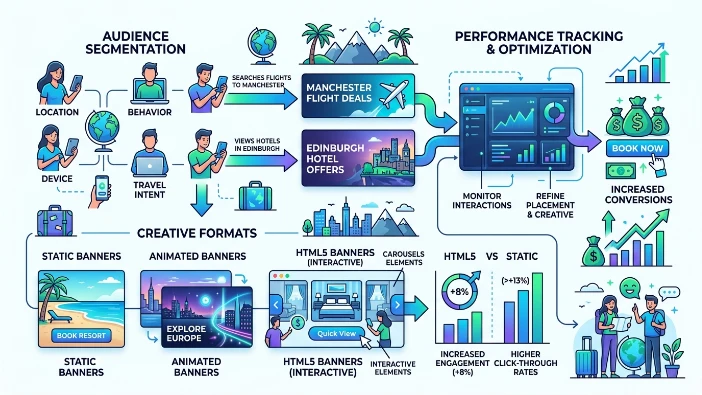
Booking platforms deploy banner campaigns across multiple digital touchpoints to guide users from awareness to reservation. They use data-driven targeting to show relevant offers to specific audience segments. Animated HTML5 banners increase engagement by 8% and click-through rates by over 13% compared to static ads. Campaigns track user interactions to optimise placement and creative performance.
The process begins with audience segmentation. Platforms divide users by behavior, location, device, or travel intent. A user who viewed hotels in Edinburgh receives different banners than someone who searched for flights to Manchester. This segmentation ensures relevance.
Next, platforms select creative formats. Static banners use single images with text overlays. Animated banners include movement, transitions, or multiple slides. HTML5 banners support interactivity like carousels or quick-view options. Data shows HTML5 ads outperform static versions significantly.
What Targeting Methods Increase Banner Campaign Effectiveness?
Targeting methods determine which users see which banners. Contextual targeting places ads on pages related to travel, such as destination guides or flight comparison sites. Behavioral targeting uses browsing history to show ads to users who visited travel sites recently. Geographic targeting displays location-specific offers, like London hotel deals to UK users.
Demographic targeting focuses on age, income, or family status. A platform might show family vacation packages to users aged 30–45 with children. Device targeting serves mobile-optimised banners to smartphone users and larger creatives to desktop visitors.
Frequency capping limits how often one user sees the same banner. Most platforms set caps at 3–5 impressions per day to prevent ad fatigue. Without caps, users ignore repeated ads, reducing campaign efficiency.
What Components Make Up a High-Converting Banner Campaign?
A high-converting banner campaign includes four core components: targeted audience segments, relevant creative assets, clear value propositions, and performance tracking systems. Creatives must communicate key messages within 2–3 seconds. Value propositions highlight specific benefits like price, availability, or unique offers. Tracking systems measure clicks, conversions, and return on ad spend to guide optimisation.
Audience segments form the foundation. Platforms create segments using first-party data from website visits, app usage, or past bookings. They also use third-party data from data providers to enrich profiles. Segments include new visitors, returning browsers, cart abandoners, and past customers.
Creative assets encompass design, copy, and format. Effective creatives use high-quality images of destinations, bold headlines, and minimal text. Color schemes align with brand identity while standing out against page backgrounds. Call-to-action buttons use action verbs like “Book Now” or “Check Availability.”
How Do Creative Elements Influence User Click-Through Rates?
Creative elements directly impact click-through rates (CTR). Animated HTML5 banners achieve over 13% higher CTR than static versions. Animations draw eyes and hold attention longer. Ads with a maximum of three images in animated formats perform best, as excessive movement overwhelms users.
Image quality matters significantly. Blurry or low-resolution photos reduce trust. High-resolution images of actual properties or destinations increase credibility. Text overlays must remain legible on all screen sizes. Fonts should be large enough to read on mobile devices without zooming.
Call-to-action placement affects conversion. Buttons positioned at the bottom or center of banners receive more clicks than those hidden in corners. Color contrast between buttons and backgrounds improves visibility. Red or orange buttons often outperform blue or green in travel contexts due to urgency associations.
What Benefits Do Banner Campaigns Provide for Booking Platforms?
Banner campaigns deliver four key benefits: expanded brand reach, increased website traffic, improved conversion rates, and measurable ROI. Remarketing display ads achieve 2–3x higher conversion rates than prospecting campaigns. Brands gain visibility among users who have not yet engaged with their platform. Traffic increases as users click banners to explore offerings. Performance data enables continuous optimisation.
Brand reach expands beyond organic search and direct traffic. Banner ads appear on third-party sites with large audiences, exposing platforms to new users. A travel blogger’s audience, for instance, discovers a booking platform through a banner placed on their destination guide.
Website traffic increases as clicks accumulate. Each click represents a potential reservation. Platforms track traffic sources to identify high-performing placements. Sites driving quality traffic receive more budget allocation.
Conversion rates improve through remarketing. Users who viewed properties but did not book receive follow-up banners. These warm audiences convert at higher rates than cold prospects. Remarketing campaigns typically achieve 2–3x higher conversion rates than initial prospecting efforts.
Learn More Here:
How Booking Platforms Improve Travel Intent Using Retargeting Ads
How Do Banner Campaigns Support the Travel Booking Funnel?
Banner campaigns support all three funnel stages: top-of-funnel, middle-of-funnel, and bottom-of-funnel. Banners focus on inspiration, showing destination highlights or travel ideas. Banners address consideration, comparing options or highlighting reviews. Banners drive action, displaying limited-time offers or scarcity messages like “Only 2 rooms left.”
At this stage, banners introduce users to travel possibilities. A user browsing a UK travel blog sees a banner promoting summer holidays in Spain. This creates awareness without requiring immediate action. Users interested in this educational stage can explore how booking platforms improve travel intent using retargeting ads for deeper consideration strategies.
Banners engage users actively evaluating options. A user comparing hotels in Barcelona receives banners showing price comparisons or guest ratings. These ads reduce decision friction by providing relevant information.
Banners target users ready to book. A user who added a London hotel to their cart but left receives a banner offering a discount or free cancellation. These ads address final barriers and prompt reservation completion.
Explore More Expert Insights:
How Tourism Brands Attract Travelers Using Banner Ads
How Travel Agencies Increase Bookings Using Banner Advertising
What Real-World Examples Show Banner Campaign Success in Travel Booking?
Real-world examples demonstrate banner campaign effectiveness across the travel industry. Animated HTML5 banners achieved 8% higher conversion lift in hotel ad tests. Conversational banners deliver 4.6% average CTR, representing a 1,214% engagement increase compared to standard formats. UK booking platforms use location-specific banners to promote domestic travel during peak seasons.
One hotel chain tested animated versus static banners across European markets. The animated version included three sliding images of room interiors, amenities, and local attractions. This creative generated 8% more bookings and 13% higher CTR than the static counterpart. The chain now recommends a maximum of three images in animated HTML5 banners for optimal performance.
Conversational banners represent an emerging format. These ads allow users to interact within the banner itself, such as asking questions or selecting preferences without leaving the page. One platform reported 4.6% average CTR with conversational banners, a 1,214.29% engagement increase over traditional display ads. Users convert on the spot instead of navigating to websites first.
UK-specific examples include seasonal campaigns promoting domestic travel. During school holidays, booking platforms display banners featuring UK coastal towns or countryside cottages. These ads target families within specific geographic regions. Location targeting ensures users in Manchester see Manchester-area offers, while London users see Thames Valley recommendations.
How Do Performance Metrics Validate Banner Campaign ROI?
Performance metrics validate return on investment through measurable outcomes. Key metrics include click-through rate, conversion rate, cost per acquisition, and return on ad spend. Industry benchmarks show remarketing campaigns achieve conversion rates 2–3 times higher than prospecting campaigns. Platforms allocate 40–60% of display budgets to remarketing based on this performance gap.
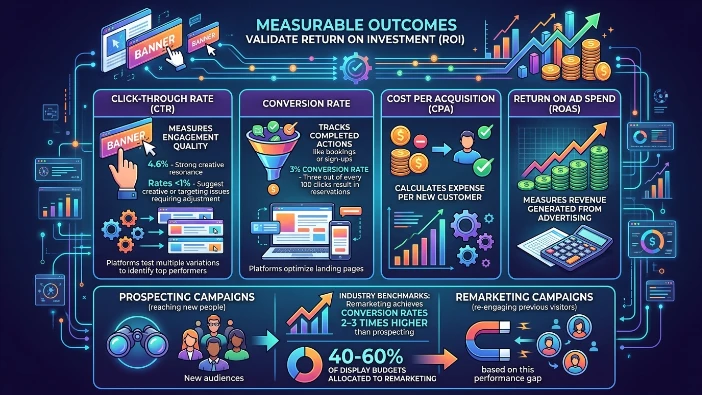
Click-through rate measures engagement quality. A 4.6% CTR indicates strong creative resonance. Rates below 1% suggest creative or targeting issues requiring adjustment. Platforms test multiple variations to identify top performers.
Conversion rate tracks completed actions like bookings or sign-ups. A 3% conversion rate means three out of every 100 clicks result in reservations. Platforms optimise landing pages to maintain or improve this rate after users click banners.
Cost per acquisition calculates spending per new customer. If a platform spends £100 on banners and gains five bookings, cost per acquisition equals £20. Platforms compare this against customer lifetime value to determine profitability. Return on ad spend measures revenue generated per pound spent. A 4:1 ROAS means £4 revenue for every £1 invested.
For More Information, Explore:
Booking Platform Ads That Turn Browsing Users Into Paid Reservations
Booking platforms increase conversions using banner campaigns by combining precise targeting, compelling creatives, and performance optimisation. These campaigns reach users at every funnel stage, from initial inspiration to final reservation. Animated formats outperform static versions, remarketing drives higher conversion rates, and data tracking enables continuous improvement. For users ready to convert, booking platform ads that turn browsing users into paid reservations represent the final optimisation step in the conversion journey.