Airline fare ads are paid digital advertisements that show specific flight prices to users to drive ticket purchases. These ads present concrete fares, travel dates, and booking links. They target users based on search intent, browsing history, or audience signals. Entities include advertisers (airlines), ad platforms (display networks), creatives (banners), and landing pages (fare pages).
Airline fare ads use structured data and dynamic feeds to show accurate prices. Feed fields include route, cabin class, price, travel dates, booking URL, and seat availability. Platforms query the feed in real time to render current fares. Example: a display ad for London–Edinburgh with a £45 economy fare links to a booking page showing the same itinerary.
How do airlines structure fare ad campaigns?
Airlines structure fare ad campaigns with segmented audiences, dynamic creative feeds, and conversion-focused bidding strategies. Campaign structure begins with audience segmentation: high-intent searchers, recent site visitors, and lookalike prospects. Dynamic creative feeds map SKUs (routes + dates) to creative templates. Bidding strategies use target CPA, ROAS, or conversion maximiser bids tied to booking events. Data layers include first-party booking data, cookie-based site signals, and CRM lists.
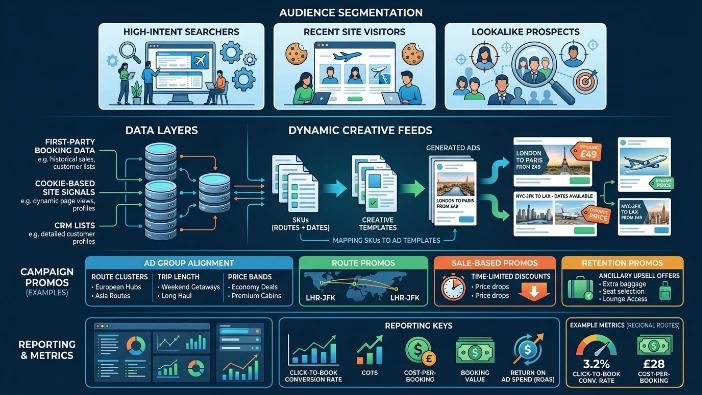
Ad groups align by route clusters, trip length, or price bands. A campaign might contain route promos (city pair focus), sale-based promos (time-limited discounts), and retention promos (ancillary upsell offers). Reporting keys: click-to-book conversion rate, cost-per-booking, booking value, and return on ad spend (ROAS). A campaign reports a 3.2% click-to-book conversion rate and £28 cost-per-booking for regional routes.
What components must a fare ad include to convert?
A converting fare ad must include a valid price, clear route, travel dates or range, a booking CTA, and a verified booking URL. Price must match the landing page and include currency. Route text names origin and destination using IATA codes or city names. Date specificity increases urgency: exact dates raise conversion; flexible ranges increase relevance for searchers without fixed travel plans. CTAs use direct verbs: “Book now,” “See fares,” or “Select seats.” Tracking parameters capture campaign and creative identifiers for attribution.
Creatives must display legible price typography and mobile-optimised assets for 320×50 and 300×250 sizes. Landing pages must prefill itinerary based on ad parameters and surface available seats for the displayed price. Example: an ad showing “Manchester → Dublin £29 return, 14–17 July” opens a landing page with those dates pre-selected and the £29 fare highlighted.
How do advertisers keep fares accurate in real time?
Advertisers keep fares accurate by using dynamic feeds, API integrations with inventory systems, and frequent feed refresh intervals. Dynamic feeds export fares with timestamps and availability flags. Integrations use pricing APIs that return live availability and reprice when seats sell out. Feed refresh frequency ranges from every 5 minutes for high-demand routes to every 60 minutes for low-demand routes. Ad servers validate price display by checking feed timestamp against a freshness threshold. If a fare expires, the ad either swaps to a fallback creative or hides the price.
Ad verification tools run automatic checks that compare ad-displayed prices to landing-page prices before approving impressions on premium inventory. Example implementation: a nightly pricing scan flags mismatched fares and removes affected creatives until a feed update resolves the discrepancy.
Which targeting methods drive the highest conversion rates?
High-converting targeting methods include search retargeting, site retargeting, and CRM-based audience match. Search retargeting captures users who searched flight-related queries on partner sites. Site retargeting serves ads to users who viewed specific itineraries or price pages. CRM-based matches use hashed email lists to target previous bookers with tailored fare offers. Layering signals improves precision: retargeting plus recent search intent raises conversion probability.
Lookalike audiences built from high-value bookers yield scalable conversions for seasonal offers. Geo-targeting around departure airports and time-of-day bids for peak booking hours also increase efficiency. Campaign retargeting site visitors who viewed “London to Malaga” within 7 days produced a 2.7× higher booking rate than a generic audience.
What creative elements increase click-to-book rates?
Creative elements that increase click-to-book rates include prominent price display, date specificity, scarcity messaging, and a single direct CTA. Price must occupy 30–50% of visible space and use contrasting colors to improve legibility. Showing exact travel dates produces higher intent than vague date ranges. Scarcity messaging uses fixed inventory language: “Limited seats at £49” or “3 seats left.” A single CTA reduces decision friction. Mobile-first designs that load under 100 KB lower friction on slower networks and improve viewability.
Testing creative variations by price prominence, color contrast, and CTA wording yields quantifiable lifts. Moving the price from bottom-right to center increased CTR by 18% and booking conversions by 9%.
How do airlines measure ROI from fare ads?
Airlines measure ROI with attribution that ties ad clicks to completed bookings, using last-click and multi-touch models for analysis. Primary metrics: cost-per-booking (CPB), return on ad spend (ROAS), conversion rate, and average booking value (ABV). Attribution uses pixel tracking, post-click UTM parameters, and server-to-server conversion events. Offline channels and meta-search referrals require import of reservation system confirmations into ad platforms via batch uploads or APIs.
Multi-touch attribution distributes booking credit across impressions and clicks across channels to evaluate upper-funnel display value. Multi-touch model attributed 40% of booking value to display impressions that first introduced fares, increasing display budget allocation by 12%.
Discover the Full Information:
How Airlines Drive Ticket Sales Using Display Campaigns
What landing page features increase completed bookings?
Landing pages must prefill itineraries, highlight the advertised fare, show seat availability, and present a streamlined booking flow. Prefilled search results reduce friction and shorten time-to-book. The advertised fare must be topmost and matched to the displayed booking option. Seat availability badges (e.g., “3 seats at this price”) clarify scarcity. The booking funnel reduces steps to three pages: select fare, passenger details, payment. Load times under 3 seconds reduce abandonment. Payment options include saved profiles and instant payment options to speed checkout.
Mobile responsiveness is required for 70–90% of traffic on some routes. Example flow: ad click lands on prefilled search, passenger auto-fill uses logged-in profile, and one-click payment completes the booking in under 90 seconds.
How do fare ads fit into the full marketing funnel?
Fare ads serve both acquisition and conversion roles by re-engaging interested users and closing bookings through price-driven stimuli. At upper-funnel stages, awareness creatives show route availability and brand presence without fares. Mid-funnel creatives introduce fares and date ranges to nurture intent. Bottom-funnel fare ads present exact prices and direct booking CTAs to close transactions. Tracking shows that display-based fare ads specifically increase conversion lift when paired with remarketing lists and timely bid adjustments during sale windows.
Integrating email, search, and display channels provides consistent messaging and reduces mismatch between ad and landing content. Example integration: coordinated email and fare-display promotions during a flash sale produced a 27% incremental bookings lift versus email alone.
What compliance and pricing rules must advertisers follow in the UK?
Advertisers must show total fares with taxes and mandatory fees, disclose any restrictions, and avoid misleading pricing claims. UK rules require that the price shown includes all compulsory taxes and carrier-imposed fees. If a fare excludes optional charges, the ad must clearly state those exclusions. Claims such as “from £X” must specify starting conditions. Ads aimed at UK users must display currency in GBP for UK departure fares. Platform policies also demand accurate landing-page pricing and accessible booking terms.
Breach of rules risks ad disapproval and regulatory scrutiny. The ad showing “£19 fares” was paused until the ad copy added “plus optional baggage fees” where applicable.
Explore More Expert Insights:
Hotel Experience Ads That Turn Stay Interest Into Direct Reservations
Travel Banner Ads That Convert Trip Interest Into Confirmed Bookings
What are common use cases and campaign examples?
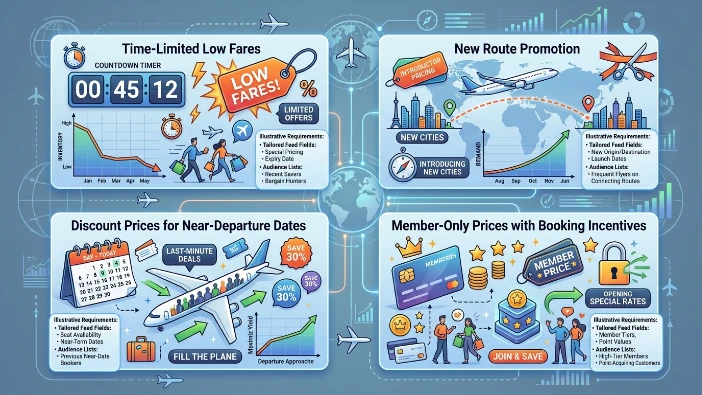
Common use cases include flash sales, route launches, last-minute seat fills, and loyalty-member offers. Flash sales advertise time-limited low fares to clear inventory quickly. Route launches promote new city pairs with introductory pricing to build demand. Last-minute seat fills target nearby departure dates with discount prices to maximise yield. Loyalty-member offers surface member-only prices with booking incentives. Each use case requires tailored feed fields and audience lists.
Explore the Complete Guide:
How Airlines Nurture Travelers Using Fare Awareness Banner Ads
How should advertisers optimise fare ad campaigns continuously?
Advertisers optimise campaigns by testing creative variants, adjusting bids by route performance, updating feed refresh rates, and refining audience windows. Run weekly creative tests for price prominence and CTA wording. Shift budget to routes with CPB under target. Shorten feed refresh intervals during high demand periods. Tighten audience windows for site retargeting to 7 days for high-intent routes. Use anomaly detection to spot feed mismatches and remove affected creatives immediately. Reducing retargeting window from 30 to 7 days improved booking rate by 34% for short-haul leisure markets.