
Banner advertising for credit cards is a paid digital ad format that displays promotional creative on websites and apps to raise awareness and consideration for specific card products. Banner ads use images, short text, and calls to action to prompt users to learn more or compare card options.
Banner advertising is a defined paid-media tactic. It includes static images, animated GIFs, HTML5 creatives, and rich media that run across display, mobile, and programmatic placements. Advertisers target placements by audience segments, contextual content, site lists, and automated bidding. In the UK, common placement types include news sites, comparison portals, and finance blogs. Cookie-based audience segments, first-party CRM lists, and publisher-provided cohorts serve as targeting inputs. Campaign metrics focus on impressions, viewable rate, click-through rate (CTR), and post-click on-site behavior such as product detail views and application starts.
How do banks use banner ads to increase card consideration?
Banks deploy finely segmented banner campaigns that deliver relevant messages to users at specific moments to move them from awareness to active consideration. Campaigns include audience segmentation, tailored creatives, sequential messaging, and measurement frameworks to quantify impact on consideration.
Banks create audience segments such as existing customers, high-spend prospects, and credit-builder prospects. They map creatives to audience needs: rewards-focused banners for high-spend segments, low-rate banners for balance-transfer prospects, and credit-building messages for subprime segments. Campaigns run programmatically with frequency caps to avoid overexposure. Banks use sequential messaging where initial banners raise awareness and follow-up banners highlight benefits or comparison points. Post-click landing pages display product features, eligibility criteria, and quick comparison tables to accelerate evaluation. Measurement uses lift tests, view-through attribution, and A/B creative tests to link display exposure to on-site search for card features and starts of the application flow.
What targeting methods increase consideration effectively?
High-precision targeting combines first-party data, contextual signals, and lookalike audiences to reach users with relevant offers and increase consideration. Targeting mixes reduce wasted reach and increase the ratio of qualified prospects who move to product pages or comparison tools.
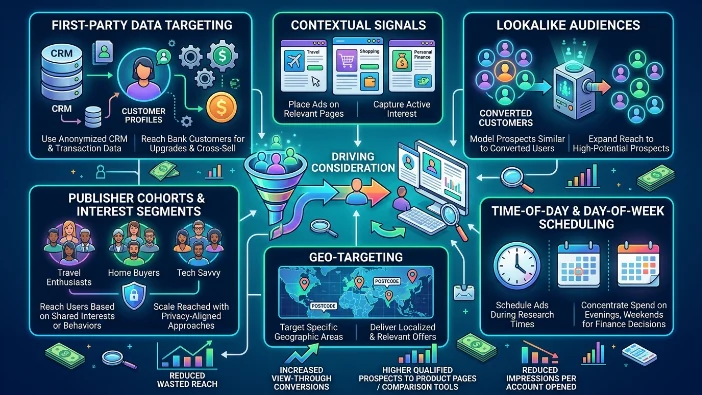
First-party targeting uses CRM and anonymised transaction data to reach bank customers for upgrade offers and cross-sell. Contextual targeting places creatives on pages about travel, shopping, or personal finance to capture active interest. Lookalike models trained on converters expand reach to similar prospects. Publisher cohorts and interest segments replace some cookie-based approaches for privacy-aligned scale. Geo-targeting narrows exposure to specific regions or postcodes for local offers. Time-of-day and day-of-week scheduling concentrate spend when users research financial decisions, such as evenings and weekends. Effective targeting reduces impressions per account opened and raises view-through conversions.
What creative elements drive consideration in banner ads?
Clear proposition, concise benefits, eligibility cues, and a focused visual hierarchy increase ad relevance and drive users to evaluate card options. Creative must state the primary benefit in five words or fewer, include a secondary benefit line, and show an eligibility hint or range.
Rewards rate, interest rate, or fee advantage. Secondary text lists one or two support points: sign-up bonus, introductory APR duration, or annual fee. Visuals use card imagery or context scenes aligned to benefits: travel imagery for travel rewards, shopping visuals for cashback. A small eligibility cue reduces wasted clicks, for example: “For UK residents, 18+” or “Subject to credit check.” Prominent click targets link to comparison pages, not direct application flows, to encourage evaluation. Variants include static 300×250, leaderboard 728×90, and mobile 320×50 formats. HTML5 creatives allow lightweight interaction such as card flip to reveal benefits without driving an application immediately.
How do banks measure banner ad impact on consideration?
Measurement uses a mix of direct response metrics and incrementality tests that compare exposed and control groups to quantify increases in site visits, product comparisons, and application starts. Key metrics include viewable impressions, CTR, view-through conversions, on-site product page views, comparison-tool usage, and application starts.
Direct response tracks clicks that lead to product pages and application starts. View-through attribution credits exposure without click when users later visit or search for card details. Incrementality uses holdout tests where a control group receives no ads and an exposed group receives the banner campaign; differences in product page visits and application starts represent the causal lift in consideration. Lift tests report percentage increases in product-detail views and application starts, with statistical significance thresholds such as p < 0.05. Multi-touch attribution models allocate value across channels but cannot replace randomized lift measurement for causal claims. Reporting cadence typically runs weekly for optimisation and monthly for strategic insight.
Which campaign structures convert awareness into consideration most reliably?
Sequential campaigns with progressive creative and landing page funnels produce higher consideration rates than single-exposure tactics.
Initial placements target broad contextual and prospect lookalike segments with high-reach creatives to generate impressions. Mid-funnel placements retarget users who viewed the banner or visited the site with benefit-specific messages and comparisons. Lower-funnel placements retarget users who visited product pages with comparison tables and eligibility information to prompt application starts. Frequency caps restrict exposures to 3–7 per week per user to avoid ad fatigue. Landing pages mirror the creative message and provide comparison tools and quick eligibility checks. This funnel reduces drop-off by aligning messaging to prior engagement and raises the ratio of product-detail views to application starts.
What legal and compliance elements must banners include in the UK?
Banners must include clear, non-misleading claims, required regulatory disclosures, and eligibility information consistent with UK financial promotions rules. Creative must follow Financial Conduct Authority (FCA) guidance on clarity, fairness, and non-misleading presentation.
Advertisements that reference interest rates must state representative APR or rate ranges where required. Promotional claims such as “0% for 12 months” must include eligibility conditions and duration. Disclosures should remain legible in the creative across sizes. Any promotional prize or bonus must include entry criteria. Cookie and tracking consent must comply with UK data-protection rules and ePrivacy requirements; publishers must present consent prompts before certain personalised targeting techniques. Banks maintain documented sign-off from compliance teams and store versions of creatives and targeting parameters for audit trails.
Learn Everything About It Here:
How Banks Boost Account Openings Using Banner Ads
What benefits do banner campaigns deliver to banks?
Banner campaigns increase the number of qualified prospects entering card comparison funnels, reduce cost per product-page visit, and improve cross-sell efficiency for targeted segments. They generate measurable lift in consideration metrics and accelerate time from awareness to product comparison.
Benefits include scalable reach to high-intent contexts, efficient retargeting of site visitors, and measurable lift via controlled tests. For existing customers, banners drive upgrades and higher lifetime value by promoting premium features to segments with higher spend. For new prospects, campaigns build interest and prime users to search and compare card offers on aggregator sites. Programmatic delivery allows rapid optimisation of creatives and bids, lowering cost per application start. Reporting ties exposure to downstream value using on-site behaviour and lift tests to quantify returns.
Explore More Expert Insights:
How Investment Firms Build Awareness Using Market Insight Ads
How Finance Brands Improve Conversion Intent Using Retargeting Ads
What real use cases show banner-led increases in consideration?
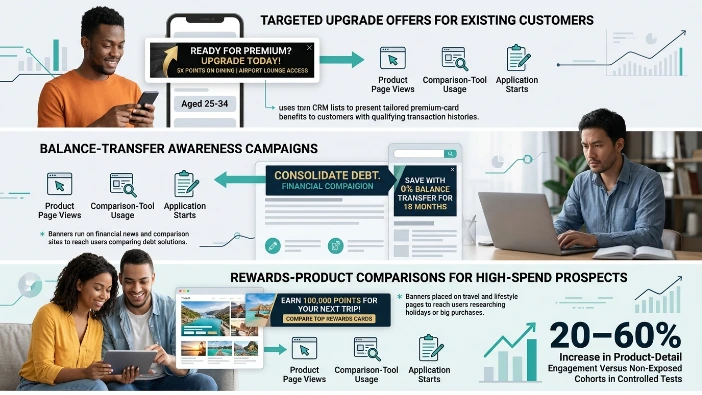
Common use cases include targeted upgrade offers for existing customers, balance-transfer awareness campaigns, and rewards-product comparisons for high-spend prospects. Upgrade campaigns to premium cards for 25–34 age segment, balance-transfer banners on financial news sites, rewards banners on travel sections of major publishers.
Upgrade campaigns use CRM lists to present tailored premium-card benefits to customers with qualifying transaction histories. Balance-transfer campaigns run on finance comparison sites to reach users comparing debt solutions. Rewards campaigns place creatives on travel and lifestyle pages to reach users researching holidays or big purchases. Each case tracks product page views, comparison-tool usage, and application starts to measure consideration lift. These campaigns commonly show increases of 20–60% in product-detail engagement versus non-exposed cohorts in controlled tests.
Find Out More:
Credit Card Banner Ads That Convert Consideration Into Approved Card Requests
How should banks optimise banner campaigns for better consideration?
Optimisation uses A/B creative tests, audience refinement, sequential messaging, and landing-page alignment to improve click-to-product and view-to-product conversion rates. Regular tests isolate headline, benefit order, eligibility cue, and CTA wording to identify the most effective combinations.
Run randomised creative tests with consistent audiences and measure product page visits and application starts as primary outcomes. Refine audiences by excluding low-intent segments and focusing on high-conversion cohorts. Adjust frequency caps based on conversion curves to balance reach and fatigue. Synchronise landing page content with the ad message to reduce post-click friction. Use incremental lift tests quarterly to validate changes and scale winners. Track KPIs at campaign and creative levels to inform budget allocation toward highest-lift tactics.