
A music platform ad that converts listeners into premium users presents a targeted message offering value, prompts a clear action, and measures conversions using defined metrics. It targets listeners based on behavior, delivers relevant creative, and tracks upgrades from free to paid accounts.
A converting ad combines precise targeting, persuasive creative, an optimised landing flow, and measurable conversion events. Targeting uses listening history, playlist interactions, device type, and session length. Creative includes short audio or visual formats, a clear value proposition, and a time-limited incentive. Conversion measurement links ad clicks or impressions to sign-up events and paid subscription starts. Keys include attribution setup, cohort analysis, and continuous A/B testing.
How do music platforms define converting ad campaigns?
A converting ad campaign uses explicit conversion goals, numeric KPIs, and user-segment definitions to evaluate success. Conversion goals include free-to-paid upgrades, trial activations, and first-payment completions.
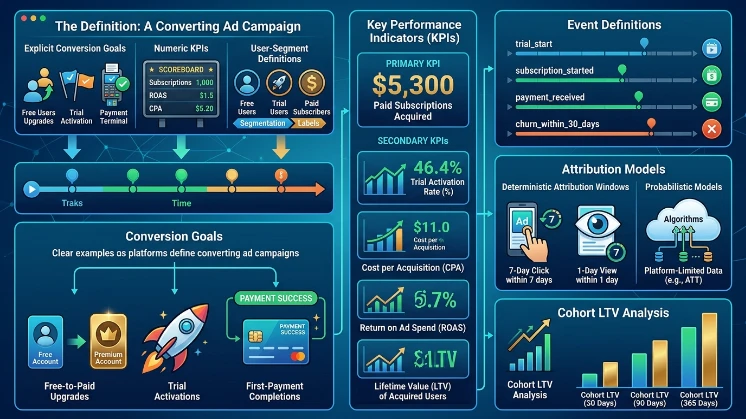
Define primary KPI as number of paid subscriptions acquired. Define secondary KPIs as trial activation rate, cost per acquisition (CPA), return on ad spend (ROAS), and lifetime value (LTV) of acquired users. Use event definitions such as trial_start, subscription_started, payment_received, and churn_within_30_days. Apply deterministic attribution windows (e.g., 7-day click, 1-day view) and probabilistic models for platform-limited data. Record cohort LTV at 30, 90, and 365 days.
What targeting strategies drive upgrades from free listening to paid subscriptions?
Targeting strategies use behavioral, contextual, and demographic signals to identify listeners with high upgrade propensity. Examples include targeting users with frequent session frequency, repeated ad exposure, and playlist saves.
Behavioral targeting captures users with session frequency ≥ 10 sessions/week, skip rate ≤ 20%, and playlist saves ≥ 5 in 30 days. Contextual targeting surfaces ads on workout playlists, focus playlists, or commute-hour listening. Demographic targeting includes age 18–34 and household income brackets where available. Device-based targeting prioritises mobile app users and connected speakers for family plans. Use lookalike modeling from high-LTV cohorts to scale acquisition.
How do creatives convert listening interest into premium sign-ups?
Converting creatives present one clear benefit, a short value statement under 10 words, and a single action prompting sign-up or trial initiation. Creatives use audio stings, 6–12 second visuals, or interactive cards with explicit offers.
Audio creatives include a 5–8 second value cue followed by a call to action. Visual banner creatives display the benefit and an action button; include text below the play area for accessibility. Use real examples: a 7-second audio spot offering “Ad-free listening for 1 month free” and a 6-second visual banner showing “Offline downloads — Start 30‑day trial”. Test creative elements in controlled A/B tests with equal traffic slices and record conversion lift.
What landing flow components increase conversion rates?
An optimised landing flow reduces friction: single-click trial start, minimal form fields, pre-filled account recognition, and clear trial-to-paid billing disclosure. The flow maps ad click to trial activation within 60 seconds.
Landing components include an attribution token passed via URL, a single CTA button, an account recognition step using device ID or remembered login, and a concise billing disclosure showing trial end date and price. Use progressive verification: require payment method only at the final confirmation, not on the first page. Capture consent and explicit acceptance of recurring billing with a checkbox. Measure conversion funnel: ad_click → landing_view → trial_start → payment_attach → subscription_started.
How is attribution and measurement implemented for subscription conversions?
Attribution links ad interactions to subscription events using tracking tokens, server-to-server events, and cohort analysis with fixed windows. Use both last-click and multi-touch models to compare performance.
Pass a unique campaign token with each ad click; persist token in first-party cookie or mobile app storage. Send server-side events for trial_start and subscription_started with the token. Use a 7-day click attribution window and a 1-day view window for initial reporting. Calculate CPA as total ad spend divided by subscriptions started within the attribution window. Compute ROAS relative to first-month revenue and cohort LTV at defined intervals. Validate attribution with randomised holdout tests to measure incremental lift.
Which pricing or offer structures convert better in ad-driven funnels?
Offers that reduce initial friction and highlight measurable value drive higher conversion: free trials of 14–30 days, discounted first month (30–50% off), and feature-limited trials (ad-free only or downloads only). Present explicit end dates and billing details.
Free trials of 30 days generate higher trial-start rates; conversion to paid varies by cohort and usually ranges from 10% to 35% at 30 days. Discounted first-month offers increase paid starts by 5–12 percentage points versus no-discount groups. Feature-limited trials attract users motivated by one feature, such as offline downloads; those trials convert at higher rates when the feature matches listening behavior. Report offer performance segmented by acquisition channel and device.
What funnel optimisations reduce cost per acquisition?
Optimisations include narrowing high-intent segments, prioritising high-conversion creatives, and increasing bid concentration on peak listening hours. Reallocate budget to channels with lower CPA and higher 90-day LTV.
Identify top 20% of segments by conversion rate and allocate 60% of spend to them. Pause creatives with conversion rate below cohort median. Raise bids by 10–30% during peak commute hours (07:00–09:00 and 17:00–19:00 local time). Implement frequency caps at 5 impressions per user per week to avoid ad fatigue. Use holdout experiments to measure incremental conversions and compute CAC versus lifetime margin.
How do retention hooks after conversion improve LTV?
Retention hooks include personalised onboarding playlists, milestone nudges, and usage-based reminders that drive continued engagement in the first 30 days. Deliver these hooks via in-app messages, email, and push notifications.
Onboarding playlists match recent listens and new-release highlights and deploy within 24 hours of trial start. Send a “First 7 days” engagement message showing saved playlists and download tips. Trigger a 21-day payment reminder with billing details before trial end. Track retention metrics: 7-day active rate, 30-day retention, and first-payment conversion. Measure lift in LTV by comparing cohorts that received retention hooks versus control cohorts.
Explore More Expert Insights:
Ticketing Retargeting Ads That Turn Event Browsers Into Buyers
Event Display Ads That Convert Ticket Consideration Into Purchases
What legal and privacy requirements affect ad-driven subscription acquisition in the UK?
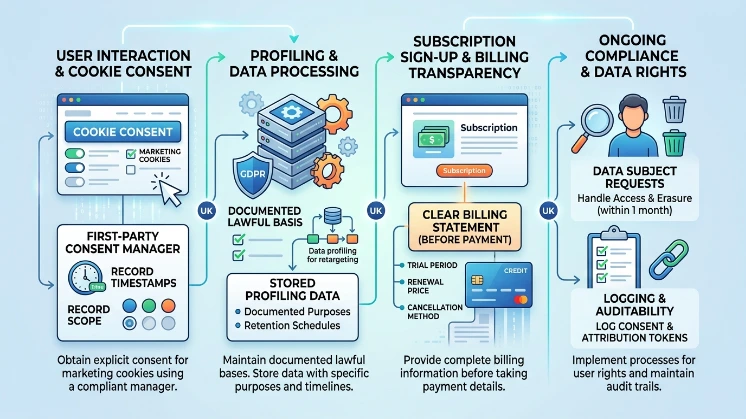
Legal requirements include explicit consent for marketing cookies, transparent billing disclosures, and GDPR-compliant data processing records. Maintain documented lawful bases for profiling and retargeting.
Obtain cookie consent for tracking using a first-party consent manager that records timestamps and consent scope. Provide a clear billing statement that shows trial period, renewal price, and cancellation method before accepting payment details. Store user profiling data under documented processing purposes and retention schedules. Implement data subject request handling for access and erasure within one month. Log consent and attribution tokens to support auditability.
What case uses demonstrate effective conversion paths on music platforms?
Effective use cases include trial-first acquisition for new listeners, discounted family plan upgrades for households, and feature-driven offers for heavy listeners. Each case uses tailored targeting, creative, and landing flow.
Click Here to Explore More:
How Music Platforms Increase Streams Using Banner Ads
Ads that convert listening interest into premium users combine precise targeting, concise creative, optimised landing flows, rigorous attribution, compliant data practices, and post-conversion retention hooks. Implement numeric goals, instrument events server-side, run controlled experiments, and scale budgets toward high-intent segments to improve CPA and LTV.
Read the Full Blog Here:
How Music Platforms Build Listener Engagement Using Banner Ads