
The UK’s second-largest ad export market in 2026 is Ireland. It accounts for significant cross-border digital and broadcast spend and affects UK publishers, ad tech, and creative agencies because regulatory alignment and currency flows influence campaign planning and measurement.
Ireland is a defined market for UK advertising exports because UK agencies sell creative, media buying, and technology services to Irish advertisers and publishers. In 2026, Ireland follows the United States as the top destination for UK ad exports by value. The market matters because advertising contracts, media buying rates, and tax treatment in cross-border services change revenue timing for UK firms. Ireland’s media ecosystem includes digital publishers, broadcast networks, and programmatic marketplaces that integrate with UK supply paths. The presence of multinational advertisers with Irish headquarters increases the volume of cross-border spend from UK-originated planning and creative work.
How did spend patterns change in Ireland in 2026 compared with 2023–2025?
Spend shifted from linear broadcast and print toward programmatic digital and connected TV. Programmatic grew 28% year-over-year in 2026; CTV grew 34%. Linear television declined 12% cumulatively since 2023; print display fell 18%.
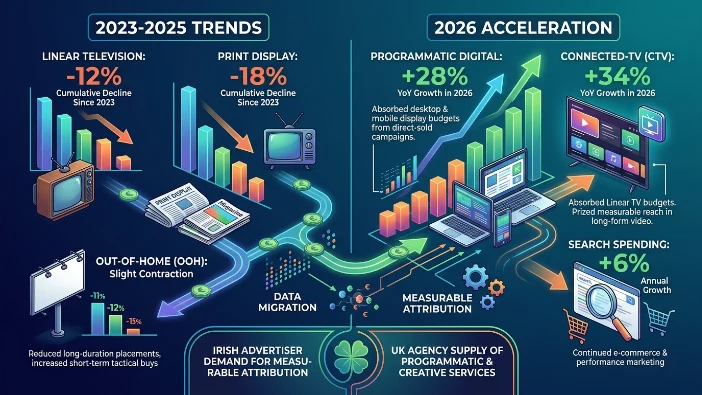
Channel-level changes show accelerated digital migration. Programmatic platforms absorbed desktop and mobile display budgets previously routed via direct-sold campaigns. Connected TV absorbed parts of linear TV budgets because advertisers prioritised measurable reach in long-form video environments. Search spending remained stable with 6% annual growth due to continued e-commerce and performance marketing. Out-of-home budgets contracted slightly because advertisers reduced long-duration placements and increased short-term tactical buys. These shifts reflect Irish advertiser demand for measurable attribution and UK agency supply of programmatic and creative services.
What regulatory or economic factors influenced that spending shift?
Key influences were post-Brexit regulatory divergence, Irish Data Protection Commission enforcement, corporate tax policies, and inflation-driven media cost adjustments. These factors changed contract structures, targeting capabilities, and campaign valuation.
Regulatory alignment affects data use and cross-border processing. Changes in consent frameworks and enforcement priorities in Ireland shifted reliance from third-party cookies toward first-party data solutions and contextual targeting. Tax policy and multinational corporate structuring in Ireland kept headquarters and marketing budgets local, increasing demand for integrated digital campaigns designed by UK agencies. Inflation and media market supply dynamics raised rates for premium prime-time inventory, pushing advertisers toward programmatic and CTV for efficient reach. Contract terms moved from fixed-rate guaranteed buys to dynamic, performance-linked models to manage budget volatility.
How do media channel components compare in performance and measurability for Irish campaigns?
Programmatic provides granular impression-level measurement; CTV delivers household-level reach with viewability metrics; search gives conversion metrics by query; linear TV gives wide reach but limited attribution; OOH provides location reach with limited conversion signals.
Programmatic advertising supplies impression tracking, click-through rates, viewability scores, and exchange-level bidding data. Advertisers use these metrics for incremental lift studies and conversion modelling. Connected TV offers device and household identifiers enabling frequency control and deterministic measurement for video completion and view-through conversions. Search provides keyword-level conversion attribution and cost-per-acquisition metrics for direct-response campaigns. Linear TV retains value for broad reach and brand-building but requires modelled attribution, such as media-mix modeling to assess impact. Out-of-home contributes to physical reach and brand salience; measurement relies on footfall analytics and panel-based attribution.
What processes do agencies and advertisers use to shift budgets effectively?
Budget shifts follow a phased process: audit historical performance, set strategic objectives, reallocate by channel based on ROI models, test new inventory, and scale based on measured uplift and attribution validation.
The audit quantifies historical return on ad spend by channel and campaign objective. Strategic objectives define target KPIs—brand reach metrics for awareness, lift metrics for consideration, and CPA for direct response. Reallocation uses media-mix modelling and incrementality tests to predict marginal returns per channel. Agencies implement controlled experiments such as holdout tests and geo-splits to measure causality. Inventory selection prioritises open auction programmatic for performance and curated deals for premium CTV inventory. Reporting cycles shorten to weekly measurements with monthly strategic reviews to allow rapid optimisation and budget rebalancing.
What components of campaign planning changed to improve ROI in 2026?
Key changes include increased first-party data activation, contextual targeting, enhanced creative variants for CTV, cross-device identity stitching, and standardised outcome-based pricing models.
First-party data activation replaced many third-party audiences. Contextual targeting returned to focus on editorial signals and content taxonomies to match ad creative with relevant content. Creative variants increased to match longer-form CTV environments and short-form social placements; video lengths and messaging adapted to placement. Identity stitching improved cross-device reporting and reduced duplication of reach counts. Outcome-based pricing tied fees to viewable impressions, completed video views, or defined conversion events, aligning media cost with measured outcomes.
What benefits did UK advertisers and publishers see from shifting spend?
Advertisers gained improved attribution, higher measurable engagement, and lower waste. Publishers gained higher CPMs for premium digital inventory and more stable demand from programmatic and CTV buyers.
Advertisers reported clearer lines between spend and conversions through incrementality testing and media-mix modeling. Measurable engagement increased due to optimised creative targeting and placement against content categories. Waste reduced as frequency caps and household-level deduplication controlled overexposure. Publishers monetised premium CTV and contextual placements at higher CPMs as advertisers rebalanced budgets away from commoditised display. Programmatic guaranteed deals and PMP (private marketplace) transactions increased publisher revenue predictability.
What use cases illustrate how advertisers deployed new strategies in Ireland?
Use cases include a retail chain shifting seasonal budgets to programmatic CTV for measured footfall lift, and a financial services firm using contextual targeting in business news sections for qualified lead generation.
The retail use case employed geo-targeted CTV with store-level attribution to measure incremental visits and sales uplift during seasonal campaigns. The campaign used household-level frequency caps and conversion pixels to track sales impact. The financial services use case employed contextual taxonomy to place display and video ads in business and personal finance sections on Irish news sites. The campaign measured lead quality through form completions and downstream account openings, attributing channels via multi-touch modelling.
Explore More Expert Insights:
From Programmatic to Premium: Why UK Brands Are Moving Budget Back to Direct Display
The Attention Economy: How UK Banner Ads on Trusted Sites Get 4× More Viewability
How will these shifts influence UK ad export relationships through 2027?
Shifts will deepen programmatic and CTV service exports, increase demand for first-party data solutions, and drive cross-border measurement standards alignment between UK and Irish markets through 2027.
UK suppliers will export more programmatic setups, data clean-room configurations, and CTV creative production. Demand for standardised measurement and privacy-compliant identity solutions will encourage industry frameworks and cooperative measurement protocols. Cross-border contracts will emphasise performance-linked terms and clear data-processing clauses. These trends will sustain revenue flows from Irish advertisers to UK agencies and technology providers while requiring continual updates to compliance and measurement methods.
How should stakeholders monitor and validate ongoing changes?
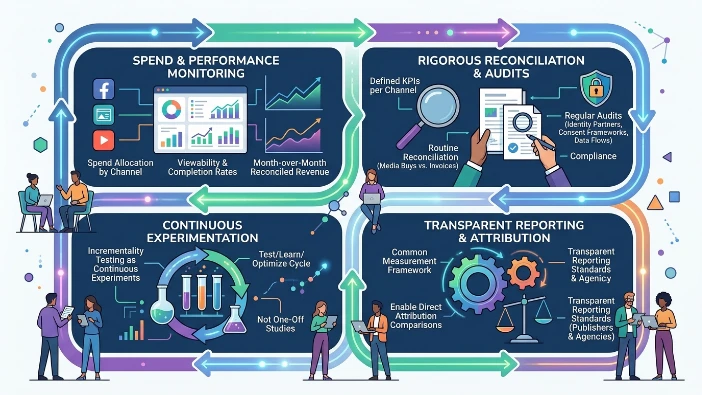
Stakeholders should monitor spend allocation by channel, viewability and completion rates, incrementality test results, and reconciled revenue reports month over month.
Monitoring requires defined KPIs for each channel and routine reconciliation between media buys and publisher invoices. Incrementality testing should run as continuous experiments, not one-off studies. Regular audits of identity partners, consent frameworks, and data flows ensure regulatory compliance. Publishers and agencies should maintain transparent reporting standards and use common measurement frameworks to enable direct attribution comparisons.
Read More to Understand Better:
How to Align Banner Creative With the Editorial Context of UK News Sections
The 2026 shift in Ireland’s advertising spend shows rapid movement from legacy channels to programmatic and connected-TV, driven by measurement demand, regulatory changes, and economic factors. These shifts change how UK firms export ad services, requiring new data practices, creative formats, and measurement processes. For readers focused on campaign planning or cross-border ad strategy, tracking channel-level ROI, enforcing robust incrementality testing, and standardising reporting provide the clearest path to validating spend reallocations.
Explore More Useful Information:
Display Advertising ROI Report Template: How UK Brands Present Campaign Results Internally