Brand awareness drives broad recognition and ad recall across a defined population; direct response drives measurable actions such as clicks, form completions, or purchases within a short attribution window.
Brand awareness focuses on reach, frequency, and viewability. Metrics include unique reach, ad recall lift, and viewable CPM (vCPM). Direct response focuses on conversion events, cost per acquisition (CPA), and return on ad spend (ROAS). Entities involved are advertisers, demand-side platforms (DSPs), publishers, tracking vendors, and measurement partners. Example brand awareness goals include achieving 60% reach among a 500,000-person target audience. Example direct response goals include 2,000 form completions with a CPA target of £25. Choose the objective that aligns with business outcomes and measurement capabilities.
How do you decide which objective fits your campaign timeline and KPI targets?
Match objective to timeline: choose brand awareness for long-term salience over weeks or months; choose direct response for short-term conversions within days or weeks.
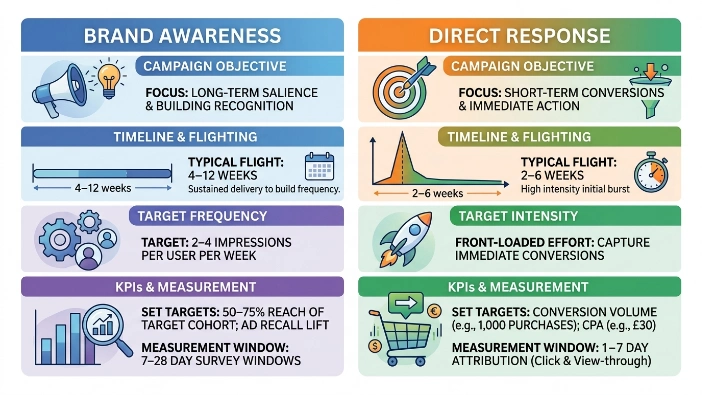
Brand awareness campaigns require sustained delivery over longer flights to build salience. Typical flights run 4–12 weeks with target frequency of 2–4 impressions per user per week. Direct response campaigns run 2–6 weeks with intensity in the first 7–14 days to capture immediate conversions. Set KPIs accordingly. For awareness, set targets such as 50–75% reach of the target cohort and ad recall lift measured via survey. For direct response, set CPA and conversion volume targets, for example 1,000 purchases at £30 CPA. Align measurement windows: awareness uses 7–28 day survey windows; direct response uses 1–7 day attribution windows for click and view-through conversions.
What campaign structures and inventory types suit each objective?
Brand awareness uses high-quality premium inventory, broad contextual targeting, and reach-optimised line items; direct response uses performance inventory, tighter contextual or audience targeting, and conversion-optimised line items.
Brand awareness benefits from premium news inventory and fixed-position placements with high viewability. Use PMP deals or direct-sold inventory to secure environment quality. Target broad topical verticals such as national news, business, or lifestyle to reach varied audiences. Direct response benefits from placements near conversion intent signals such as finance or retail content and from remnant inventory with lower CPMs for cost efficiency. Use open-exchange for scale when paired with strong tracking and fraud controls. For both objectives use creative variants: awareness creatives focus on simple visuals and brand cues; direct response creatives include explicit value propositions and CTA elements linked to landing pages.
How should measurement and attribution differ between objectives?
Use independent reach and recall measurement for awareness and event-based, attribution-aware measurement for direct response with conversion windows and viewability filters.
Awareness measurement uses independent survey panels or ad-lift studies that report ad recall and brand metrics. Include viewability thresholds, for example 50% pixels in view for one continuous second for display. For direct response, use deterministic event tracking, server-to-server postback, or pixel-based measurement with attribution windows of 1–7 days for clicks and 1–3 days for view-throughs. Employ post-click and view-through attribution models and validate with measurement partners. Use fraud and invalid traffic (IVT) filters in both cases to ensure data integrity. Reconcile DSP logs with verification reports weekly to confirm conversions and spend alignment.
What budget allocation and bidding strategies work for each objective?
Allocate budgets by funnel role: dedicate 40–70% of spend to brand awareness when building salience, and 30–60% to direct response when optimising for conversions; use reach bidding for awareness and CPA/ROAS bidding for direct response.
For brand awareness use vCPM or reach-optimised bidding that prioritises unique reach and viewability. Set frequency caps such as two impressions per user per week. For direct response use target CPA or target ROAS bidding with conversion tracking enabled. Apply dayparting and geo-modifiers to allocate spend to high-conversion times and regions. Example split for a product launch: 60% awareness, 40% direct response during the initial four-week launch, then shift to 30% awareness, 70% direct response for the following six weeks depending on performance signals.
How do creative strategy and landing experiences differ by objective?
Awareness creatives emphasise brand assets and simple messaging; direct response creatives include clear calls to action and link to conversion-optimised landing pages.
Awareness creatives use logo prominence, single-line taglines, and 6–10 second animated banners or rich media to drive recall. Use high-resolution images and consistent colour schemes. Direct response creatives use concise offers, explicit CTAs, and clear benefit statements. Link creatives to landing pages optimised for conversion with fast load times under 3 seconds, a single visible CTA, and minimal form fields—ideally three or fewer. Use tracking parameters for campaign source, creative ID, and placement to attribute conversions accurately.
What targeting and audience strategies align with each objective?
Awareness uses broad contextual and demographic targeting for scale; direct response uses intent signals, behavioral segments, and first-party audiences for precision.
For awareness, use contextual targeting across topical verticals and broad demographic buckets such as age groups 25–44 or 45–64. Use regional targeting by UK nation or city where relevant. For direct response, use in-market intent segments, retargeting of recent site visitors, and lookalike audiences built from high-value customers. Employ publisher first-party segments where available for improved match rates. Ensure privacy compliance with UK data protection rules and use cohort-based segments when deterministic identifiers are unavailable.
How do brand safety and environment selection impact objective performance?
Choose verified premium environments for awareness to protect brand equity; use context-appropriate and high-traffic environments for direct response to maximise conversions.
Brand safety includes editorial governance, metadata standards, and verification coverage. Awareness benefits from placements in verified news environments that convey trust and reduce adjacency risk. Direct response benefits from environments aligned with purchase intent, such as finance sites for financial products or retail news for e-commerce. Apply page-level contextual filters and independent verification to enforce brand suitability for both objectives. Balance safety controls with reach requirements to avoid unnecessary exclusion of valuable inventory.
Must-Read Detailed Guide:
How to Plan a UK Banner Campaign Across Multiple News Sites Without Duplicating Reach
How do you test and transition between awareness and direct response tactics?
Run sequential testing: start with a reach-focused awareness phase, measure lift, then run targeted direct response waves with controlled retargeting and incrementality tests.
Begin with a 2–6 week awareness phase to build salience in the target cohort. Measure lift using brand-lift studies. After baseline awareness, run direct response waves using retargeting for users exposed to awareness ads and control groups for incrementality measurement. Use randomised controlled tests or geo-based holdouts to measure incremental conversions. Adjust budget allocation based on measured CPA and lift metrics. Example execution: 4-week awareness flight with 60% of budget, followed by 4-week direct response flight with audience retargeting of users exposed at frequency ≥2.
Explore More Expert Insights:
Why Running Banners Alongside Sponsored Content Lifts UK Conversion Rates by 34%
Multi-Site Banner Campaign Setup: What to Expect in Week 1 Through Week 8
What outcomes and ROAS expectations are realistic for UK banner campaigns by objective?
Expect awareness outcomes as reach percentage, ad recall lift, and viewability; expect direct response outcomes as CPA, conversion volume, and ROAS with industry CPM and conversion ranges.
Typical awareness outcomes include 50–75% reach within the target cohort and ad recall lift of 2–6 percentage points for well-executed flights. CPMs for premium UK inventory range from £6–£25; vCPM will be higher. For direct response, expect CPAs to vary widely by vertical: lead generation CPAs often range from £10–£80; e-commerce CPAs range from £15–£150 depending on average order value. ROAS targets depend on margin structure; set specific CPA or ROAS thresholds before optimisation. Use verification and reconciliation to ensure reported ROAS aligns with sales data.
How do you operationalise a decision and next steps for campaign execution?
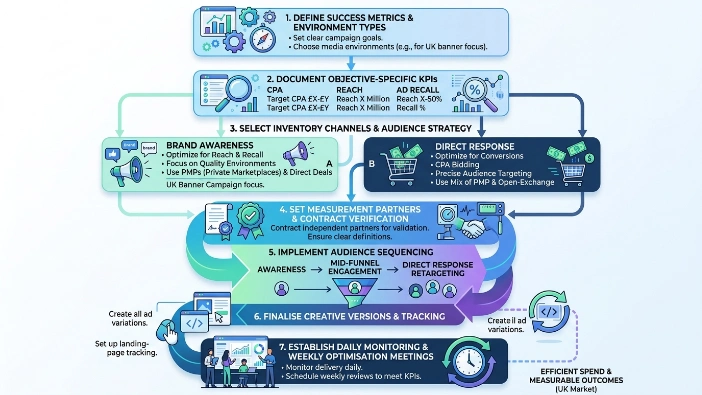
Define success metrics, select environment types, set measurement partners, and implement audience sequencing with clear budgets and timelines for end-to-end execution.
Document objective-specific KPIs and acceptable ranges for CPA, reach, and ad recall. Select inventory channels: PMPs and direct deals for awareness, and a mix of PMP and open-exchange for direct response. Contract verification and measurement partners for independent validation. Implement audience sequencing: awareness → mid-funnel engagement → direct response retargeting. Finalise creative versions and landing-page tracking. Establish daily delivery monitoring and weekly optimisation meetings to meet KPIs.
Choosing between brand awareness and direct response for UK banner campaigns requires explicit alignment of objectives, timelines, inventory selection, measurement, and creative strategy. Brand awareness optimises for reach, recall, and environment quality with PMPs and direct deals. Direct response optimises for conversions with CPA bidding, conversion-optimised creative, and precise audience targeting. Use sequential testing and independent measurement to validate lift and incremental conversions. Clear KPI definitions, contractual verification, and audience sequencing ensure efficient spend and measurable outcomes in the UK market.
Discover the Full Information:
Brand Safety in UK Digital Advertising: Why News Environments Score Highest in 2026