
A multi-site banner campaign places display creatives across multiple publisher domains or apps to maximize reach and contextual coverage. Advertisers run multi-site campaigns to increase reach, control frequency, access diversified inventory, and measure cross-site performance at scale.
A multi-site banner campaign delivers visual display ads—static images, HTML5, or in-banner video—across a network of publisher sites or apps. The campaign uses central trafficking and targeting rules to ensure consistent creative delivery. Running across multiple sites reduces dependency on a single publisher’s traffic patterns. Multi-site setups use programmatic buying, private marketplaces, or direct publisher deals to secure inventory. Core entities include demand-side platforms (DSPs) for bidding, ad servers for creative delivery and reporting, verification vendors for viewability and fraud detection, and data segments for audience targeting. Real examples include a national retail campaign running on news sites, lifestyle blogs, and shopping apps, and a finance awareness campaign distributed across financial news publishers and mobile apps.
What happens in week 1 of setup and launch?
Week 1 focuses on planning, creative finalization, trafficking, and initial targeting. Tasks include inventory selection, creative upload, tag generation, frequency cap settings, and launch checks for viewability and tracking pixels.
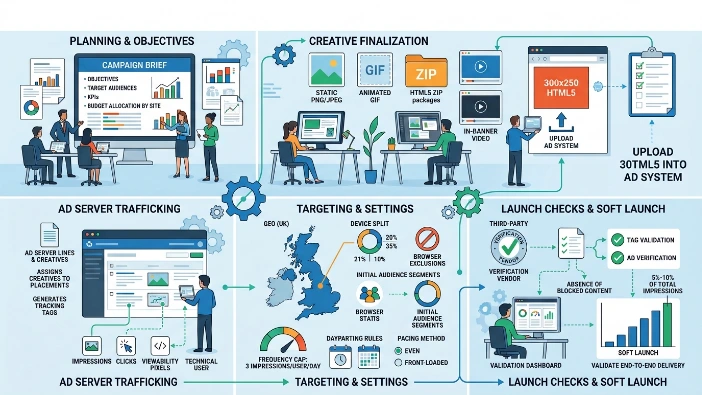
Begin with a campaign brief that defines objectives, target audiences, KPIs, and budget allocation by site. Finalize creatives in required formats: static PNG/JPEG, animated GIF, or HTML5 ZIP packages and in-banner video files. Configure ad server lines and creatives, assign creatives to placements, and generate tracking tags for impressions, clicks, and viewability pixels. Establish targeting parameters: geo (United Kingdom), device split, browser exclusions, and initial audience segments.
Set frequency caps, dayparting rules, and pacing method even delivery or front-loaded. Run tag validation and ad verification checks using third-party tools to confirm correct firing and absence of blocked content. Execute a soft launch on a small percentage (5%–10%) of total impressions to validate end-to-end delivery and measurement. Real examples include uploading a 300×250 HTML5 creative, setting a frequency cap of 3 impressions per user per day, and validating tags with a verification vendor.
What should teams monitor in week 2 to week 3?
Monitor delivery pacing, viewability, invalid traffic, CTR, and creative performance. Adjust targeting, creative rotation, and pacing to correct under-delivery or high invalid traffic early.
During weeks 2 and 3, review daily delivery reports for impressions, spend, and pacing versus planned CPM or impression goals. Inspect viewability rates by site and placement, aiming for above-target thresholds (for example, 60% viewability). Check third-party verification for invalid traffic (IVT) and brand-safety flags and remove problematic placements. Compare CTR by creative to identify low-performing variants and swap or optimize creatives. Optimize audience segments by excluding low-performing segments and shifting budget to higher-performing cohorts. Confirm frequency cap adherence and adjust if overexposure or underexposure appears. Real examples include redistributing budget away from a publisher with 25% IVT and low viewability and increasing allocation to providers with 70% viewability.
How do optimization cycles run in weeks 4 and 5?
Weeks 4 and 5 run iterative optimization: creative A/B testing, site-level reallocation, bid adjustments, and pacing refinements. Use measured lift and conversion data to reweight inventory toward higher incremental performance.
Implement controlled creative A/B tests to compare messaging, CTA wording, and visual elements. Use site-level performance to reallocate spend toward publishers with higher viewability and lower CPM. Adjust bid strategies in programmatic buys: increase CPM floors for premium private marketplace deals and lower bids on remnant inventory. Refine dayparting to prioritize hours with higher engagement. Activate retargeting segments for users who viewed landing pages but did not convert. Reconcile ad server counts with DSP and verification vendors to ensure consistent metrics. Real examples include shifting 20% budget from low-viewability long-tail inventory to a private marketplace bundle that delivered 35% higher viewability.
What measurement and attribution checks occur in week 6?
Week 6 emphasizes attribution validation, conversion window calibration, and incremental lift tests. Confirm that tracking pixels record conversions and that multi-touch attribution models align with business outcomes.
Validate that conversion pixels and server-to-server events fire consistently across publisher domains and that attribution windows reflect campaign sales cycles (for example, 7-day and 30-day windows). Run cohort or holdout lift tests where feasible to measure incremental impact versus control groups. Compare last-click conversions with multi-touch attribution to identify banner contributions earlier in the funnel. Reconcile discrepancies between ad server, DSP, and analytics platform numbers and document reasons such as viewability thresholds, click tracking differences, or ad-blocking. Real examples include confirming server-side conversion events for a sign-up form and running a 10% holdout to measure incremental registrations attributable to the campaign.
How should reporting and optimization solidify in week 7?
Week 7 consolidates reporting into actionable insights: finalize site and creative winners, lock pacing, and prepare end-of-flight frequency and audience rules to maximize final conversion windows.
Produce aggregated reports showing impressions, spend, CPM, viewability, CTR, conversions, and cost-per-action (CPA) by site, placement, creative, and audience segment. Identify top-performing creatives and scale them; retire underperformers. Apply final frequency capping to avoid wasted impressions in the campaign run-out phase. If the campaign runs an extension or retargeting phase, craft stricter audience rules for highly engaged groups. Prepare a performance brief that lists all changes made and the rationale for final budget allocation. Real examples include promoting an HTML5 creative across all high-viewability placements and setting a final frequency cap of two impressions per user for the campaign tail.
What final actions and handoffs happen in week 8?
Week 8 focuses on wind-down: conversion reconciliation, billing reconciliation, creative archive, and a post-campaign performance review with recommendations for future flights.
Reconcile conversions and revenue in analytics and ad server systems to confirm net results. Verify invoice line items against delivery reports and resolve discrepancies with publishers or platforms. Archive creatives, tags, and campaign settings for compliance and future relaunch efficiency. Produce a post-campaign analysis that documents CPM, viewability, CTR, CPA, incremental lift, and lessons learned by site and creative. Include clear recommendations for future targeting, creative formats, and inventory sources based on measured outcomes. Real examples include reconciling a 2% discrepancy between DSP spend and publisher invoice caused by rounding and delivering a final report that lists publisher performance by viewability and CPA.
Explore More Expert Insights:
Banner Advertising Packages for UK Brands: Formats, Placements and Pricing Tiers
How One UK Tech Brand Achieved 0.8% CTR on News Site Banners in a 6-Week Run
What operational components support campaign success throughout weeks 1–8?
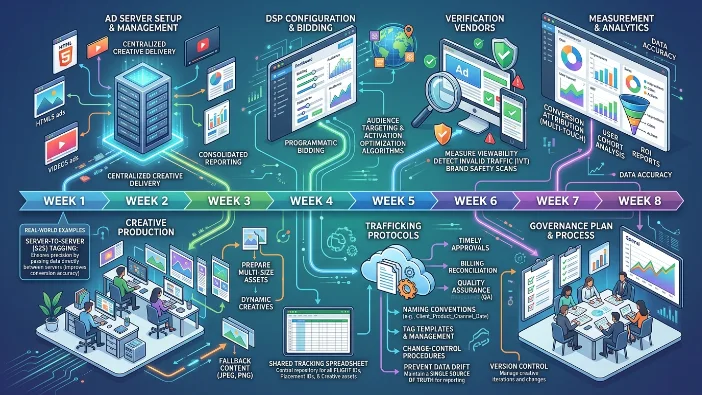
Key components include ad server setup, DSP configuration, verification vendors, measurement platforms, creative production, trafficking protocols, and a governance plan for QA and billing reconciliation.
Ad servers centralize creative delivery and reporting. DSPs handle programmatic bidding and audience activation. Verification vendors measure viewability and IVT. Analytics platforms attribute conversions and support cohort analysis. Creative production teams prepare multi-size assets and fallbacks. Trafficking protocols define naming conventions, tag templates, and change-control procedures. Governance ensures timely approvals, billing checks, and escalation paths. Maintain version control for creatives and a single source of truth for reporting to prevent data drift. Real examples include using server-to-server tagging for conversion accuracy and maintaining a shared tracking spreadsheet for all flight IDs and creatives.
What outcomes should advertisers expect by the end of an eight-week multi-site flight?
Expect consolidated delivery across sites, validated viewability and fraud metrics, identified high-performing creatives and publishers, measurable incremental lift or conversions, and a clear plan for next-phase scaling or retargeting.
By campaign end, advertisers receive a full performance dataset showing cost and outcomes by dimension. Expect to know which sites and creatives produced the best CPA and viewability-adjusted CPM. Decision points include whether to scale high-performing inventory, repeat creative concepts, or retire underperforming channels. Documented lift results guide budget allocation between awareness and direct-response tactics in future campaigns. Real examples include confirming a 15% uplift in site visits attributable to banner exposure and reallocating future budget toward private marketplace inventory with superior viewability.
Explore More Useful Information:
UK Digital Ad Spend Hit £20.4bn in 2025: Where Banner Advertising Fits in the Mix
A structured eight-week multi-site banner campaign follows disciplined phases: planning and soft launch in week 1, early monitoring in weeks 2–3, active optimization in weeks 4–5, measurement validation in week 6, consolidation in week 7, and reconciliation in week 8. Core activities include creative verification, viewability and IVT monitoring, cohort lift testing, and operational governance across ad servers, DSPs, and verification vendors. When teams follow these steps, they produce reliable performance data and clear recommendations for scaling or refinement in future flights.
Check the Complete Explanation:
UK Display Advertising Benchmarks 2026: CTR, Viewability and CPM by Sector