

The UK digital advertising market reached £20.4 billion in 2025 due to increased programmatic video, search growth, and sustained display investment. Major contributors include mobile ad growth, streaming inventory, and advances in measurement that channel more budgets into digital formats.
Digital ad spend refers to total advertiser payments for online inventory, targeting, and delivery across channels. In 2025, the headline £20.4bn figure aggregates search, social, display (including banner), video, classifieds, and programmatic fees. Measurement improvements for viewability and attention drove reallocation from offline channels into digital. Mobile interaction time rose, increasing cost-per-click and cost-per-thousand-impression pressure for premium inventory. Programmatic adoption reached new penetration levels in display and video buying, raising total spend while compressing manual insertion-order activity. Real examples include increased advertiser investment in video-on-demand ad breaks and native display placements across major publishers in the UK.
How is banner advertising defined and what types does it include?
Banner advertising is display inventory that uses static images, animated GIFs, HTML5 creatives, or rich media within web and app placements. Types include standard banners, leaderboard, skyscraper, MPU, responsive display, and rich media with interactive elements.
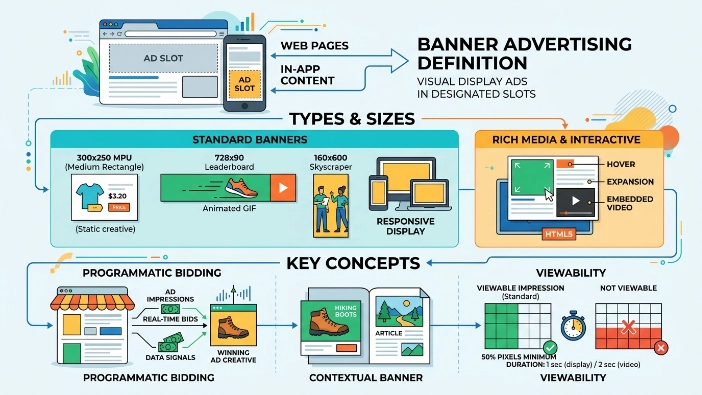
Banner advertising denotes visual display ads delivered in designated slots on web pages or in-app content. Standard banners include 300×250 MPU, 728×90 leaderboard, 160×600 skyscraper, and responsive sizes that adapt to device. Rich media banners include HTML5 and interactive elements such as hover, expansion, or embedded video. Programmatic banners use real-time bidding to match impressions to bids.
Contextual banners serve ads based on page content signals. Viewability measures track whether at least 50% of pixels are visible for one second for display and two seconds for video, forming an industry standard for counting viewable impressions. Real examples include a 300×250 static creative on a news article and an expandable HTML5 MPU on an entertainment site.
Why did display and banner formats remain part of the budget mix in 2025?
Display and banner formats persisted because they deliver broad reach, measurable impressions, and cost-effective frequency control. They support upper-funnel goals such as awareness and recall, and integrate with programmatic buying and cross-device targeting.
Display formats provide predictable CPM-based inventory for awareness campaigns. Advertisers use banners to reach large audiences quickly at lower CPMs than premium video. Banner inventory integrates with demand-side platforms for frequency capping and audience targeting based on data signals. Measurement improvements, including viewability and attention metrics, made display reporting closer to media-planning standards. Banners support sequential messaging when combined with video or search follow-up. Real examples include awareness flights with high-impression banner delivery around major cultural events and seasonal launches.
Where does banner advertising fit in the digital marketing funnel?
Banner advertising fits at the top and middle of the funnel for awareness and consideration. It creates reach, supports brand recall, and primes audiences for subsequent research and conversion-focused channels like search or video.
At the top of the funnel, banners maximize reach and deliver impressions that seed audience recognition. In the mid-funnel, targeted banners refine exposure to defined segments and deliver creative variations that build consideration. Metrics for banner success at these stages prioritize viewable impressions, CPM efficiency, and lift studies that link exposure to search and site visits. Sequential campaigns place banners before conversion tactics to increase efficiency of paid search and retargeting. Real examples include national awareness campaigns run with widespread banner placement before a retail seasonal promotion and targeted banners shown to users who visited specific content categories to drive consideration.
What performance metrics define banner effectiveness?
Key metrics are CPM for cost, viewability rate for quality, click-through rate for engagement, and post-exposure lift for impact. Attention metrics and engagement time complement viewability to assess real audience exposure.
CPM indicates cost per thousand impressions and guides budget allocation for reach. Viewability rate shows the proportion of impressions that meet industry viewability thresholds. Click-through rate measures immediate engagement but declines as a sole success metric for awareness campaigns. Post-exposure lift uses holdout tests to measure increases in brand metrics or search behavior after banner exposure. Attention metrics measure dwell time and interaction to indicate active exposure beyond passive viewability. Real examples include comparing two publishers where one has 70% viewability and 0.05% CTR and the other 50% viewability and 0.08% CTR, informing placement choices based on campaign objective.
How do programmatic and direct-buy differ for banner inventory?
Programmatic buys use automated, auction-based systems with real-time bidding and data-driven targeting. Direct-buy uses negotiated deals or private marketplaces offering fixed placements, guaranteed volumes, and premium context control.
Programmatic buying uses supply-side and demand-side platforms to bid on impressions in milliseconds. It enables audience targeting, frequency controls, and dynamic creative optimization. Private marketplaces and preferred deals provide programmatic access with curated publisher inventory and negotiated floors. Direct buys involve insertion orders and fixed placements that guarantee position, volume, and creative context. Advertisers choose programmatic for scale and targeting efficiency, and direct buys for brand safety and premium context. Real examples include programmatic remnant inventory purchased via real-time bidding and a negotiated premium homepage banner run through a publisher direct deal.
What targeting and measurement capabilities are available for banner advertising?
Targeting options include contextual, demographic, behavioral, and first-party audience segments. Measurement includes viewability tracking, deterministic conversions, probabilistic attribution, cohort lift tests, and third-party verification.
Contextual targeting matches creative to page content. Demographic targeting uses inferred age and gender signals. Behavioral targeting uses browsing signals and audience segments from data providers. First-party targeting uses site visitor lists and CRM matches. Measurement tools verify viewability, detect invalid traffic, and measure post-exposure conversions. Attribution models combine last-click, multi-touch, and incrementality experiments to determine banner contribution. Real examples include serving banners to users who visited product pages in the prior 30 days and running A/B holdouts to measure sales lift.
What benefits does banner advertising deliver for UK advertisers specifically?
Banner advertising provides scalable reach across UK audiences, cost-efficient CPM performance, rapid deployment for time-sensitive events, and integration with programmatic marketplaces that support local targeting and currency settlement in GBP.
Banners reach national and regional audiences across news, retail, and entertainment sites in the UK. They offer cost predictability via CPM buying and allow rapid creative swaps for promotions tied to local events. Programmatic inventory includes UK-focused publisher bundles and private marketplaces for contextual relevance. Measurement ecosystems in the UK emphasize viewability and third-party verification, improving buyer confidence. Banners support cross-device exposure and work with UK-specific data sources such as publisher direct audiences and first-party CRM lists for remarketing. Real examples include high-reach banner flights timed to UK bank holidays and regional promotions with geo-targeted creatives.
Explore More Expert Insights:
How Contextual Targeting Replaced Cookie-Based Retargeting for UK Brands in 2026
The UK Holds the World’s Highest E-commerce Retail Share: Why Display Advertising Wins
What are common use cases for banner advertising in a campaign mix?
Common use cases include national awareness campaigns, event promotion, content-driven sponsorship, sequential messaging for consideration, and audience amplification to support search and social channels.
Awareness campaigns use banners to saturate market segments before product launches or events. Event promotion places banners on relevant content categories and publisher sections. Content sponsorship pairs banner creatives with editorial content for contextual relevance. Sequential messaging uses banners to present different creative phases across campaign weeks. Audience amplification pushes high-reach banner exposure to increase the efficiency of lower-funnel channels like paid search and retargeting. Real examples include a multi-week banner schedule leading into a major retail sale and a content sponsorship aligning banner presence with related editorial features.
How should advertisers assess whether banners are the right channel for their objective?
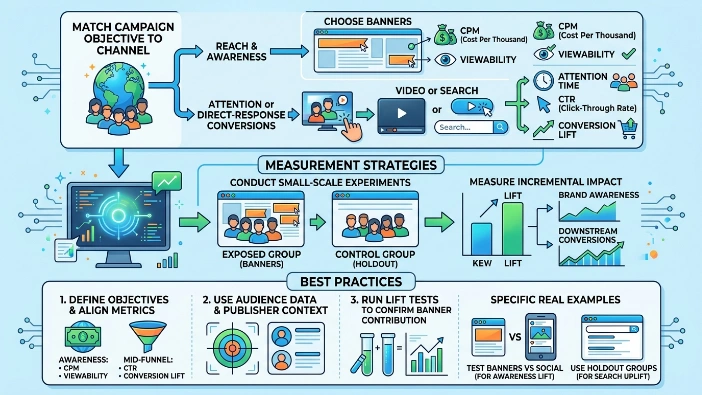
Match campaign objective to metric: choose banners for reach and awareness when CPM and viewability matter. Choose video or search when attention time or direct-response conversions drive success. Use lift tests to confirm banner contribution.
Define objectives and select metrics that align with them: CPM and viewability for awareness, and CTR and conversion lift for mid-funnel testing. Run small-scale experiments that compare banner exposure against control groups to measure incremental impact on brand awareness and downstream conversions. Use publisher context and audience data to ensure exposure aligns with target segments. Real examples include testing banners against social placements for awareness lift and using holdout groups to measure search uplift.
Read More to Understand Better:
UK Display Advertising Benchmarks 2026: CTR, Viewability and CPM by Sector
The £20.4bn UK digital ad spend in 2025 reflects growing mobile usage, programmatic reach, and improved measurement. Banner advertising remains a core channel for reach, awareness, and consideration. Banners include static, HTML5, and rich media formats and operate via programmatic and direct buys. Key metrics are CPM, viewability, CTR, and post-exposure lift. Use banners when reach and scalable impressions drive the objective, and validate contribution through lift testing and measurement.
Get the Full Insights Here:
Multi-Site Banner Campaign Setup: What to Expect in Week 1 Through Week 8



