

Editorial partnerships are seen as independent information sources, while paid ads are perceived as commercial messages; this difference drives higher trust for editorial partners among UK audiences.
Editorial content is defined as material produced by newsrooms, journalists, or independent content creators based on editorial standards, fact-checking, and newsroom oversight. ‘Paid advertising’ is defined as content created to promote a product or service in exchange for payment; it is labelled as ‘advertising’ or ‘sponsored content’. UK audiences distinguish these two by origin, intention, and disclosure. ‘Origin’ refers to who creates the message: journalists versus marketers.
Intention refers to primary purpose: informing versus selling. Disclosure refers to whether the content is presented as editorial or paid promotion. Studies of audience behavior in the UK show higher perceived trust when content originates from editorial sources that declare editorial control, use bylines, and cite sources. The result is a measurable credibility gap where editorial partnerships perform better on trust metrics such as believability, willingness to share, and perceived usefulness.
Why do UK audiences perceive editorial partners as more trustworthy than paid advertisements?
Trust derives from perceived editorial independence, transparent sourcing, and consistent regulatory expectations that apply to editorial content but not to paid ads.
Editorial independence means editors and journalists select topics and angles based on public interest, not commercial return. Transparent sourcing appears when articles include named journalists, references, interviews, and links to primary documents. Regulatory expectations include obligations under UK media regulation, press codes, and journalistic ethics that apply to established editorial outlets. Paid ads are subject to advertising codes, but audiences view those as permissive for commercial messaging. The combination of independence, transparency, and regulation forms a credibility scaffold.
When UK readers encounter editorial partnerships guest articles, co-produced features, or brand-funded journalism with editorial control they register stronger trust signals than they register for display ads, native ads, or social promotions. This difference shows in metrics: editorial formats yield higher time on page, higher article completion rates, and higher reader recall.
How do editorial partnerships work operationally in the UK media system?
Editorial partnerships combine journalistic resources with external expertise while preserving editorial control, defined roles, and disclosure protocols.
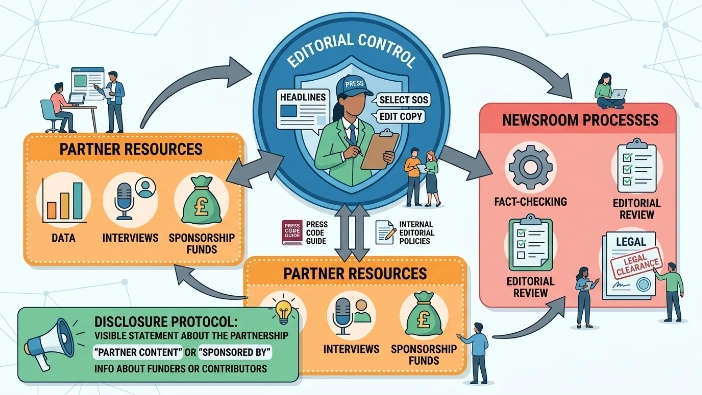
Operationally, editorial partnerships begin with a clear agreement that assigns responsibilities: the newsroom retains editorial control; the partner supplies data, interviews, or sponsorship funds. Editorial control means journalists set headlines, select sources, and edit copy. Disclosure protocols require visible statements about the partnership, often labeled “partner content” or “sponsored by,” and include information about funders or contributors.
Editorial partnerships use newsroom processes such as fact-checking, editorial review, and legal clearance to ensure content meets editorial standards. In the UK, many outlets follow press code guidelines and internal editorial policies that stipulate separation between commercial and editorial teams. The result is content that leverages partner resources while preserving journalistic standards, which sustains audience trust.
What components of editorial content increase audience trust in the UK?
Named authorship, cited sources, data transparency, and visible editorial review are the primary trust-enhancing components in editorial content.
Named authorship signals accountability by attaching a journalist’s reputation to the content. Cited sources and links to primary documents allow readers to verify claims independently. Data transparency includes methods, sample sizes, and data provenance when research or surveys are referenced. Visible editorial review appears as editorial notes, fact-checking statements, and corrections policies. Each component creates verifiable threads that audiences use to judge credibility. For example, a partnership article that includes a named reporter, hyperlinks to government reports, a methodology box for a poll, and an editor’s note increases reader confidence relative to a branded feature with no named author or source links.
What are the measurable benefits of using editorial partners versus paid ads in the UK?
Editorial partnerships deliver higher trust metrics, longer engagement, and improved message retention compared with paid advertisements.
Trust metrics include believability scores from surveys and net trust indices. Engagement metrics include time on page, scroll depth, and article completion rates. Message retention is measurable through recall tests conducted days after exposure. UK media measurement studies show editorial features produce average dwell times that are two to four times higher than display ads and recall rates that are higher by similar margins. Editorial partnerships also produce secondary benefits such as social amplification when readers share content with commentary. These measurable benefits translate into more effective audience education and stronger reputation outcomes for topics that require nuance, such as public policy, health information, or corporate responsibility disclosures.
In what use cases do UK organisations gain the most from editorial partnerships rather than paid ads?
Organisations gain most when goals require trust, nuance, or long-form explanation: public information campaigns, complex product explanations, and reputation management.
Public information campaigns that require behavior change benefit from editorial channels because audiences trust verified information from journalists. Complex products financial services, technical B2B solutions, or regulated industries—benefit from long-form editorial explanation that allows for context, expert quotes, and cited evidence. Reputation management and thought leadership work when third-party editorial validation supports claims with independent reporting. For example, a public health drive that partners with a national outlet to publish investigative context, interviews with clinicians, and links to official guidance achieves higher uptake than a short-form paid campaign. Similarly, a technical industry partnership that results in a deep-dive explainer with sourced data and expert commentary yields better comprehension than banner ads.
How does disclosure affect audience trust in editorial partnerships within the UK?
Clear, prominent disclosure that explains funding and editorial arrangement increases trust relative to hidden or ambiguous disclosure.
Disclosure must state who funded the content and what editorial role the partner had. Prominent disclosure appears near the title or byline and uses plain language such as “This article was published in partnership with” followed by a description of the partnership terms. UK audiences interpret explicit, plain-language disclosure as a positive trust cue because it signals transparency. Ambiguous or buried disclosures reduce trust and can trigger negative reactions when readers discover commercial involvement later. Regulatory guidance in the UK supports clear labelling to protect editorial integrity and audience expectations. A study of reader responses indicates that clear disclosure combined with editorial control preserves trust while ambiguous disclosure erodes it.
What processes ensure editorial independence in partner content for UK publishers?
Processes include contractual editorial control, independent fact-checking, and separation of commercial and editorial teams.
Contractual editorial control must be written and enforced so journalists retain final decision rights over content, headlines, and tone. Independent fact-checking involves third-party reviewers or internal fact-check teams that verify claims, data, and quotations. Functional separation requires commercial teams to handle funding and brief creation while editorial teams handle content decisions. Additional safeguards include pre-publication legal review limited to defamation risk and post-publication correction policies. These processes create defensible editorial independence and allow readers to evaluate content on journalistic standards rather than commercial intent.
Explore More Expert Insights:
How News Media Partnerships Are Replacing Expensive Programmatic Buys in the UK
UK Media Fragmentation: Why Single-Platform Strategies Fail in 2026
What evidence shows UK audiences act differently after reading editorial partner content compared with paid ads?
Empirical studies show higher sharing rates, higher article completion, and greater recall for editorial partner content versus paid ads.
Quantitative evidence includes metrics such as share rates, completion rates, dwell time, and recall tests. Share rates for editorial partner pieces are higher because readers attribute informational value to these pieces. Completion rates are higher because editorial formats provide depth and narrative structure that sustain attention. Recall tests that query key facts 48 to 72 hours after exposure show better retention for editorial content. These behaviors indicate that audiences process editorial content as informative material, not merely promotional messaging. For topics that require informed decision-making, editorial content leads to better-informed audiences and higher-quality public conversation.
How should researchers and practitioners assess the credibility gap in future UK studies?
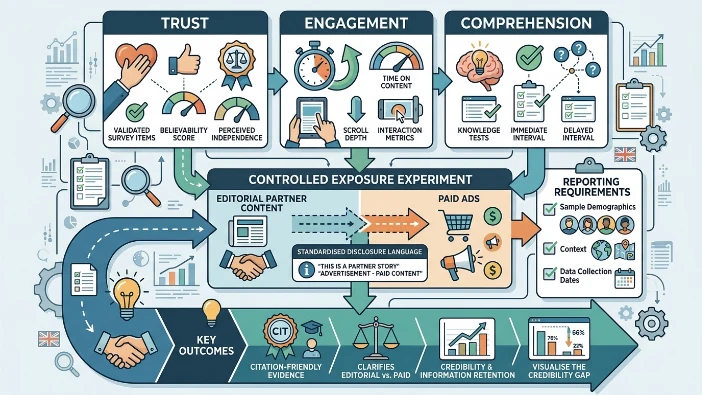
Assessments should measure trust, engagement, and comprehension separately, using controlled exposure and standardised disclosure language.
Research design must separate trust from engagement and comprehension. Trust can be measured with validated survey items that probe believability and perceived independence. Engagement metrics should include time on content and scroll depth. Comprehension requires knowledge tests immediately and at delayed intervals. Controlled exposure experiments should randomise participants to editorial partner content versus paid ads with standardised disclosure wording to isolate the effect of editorial origin. Reporting must include sample demographics, context, and data collection dates. This approach yields citation-friendly evidence that clarifies how editorial formats outperform paid ads on credibility and information retention.
Read More to Understand Better:
8 Red Flags in UK Media Partnership Proposals You Should Never Ignore
Editorial partnerships produce higher trust than paid ads in the UK because they present independent authorship, transparent sourcing, and visible editorial control. Operational safeguards—contractual editorial rights, fact-checking, and disclosure preserve that trust. For topics requiring depth, nuance, or public confidence, editorial partnerships deliver better engagement, retention, and sharing than paid advertising. Researchers should use controlled, component-based measures to quantify the credibility gap and guide media strategy decisions.
Get the Full Insights Here:
B2B Lead Generation Through Media Partnerships: A 12-Month UK Attribution Study



