

A multi-publisher partnership strategy coordinates content, distribution, and measurement across multiple news publishers to reach diverse audience segments and increase incremental reach.
A partnership strategy formally connects a lead organisation with two or more publishers. Publishers include national newspapers, regional digital outlets, specialist vertical sites, and audio or newsletter producers. The strategy defines content roles, distribution timing, revenue or cost-sharing rules, and shared measurement standards. The goal is to access unique audiences that single publishers cannot deliver alone and to align messaging for consistent user journeys. This approach requires documented agreements, technical integration for analytics, and editorial workflows for content repurposing.
How do organisations start building such a strategy?
Start by mapping target audiences, identifying compatible publishers, and agreeing pilot objectives for reach, engagement, and measurement.
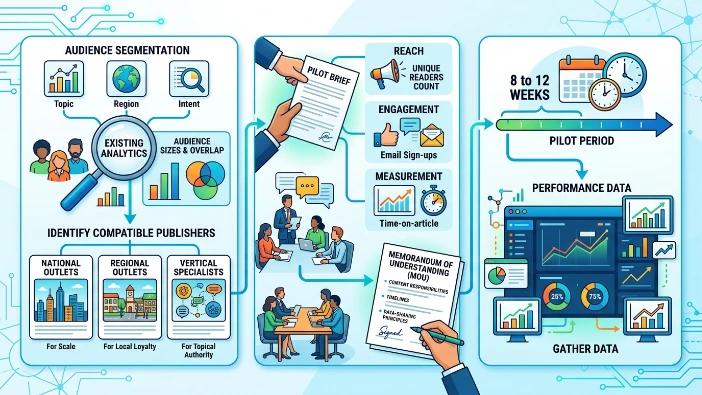
Begin with audience segmentation by topic, region, and intent. Use existing analytics to quantify audience sizes and overlap. Identify publishers that serve complementary segments: national outlets for scale, regional outlets for local loyalty, and vertical specialists for topical authority. Reach out with a clear pilot brief that defines objectives such as incremental unique readers, email sign-ups, or time-on-article. Draft a memorandum of understanding that sets content responsibilities, timelines, and data-sharing principles. Establish a pilot period of 8 to 12 weeks to gather performance data.
What processes govern editorial collaboration and content mapping?
Editorial collaboration requires content mapping, format adaptation, publication schedules, and version control to maintain consistency across publishers.
Map content by primary asset and derived assets. Primary assets include long-form reports, investigative pieces, or data visualisations. Derived assets include short videos, explainer articles, newsletter inserts, and social clips. Assign owner roles: one publisher manages the primary asset while partners host derived assets or republication with attribution. Set publication windows to sequence distribution for maximum impact. Use shared content calendars and a version-controlled repository for assets. Define metadata standards for headlines, bylines, and canonical URLs to avoid duplication penalties in search engines.
Which measurement frameworks work for multi-publisher campaigns?
Measurement frameworks must combine unified KPIs, cross-publisher attribution, and privacy-compliant data links to report incremental reach and engagement.
Agree on unified KPIs such as incremental unique users, engaged sessions (defined as sessions longer than 60 seconds or with two or more page views), and newsletter opt-ins. Use server-side event collection for consistent event definitions across publishers. Implement hashed first-party identifiers or cohort analysis in a secure clean room to measure cross-publisher journeys while protecting user privacy. Run A/B or holdout tests with control geographies or time windows to measure incremental reach. Produce a shared dashboard with standard metrics and weekly reporting cadence.
What technical integrations are required?
Technical integrations include server-to-server event collection, shared tagging standards, and secure data-exchange mechanisms for aggregated analysis.
Publishers implement a common event schema that records page views, engaged sessions, and consent signals. Use server-to-server endpoints where client-side tracking is unreliable. For cross-publisher identity resolution, set up hashed identifiers exchanged through a privacy-approved clean room or via aggregated cohort exports. Configure canonical tags and structured data to guide search indexing and avoid duplicate content issues. Ensure compliance with the UK data protection framework and documented data retention rules.
What legal and governance components must be in place?
Legal components require data processing agreements, content licensing terms, revenue-sharing clauses, and editorial liability provisions.
Draft data processing agreements that specify lawful bases for processing and the scope of data exchange. Define content licensing: whether partners republish full articles, excerpts, or summaries, and how attribution appears. Specify revenue or cost-sharing models for paid placements or ad revenue where applicable. Include clauses that address editorial liability, corrections, and retractions. Assign a governance committee with representatives from each publisher to oversee policy compliance, data audits, and dispute resolution.
What content types and formats deliver the best results across publishers?
Best results come from a mix: long-form flagship assets, short-form social clips, audio episodes, and newsletters tailored to each publisher’s audience.
Flagship long-form assets attract backlink value and specialist readers when hosted on a primary publisher site. Short-form social clips drive discovery on platform feeds and link back to partner sites. Audio episodes capture commuting and multitasking audiences and extend reach to podcast subscribers. Newsletters provide direct, permissioned distribution and drive repeat visits. Tailor formats to partner strengths: for example, a regional publisher runs localised summaries; a vertical site runs deep technical analysis; a national site promotes the flagship asset for scale.
How do partners share costs and monetise collaborations?
Partners share costs via fixed contributions, revenue splits for monetised placements, or barter arrangements for audience access and ad inventory.
Cost-sharing models include proportional contributions based on expected audience access or fixed fees for hosting and production. Revenue splits apply when campaigns run monetised placements, sponsored content, or subscription conversions; splits align to contribution of traffic and production resources. Barter arrangements trade newsletter placements or social distribution for hosting rights. All financial terms must be transparent and reflected in the partnership agreement with reporting obligations for ad revenue and conversion metrics.
What benefits do organisations achieve with this strategy?
The strategy increases incremental unique reach, improves audience targeting, and reduces dependence on single-platform algorithms while enhancing measurement of downstream outcomes.
Multi-publisher distribution accesses distinct audience pools that increase total unique users beyond what any single publisher delivers. Targeting improves because each publisher brings contextual relevance and trust with specific segments, raising engagement quality. Reliance on external algorithms decreases because owned assets and newsletter placements provide predictable direct reach. Cross-publisher measurement captures downstream outcomes such as newsletter subscriptions and repeat visits, enabling better attribution of value per channel and more informed budget allocation.
Which risks and challenges require mitigation?
Risks include audience overlap, inconsistent editorial standards, data non-compliance, and technical integration failures that reduce measurement accuracy.
Audience overlap reduces incremental reach and requires overlap analysis to optimise partner selection. Editorial inconsistencies can confuse users and damage credibility; mitigate with agreed editorial guidelines and fact-check workflows. Data non-compliance risks regulatory penalties; mitigate with legal review, consent capture, and minimal data exchange. Technical failures in event collection or identifier hashing distort reporting; mitigate with end-to-end testing, monitoring, and fallback tracking methods.
Explore More Expert Insights:
KPIs That Actually Matter When Measuring a UK Media Partnership Performance
How to Negotiate a UK Publisher Partnership That Protects Your Brand and Budget
What use cases show clear ROI for multi-publisher partnerships?
Use cases with clear ROI include regional subscription drives, specialist content launches, and national awareness campaigns timed to policy events or seasonal peaks.
Regional subscription drives use local publishers plus national amplification to convert local interest into paid subscriptions with lower acquisition costs. Specialist content launches in areas like health or education use vertical publishers and newsletters to attract professional audiences who convert to memberships or whitepaper downloads. National awareness campaigns tied to elections or public-health windows use coordinated timing across broadcasters, national outlets, and community publishers to maximise verified reach and engagement during defined periods.
How should teams scale a successful pilot?
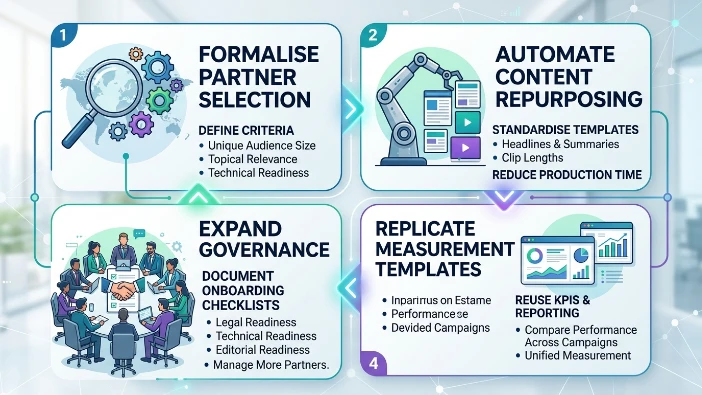
Scale by formalising partner selection criteria, automating content repurposing, and replicating measurement templates across additional publishers.
Define selection criteria that prioritise unique audience size, topical relevance, and technical readiness. Standardise content-repurposing templates for headlines, summaries, and clip lengths to reduce production time. Reuse measurement templates and KPIs to compare performance across campaigns. Expand governance to manage more partners and document onboarding checklists for legal, technical, and editorial readiness.
Building a multi-publisher partnership strategy across UK news verticals requires audience mapping, clear editorial roles, unified measurement, technical integration, and legal governance. Pilots of 8 to 12 weeks provide evidence on incremental reach and engagement. Successful scaling depends on standardised templates, transparent cost-sharing, and rigorous compliance controls. This strategy reduces single-platform dependence while enabling targeted access to distinct audience segments.
Check the Complete Explanation:
UK Media Fragmentation: Why Single-Platform Strategies Fail in 2026
Readers interested in the educational stage of healthcare awareness campaigns can explore Building a Multi-Publisher Partnership Strategy Across UK News Verticals
Explore More Useful Information:
How Times Intelligence Media Group Partners Deliver 4M+ Monthly Unique Readers



