

A UK publisher partnership is a contractual collaboration between a brand and a media publisher to create, distribute, and measure content; key entities include the brand, the publisher, legal counsel, procurement, and analytics teams.
A publisher is an organisation that owns distribution channels such as websites, newsletters, podcasts, and events. A brand is the commercial party seeking audience reach, leads, or thought-leadership outcomes. Legal counsel drafts or reviews contractual terms to protect intellectual property and liability exposure. Procurement vets vendor suitability and negotiates commercial terms. Analytics teams define tracking and reporting requirements that link publisher activity to marketing systems.
Define publisher inventory clearly. Inventory types include sponsored articles, branded content series, newsletter placements, native ads, and hosted events. Define outcomes for each inventory item in measurable terms, for example a target number of qualified leads, time-on-content thresholds, or audience segment reach. Define decision rights for content editing, distribution timing, and amplification budgets.
How do you prepare internally before negotiating with a UK publisher?
Preparation requires clear objectives, defined KPIs, a budget envelope, risk tolerances, and an approved stakeholder list for decision-making.
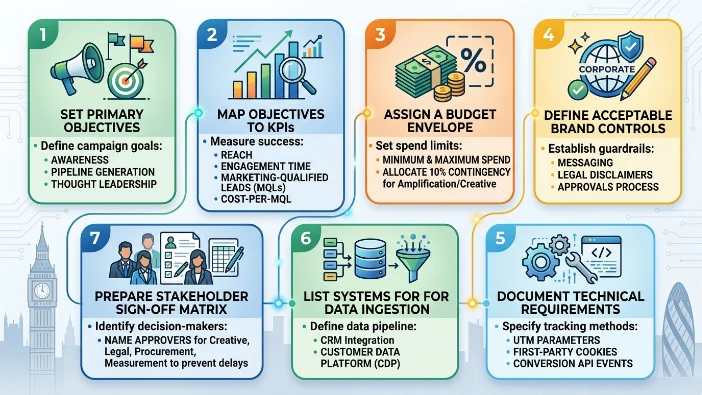
Set primary objectives: awareness, pipeline generation, or thought leadership. Map objectives to KPIs such as reach, engagement time, number of marketing-qualified leads (MQLs), or cost-per-MQL. Assign a budget envelope with minimum and maximum spend, and allocate a contingency of 10% for amplification or creative iterations. Define acceptable brand controls, including messaging, legal disclaimers, and approvals.
Document technical requirements. Specify required tracking methods such as UTM parameters, first-party cookies, or conversion API events. List systems for data ingestion, for example CRM or customer data platform (CDP). Prepare a stakeholder sign-off matrix that names approvers for creative, legal, procurement, and measurement to prevent delays during implementation.
What contract clauses protect brand reputation and legal exposure?
Focus contract clauses on IP ownership, editorial control, indemnities, liability caps, and compliance with UK advertising and data protection law.
Intellectual property clauses must state who owns master assets, who receives syndication rights, and duration of usage. Editorial control clauses must define approval windows, number of revision rounds, and the final approval authority. Indemnity clauses assign responsibilities for third-party claims arising from content, and liability caps limit financial exposure to a mutually agreed sum.
Include a clause confirming compliance with UK advertising standards and disclosure rules, for example transparency about sponsored content. Add a data protection clause that specifies roles (data controller versus data processor), purpose limitation, retention periods, and obligations under UK GDPR. Require audit rights for any data processing that impacts your brand or customers.
How should measurement and data-sharing be structured for accountability?
Agree on specific KPIs, instrumentation methods, data schemas, reporting cadence, and secure transfer protocols before work starts.
Define KPIs by funnel stage: awareness measured by unique reach and view-through rate, consideration measured by time on content and content completions, and pipeline contribution measured by MQLs and SQLs. Specify instrumentation methods such as server-side events, conversion APIs, and hashed identifiers to preserve privacy. Provide the publisher with a data schema showing required fields, for example timestamp, content ID, event type, and anonymous lead token.
Set reporting cadence and format: weekly raw event dumps, monthly cohort analysis, and quarterly attribution reports. Define secure transfer protocols such as SFTP or encrypted APIs. Include responsibility for data reconciliation and an agreed-upon window for attribution, for example 90 days from exposure to conversion.
How do you structure commercial terms to protect budget and incentivise performance?
Use a blended commercial model with base fees, performance incentives, and usage premiums tied to defined milestones and payment triggers.
Structure a base production fee that covers creative and editorial work. Add performance incentives that pay incremental fees for achieving predefined lead volumes or conversion rates. Include usage premiums for extended syndication rights or perpetual licensing beyond an initial 12-month term. Define payment triggers precisely: payments upon content delivery, first live date, and verified lead delivery.
Include cancellation terms with graded refunds based on work completed. Specify currency and invoicing details for UK payments, net payment terms, and any late-payment interest. Require itemised invoices that map costs to deliverables and performance metrics to enable budget reconciliation.
What negotiation tactics protect brand messaging and editorial control?
Secure clear approval steps, final sign-off authority, and explicit boundaries on editorial changes to prevent messaging drift.
Define a content brief that lists mandatory claims, disallowed claims, and required legal language. Set approval timelines, for example two business days for factual checks and five business days for full editorial approval. Reserve final sign-off for a named brand representative and limit publisher rights to non-substantive edits for formatting.
Include a pre-publication proofing requirement where the draft is delivered in final layout for approval. Add remediation steps for unacceptable content, including removal within specified hours and financial remedies if the publisher fails to act.
What risk mitigations protect data privacy and compliance?
Include specific data processing terms, minimisation principles, retention limits, and incident response obligations aligned with UK GDPR.
Specify the lawful basis for processing any personal data and restrict data sharing to necessary fields only. Require minimisation, pseudonymisation, or hashing of identifiers before transfer. Set retention limits aligned with business needs, for example, delete or anonymise lead tokens after 24 months unless subject consents are recorded.
Define incident response timelines, for example, notification within 72 hours of a breach, and require cooperation for regulatory investigations. Require the publisher to maintain records of processing activities and to provide documentation of security measures such as ISO 27001 certification or equivalent.
What governance processes ensure ongoing performance and adaptability?
Implement a governance cadence with performance reviews, KPIs, change control, and renewal criteria to manage scope and budget throughout the partnership.
Establish a weekly implementation meeting for the first 8 weeks, then monthly strategic reviews. Use a change-control process for scope changes with written approval and budget impact statements. Define renewal criteria based on performance thresholds, for example meeting 80% of agreed KPIs over a 90-day window.
Include escalation paths for disputes and an agreed mediation process before contract termination. Maintain a shared project plan with milestones, owners, and deadlines to ensure accountability.
Explore More Expert Insights:
Content Licensing vs Co-Creation: Which Media Partnership Model Suits Your Brand?
How to Identify the Right UK Media Partner for Your Industry in 4 Steps
What are common use cases and negotiation examples for UK brands?
Typical use cases include lead-generation content series, sponsored research reports, and event partnerships; negotiate terms specific to each use case with clear deliverables and measurement.
For a lead-generation content series, negotiate gated asset specifications, lead fields required, lead verification steps, and a cost-per-verified-lead schedule. For sponsored research, define methodology transparency, data access for verification, and co-branding permissions. For event partnerships, confirm attendee lists, data capture methods, on-site branding rights, and post-event reporting.
Real examples: a three-month thought-leadership series with a publisher where the brand pays a base fee of £25,000 plus £150 per verified lead after a 50-lead threshold; a sponsored research brief that requires the publisher to provide raw dataset samples and independent methodology disclosure; an event partnership where the publisher provides attendee contact tokens and the brand retains the right to follow-up communications within 30 days.
How do you close the deal while preserving flexibility and control?
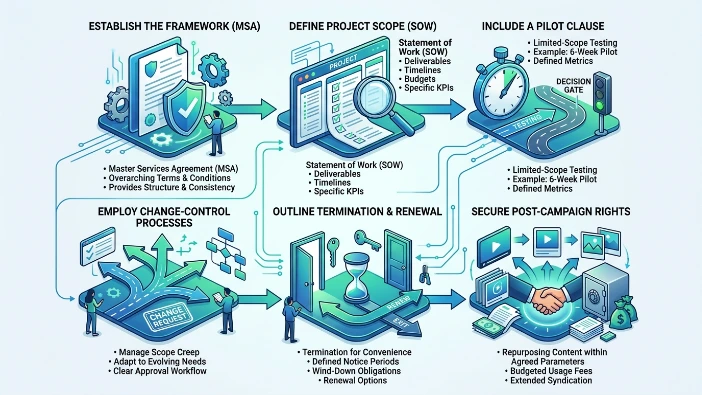
Close with a signed master agreement that includes a statement of work, clear KPIs, payment schedules, and termination and renewal clauses to balance control and adaptability.
Use a master services agreement (MSA) for overarching terms and a statement of work (SOW) per campaign that details deliverables, timelines, budgets, and KPIs. Include an initial pilot clause for limited-scope testing, for example a 6-week pilot with defined metrics and a decision gate. Ensure the MSA includes termination for convenience with notice periods and defined wind-down obligations.
Dive Deeper Into This Topic:
What B2B Creator Partnerships Look Like in 2026 Versus 2023 in the UK
Retain flexibility through defined change-control processes and renewal options. Secure post-campaign rights for repurposing content within agreed parameters and budgeted usage fees for extended syndication.
Learn Everything About It Here:
Agency vs Direct Publisher Partnership: A Cost-Benefit Analysis for UK Brands



