An audience insight subscription provides ongoing, updated audience data and regular analysis; a one-off report delivers a single comprehensive dataset and recommendations for a defined period.
An audience insight subscription supplies continuous feeds, monthly or weekly reports, dashboard access, and periodic strategy reviews. A one-off report provides a snapshot analysis covering a fixed historical window, detailed recommendations, and raw exports for the covered period. Important entities: data cadence (update frequency), scope (topics and channels covered), delivery format (dashboards, PDFs, data extracts), and governance (consent, retention rules). Subscriptions support iterative optimisation and sustained measurement. One-off reports support discrete campaigns, audits, or launch decisions.
When is a subscription the better choice?
Choose a subscription when campaigns run longer than three months, require iterative testing, and need up-to-date audience signals for performance optimisation.
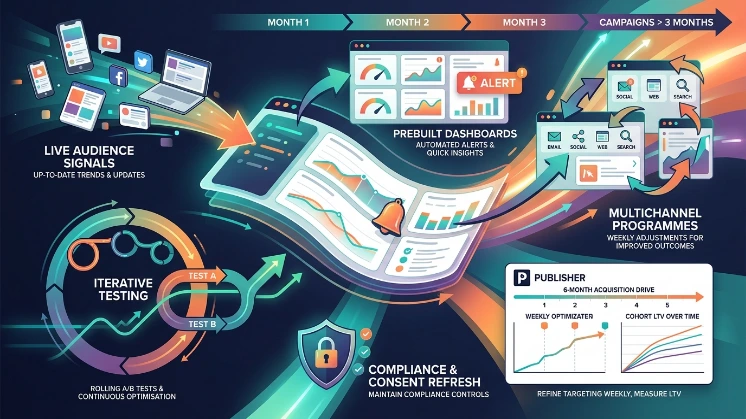
Subscriptions deliver continuous audience trend tracking and live segment updates. They support rolling A/B tests and enable rapid content or media shifts based on fresh signals. Subscriptions reduce time-to-insight by providing prebuilt dashboards and automated alerts for audience shifts. They suit multichannel programmes where weekly or monthly adjustments improve outcomes. Subscriptions help maintain compliance controls and consent refresh workflows. A publisher running a six-month acquisition drive uses a subscription to refine targeting weekly and measure cohort LTV over time.
When does a one-off report serve better?
Choose a one-off report for short campaigns, market entry assessments, or when a fixed-cost, time-bound analysis meets decision needs.
One-off reports suit pre-launch market scans, competitor audits, and single-campaign creative briefs. Reports provide a deep dive into historical performance, audience segments during a defined period, and tactical recommendations for immediate execution. They require no ongoing commitment and deliver complete exports for internal use. One-off reports work for one-off events, seasonal campaigns, or procurement-stage evaluations. A charity running a two-month fundraising appeal commissions a one-off report to inform immediate messaging and channel mix.
What are the cost and commercial differences?
Subscriptions use recurring pricing tied to data volume or user seats; one-off reports use fixed fees tied to scope, depth, and delivery timeframe.
Subscription pricing often charges monthly or annually and scales with the number of audience segments, data connectors, and dashboard seats. Subscriptions include ongoing support and updates. One-off report pricing is a single payment based on the number of data sources, depth of analysis, custom modelling, and delivery speed. Subscriptions produce predictable monthly budgets and lower per-insight costs over time. One-off reports contain all costs up front and avoid recurring commitments. Example: a subscription at scale can average lower cost per analysis over a 12-month period versus repeated one-off reports for the same scope.
How do timelines and delivery compare?
Subscriptions provide live access and regular deliverables; one-off reports provide a single delivery within a defined project timeline, usually 2–8 weeks.
Subscriptions grant immediate access to dashboards and near-real-time feeds once integration completes. Monthly briefings and ad-hoc deep dives occur as part of the subscription. One-off reports follow a project plan: scoping, data collection, analysis, and delivery. Typical one-off report timelines range from 2 weeks for standard templates to 8 weeks for complex custom studies. Subscriptions require initial integration work but reduce future delivery overhead. Example: a time-sensitive campaign requiring insights in 10 days chooses a one-off report with a rapid delivery timeline.
What differences exist in methodology and data freshness?
Subscriptions prioritise ongoing data ingestion, automated normalisation, and trend continuity; one-off reports prioritise full historical depth and bespoke analysis for a fixed time window.
Subscriptions ingest events and metrics continuously and apply standard normalisation rules for comparability. They support cohort tracking and evolving segment definitions. One-off reports pull comprehensive historical datasets, run bespoke models, and produce end-to-end documentation for the analysed window. Subscriptions excel at detecting recent behavioural shifts; one-off reports excel at deep, contextual analysis of past performance. Example: a subscription highlights a sudden 18% uplift in mobile engagement within two weeks; a one-off report explains multi-year seasonality and structural audience shifts.
What governance and compliance controls differ?
Subscriptions embed continuous consent checks, automated retention policies, and audit trails; one-off reports require documented source attestations and one-time DPIAs when linking to first-party profiles.
Subscriptions automate consent status checks for incoming data and enforce retention schedules at scale. They maintain access logs and regular compliance reviews. One-off reports demand explicit documentation of data provenance and the legal basis for processing during the covered period. Both models require Data Protection Impact Assessments when processing sensitive categories or linking external signals to personal profiles. Example: a subscription automatically blocks non-consented segments from export; a one-off report includes a compliance appendix detailing sources and lawful bases.
How do outcomes and ROI measurement differ?
Subscriptions allow continuous ROI measurement through incremental testing and cohort LTV; one-off reports measure immediate uplift and provide a baseline for short-term campaign ROI.
Subscriptions support iterative optimisation and continuous measurement of lifetime metrics, enabling improved acquisition cost per cohort and long-term revenue forecasting. One-off reports measure short-term conversion uplifts, audience reach improvements, and provide benchmarks for a specified period. Subscriptions facilitate attribution refinements over months; one-off reports deliver immediate causal insights for discrete campaign windows. Example: a subscription reveals a 20% improvement in retention for cohorts after three months of iterative content changes; a one-off report records a 6% conversion uplift during a single campaign.
What implementation and resource considerations apply?
Subscriptions require integration work, ongoing analyst seats, and governance roles; one-off reports require focused analyst time and project management during the engagement period.
Subscriptions need initial connector setup to feeds, data warehouse or CDP configuration, and regular maintenance. They require at least one named analyst or manager to act on alerts and run experiments. One-off reports need scoped analyst hours and a project lead for the delivery timeline. Subscriptions demand ongoing budget allocation for seats and storage. One-off reports fit one-time budget approvals and procurement cycles. Example: subscriptions typically require a technical integration lasting 2–6 weeks; one-off reports often complete with a single five-day intensive analysis block.
Which model suits different UK campaign types?
Short campaigns and procurement-stage decisions fit one-off reports; long-term audience development, subscription growth, and iterative acquisition fit subscriptions.
Seasonal promotions or single-event campaigns benefit from the focused insights of a one-off report. National campaigns that require repeated optimisation, such as subscription growth or ongoing engagement programmes, benefit from subscriptions. Multi-channel campaigns with monthly budget reallocation need subscription-level freshness to inform weekly decisions. Smaller teams with no ongoing analytics capacity may prefer one-off reports with clear handover documentation. Example: a charity’s three-month appeal uses a one-off report; a media group’s year-long acquisition programme uses a subscription.
Explore More Expert Insights:
How to Present Audience Insight Findings to a UK Marketing Board in 12 Slides
Audience Insights Service Pricing: What UK Brands Typically Invest and What They Get
How do teams compare vendors or internal models?
Evaluate based on data connectors, update cadence, governance features, pricing transparency, and proof of outcomes through case evidence or pilots.
Assess available connectors for required channels and the speed of data ingestion. Check cadence options—daily, weekly, monthly—and dashboard customisability. Confirm governance capabilities: consent handling, retention automation, and audit logs. Compare pricing for seats and data volume against expected analysis frequency. Request past-case evidence or run a short pilot to measure delivery quality and impact. For subscriptions, require a 30–90 day pilot to validate integrations and initial outcomes. Example: a procurement team runs a four-week pilot to validate a subscription’s ability to reduce cost-per-acquisition.
What are recommended decision criteria for UK campaigns?
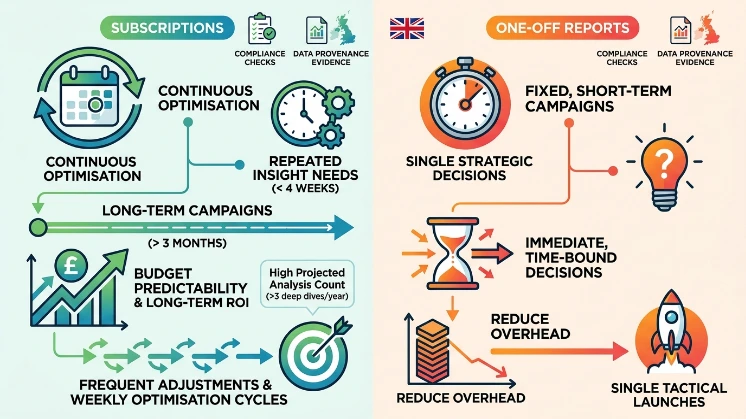
Select subscriptions when you need continuous optimisation, expect repeated insight needs every four weeks or less, and plan campaigns longer than three months; choose one-off reports for fixed, short-term campaigns or single strategic decisions.
Estimate insight cadence: frequent adjustments require subscriptions. Budget predictability and long-term ROI argue for subscriptions when the projected analysis count exceeds three deep dives per year. For immediate, time-bound decisions, choose one-off reports to reduce overhead. Ensure compliance checks and data provenance evidence for either choice. Build a simple decision matrix: campaign length, required cadence, budget availability, and internal execution capacity to guide selection. Campaigns with weekly optimisation cycles select subscriptions; single tactical launches select one-off reports.
Complete Details Available Here:
What First-Party Data Means in 2026 and Why 75% of UK Marketers Prioritise It
Subscriptions deliver continuous, actionable audience intelligence suited to long-term UK campaigns and iterative optimisation. One-off reports deliver focused, time-bound analysis for discrete campaigns and strategic decisions. Choose based on campaign length, cadence needs, budget model, and internal capacity. Documentation of sources, legal basis, and experiment outcomes remains essential for both models.
Discover the Full Information:
How to Use Competitor Audience Data to Find Untapped UK Reader Segments