
Competitor audience data is information about other publishers’ or platforms’ audiences gathered from public sources, aggregated measurement, and shared insights for comparative use.
Competitor audience data includes audience size estimates, demographic breakdowns, topical interests, engagement metrics, and traffic sources. Important entities: data source (analytics, panels, public APIs), audience segment (group defined by behaviour or attribute), and metric (pageviews, visit duration, unique users). Data sources range from industry panels and public reporting to social platform audience insights. UK publishers use competitor audience data to map where readers consume similar content, identify high-engagement topics, and locate demographic gaps. Example: a national newspaper’s public traffic report shows high mobile readership for politics articles, which informs competitor comparisons.
How do you collect competitor audience data legally and ethically?
Collect competitor audience data using publicly available reports, third-party aggregated panels, social platform insights, and compliant scraping governed by terms of service.

Start with industry-standard measurement panels that publish comparative reach figures. Use publicly released audience reports and publisher rate cards that list demographics and monthly unique visitors. Use social platform audience tools to view interest clusters and engagement metrics for competitor posts. Where automated collection is necessary, follow platform terms and UK legal limits; avoid harvesting personal data or bypassing access controls. Record provenance and timestamps for each dataset. Magazine uses a social platform’s audience insights to see topic interest percentages for a competitor’s recent posts. An analytics vendor provides aggregated country-level traffic estimates for a group of rival sites.
How do you define untapped reader segments?
Untapped reader segments are audience groups with measurable interest in relevant topics but low current engagement with your site or content.
Define segments by demographic attributes, behavioural signals, topic affinity, and channel preference. Use comparative metrics: coverage rate (share of competitor’s audience not reached by your channels), engagement potential (average time on topic pages across competitors), and conversion gaps (low subscription or signup rates relative to interest). Identify segments with high topical interest and low contact frequency. Example: readers aged 25–34 with interest in local environment issues who read competitor blogs but have low loyalty signals on your site. Commuter readers who engage with competitors’ short-form content on mobile platforms yet rarely visit your mobile app.
What processes turn competitor data into usable audience insight?
Processes include data ingestion, normalisation, gap analysis, segment scoring, and hypothesis testing using controlled experiments.
Ingestion collects competitor metrics from panels, public reports, and platforms into a single workspace. Normalisation aligns metric definitions and time windows to enable valid comparisons. Gap analysis compares topic reach, frequency, and engagement between competitors and your properties. Segment scoring ranks potential segments by size, engagement potential, and strategic fit. Hypothesis testing designs experiments—headline variants, distribution shifts, or content formats—to validate segment responsiveness. Maintain a clear audit trail for sources and assumptions. A publisher ingests monthly unique visitor estimates, aligns them to calendar months, and runs A/B tests for a candidate segment identified as loyal to competitor newsletters.
What components form a competitor audience analysis framework?
Core components are source inventory, normalisation rules, segment taxonomy, scoring model, and experiment protocol.
Source inventory lists panels, social tools, public reports, and any third-party datasets. Normalisation rules define metrics to use (monthly unique users, average session duration) and conversion factors for differing measurement methodologies. Segment taxonomy categorises audiences by demographics, intent, topic affinity, and device use. Scoring models weight size, engagement, and monetisation potential to prioritise segments. Experiment protocols specify sample sizes, KPIs, and control groups for validating targeting strategies. Example: the taxonomy separates “local policy readers” from “national policy readers” by keyword and geographic reach. Example: the scoring model assigns 40% weight to engagement and 60% weight to monetisation potential.
What tools and data sources provide competitor audience signals?
Useful tools include measurement panels, public industry reports, social audience insights, search trends, and content-level traffic estimators.
Measurement panels provide calibrated reach and demographic splits for the UK market. Public industry reports supply monthly totals and category breakdowns. Social platforms show engagement per post and inferred interest clusters. Search trends reveal topic demand and seasonal patterns. Content-level estimators give headline-level traffic approximations and backlink profiles. Use a combination of sources to triangulate segment size and interest intensity. Example: a panel shows demographic split, a social tool reveals topic engagement, and a content estimator confirms headline-level traffic for the competitor’s best-performing pieces.
What metrics identify high-potential untapped segments?
Key metrics include uncovered reach percentage, topic engagement rate, frequency of visits, device concentration, and conversion gap.
Uncovered reach percentage measures the share of competitor audience not reached by your channels. Topic engagement rate records average time and pages per session for topic pages across competitors. Frequency of visits shows repeat consumption patterns. Device concentration indicates whether mobile or desktop dominates consumption. Conversion gap compares competitor-driven conversion rates to your baseline for similar audiences. Combine these metrics into a composite score to rank segments. Example: a segment with 30% uncovered reach, 4-minute topic engagement, and a 20% conversion gap ranks high for testing.
What strategies activate competitor-derived segments without direct targeting?
Activation strategies include tailored content creation, distribution adjustments, format experiments, and partnership-driven syndication based on segment preferences.
Create content aligned with identified topic interests and preferred formats. Adjust distribution by promoting content on channels where the segment shows high activity, such as specific social platforms or newsletters. Experiment with formats—short explainer pieces for high mobile consumption or long-form analysis for engaged desktop readers. Use syndication or guest contributions on platforms frequented by the segment to build initial reach. Track performance against control groups and refine content and distribution iteratively. Example: publish short mobile-first explainers for commuters identified from competitor social engagement, then measure uplift in mobile visits.
How do you measure success and iterate?
Measure success with segment-specific KPIs: engagement rate lift, incremental reach, conversion uplift, and retention improvements over defined time windows.
Set baseline metrics before activation. Run experiments with control and exposed groups to calculate incremental lift. Measure engagement rate lift by comparing time on page and pages per session for the target segment. Track incremental reach as net new users attributable to the activation. Calculate conversion uplift for subscriptions, signups, or other monetisation outcomes. Monitor retention over 30, 90, and 180 days to assess long-term value. Iterate by updating the scoring model and repeating experiments for underperforming segments. Example: an experiment shows a 15% engagement lift for a tailored content series and a 4% subscription conversion uplift for the exposed cohort.
What privacy and compliance considerations apply?
Compliance requires that targeting uses aggregated or consented identifiers and that no personal data is scraped or reidentified from competitor sources.
Avoid collecting or storing personal data from competitor domains. Use aggregated panels, anonymised interest clusters, and consented first-party identifiers for activation. Maintain documentation of data sources, legal bases for processing, and retention schedules. Perform privacy impact assessments when linking external signals to first-party profiles. Ensure all outreach respects opt-in preferences and unsubscribes. Use anonymised cohort activation for a social ad test rather than uploading competitor-derived user lists to avoid reidentification risks.
Explore More Expert Insights:
Seasonal Audience Shifts on UK News Sites: A 12-Month Behavioural Calendar
Understanding Dwell Time, Scroll Depth and Click Patterns on UK News Properties
Which UK use cases demonstrate value?
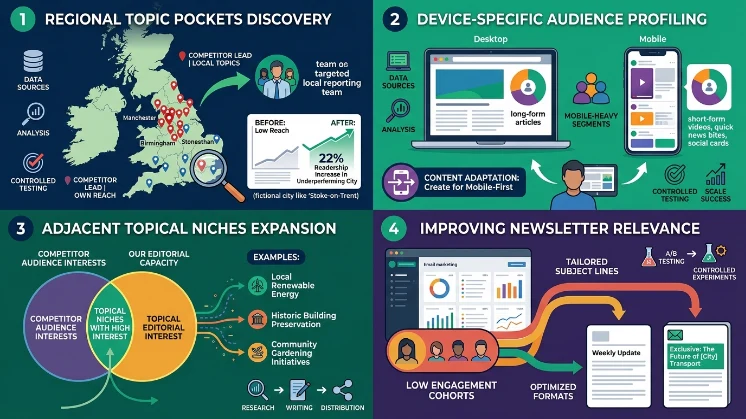
Use cases include discovering regional topic pockets, finding device-specific audiences, expanding into adjacent topical niches, and improving newsletter relevance for low-engagement cohorts.
Regional discovery identifies areas where competitors lead on local topics and your reach is low, enabling targeted local reporting or distribution. Device analysis uncovers mobile-heavy segments that require short-form content. Adjacent topic expansion reveals niche subjects with high interest in competitor audiences that fit editorial capacity. Newsletter optimisation targets low-engagement cohorts with tailored subject lines and formats. Each use case requires source triangulation and controlled testing before scaling. A regional content push increases local readership by 22% in an underperforming city after targeting an untapped competitor audience segment.
How should teams structure work to scale findings?
Teams should centralise competitor signals, assign segment owners, standardise experiment protocols, and maintain a repository of validated segments and outcomes.
Find Out More:
What First-Party Data Means in 2026 and Why 75% of UK Marketers Prioritise It
Centralise data collection and normalisation in a shared workspace. Assign segment owners responsible for content and distribution experiments. Standardise experiment design, sample sizes, and success thresholds to ensure comparability. Maintain a repository with segment definitions, sources, experiment results, and monetisation outcomes for reuse. Update the repository quarterly based on new competitor signals and market shifts. Content team assigns a segment owner for “urban commuters” who runs monthly format experiments and logs results in the central repository.
Dive Deeper Into This Topic:
Audience Insight Subscription vs One-Off Report: Which Model Fits Your UK Campaign?