
First-party data is information collected directly from an organisation’s audience through owned channels, captured with user consent and stored for exclusive use.
First-party data includes behavioural records, transactional history, subscription details, CRM entries, and direct feedback gathered on owned websites, apps, email lists, loyalty programmes, and offline interactions. Important entities: data subject (individual), data controller (organisation collecting data), and consent record (timestamped permission). In the UK, first-party data must follow UK GDPR and the Data Protection Act 2018 requirements. Examples include website session logs tied to authenticated users, purchase histories from e‑commerce checkouts, and responses to post-purchase surveys.
How is first-party data collected?
First-party data collection uses owned digital and offline touchpoints with explicit or implied consent recorded and linked to user identifiers.
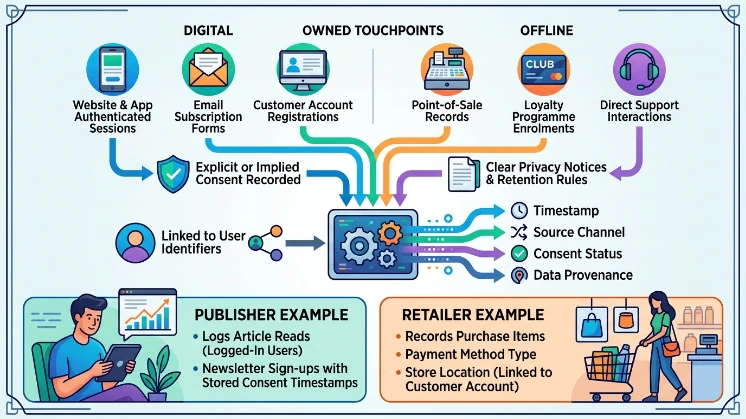
Collection methods consist of authenticated sessions on websites and apps, email subscription forms, customer account registrations, loyalty programme enrolments, point-of-sale records, and direct support interactions. Each record must capture metadata: timestamp, source channel, consent status, and data provenance. Collection processes require clear privacy notices and retention rules. A publisher logs article reads for logged-in users plus newsletter sign-ups with stored consent timestamps. A retailer records purchase items, payment method type, and store location linked to a customer account.
Which components make up first-party data?
Components include identifiers, behavioural events, transactional records, profile attributes, and consent metadata stored in secure systems.
Identifiers are persistent keys such as hashed emails, customer IDs, or device IDs. Behavioural events are pageviews, time-on-page, click events, and app sessions. Transactional records are purchases, returns, and subscription changes. Profile attributes include demographics, stated preferences, and declared interests. Consent metadata records who consented, when, and which processing purposes were allowed. Data storage systems include CRM platforms, CDPs (customer data platforms), analytics databases, and secure data warehouses. Example: a news site’s CDP contains hashed email, articles read, frequency of visits, subscription tier, and consent for marketing emails.
Why do 75% of UK marketers prioritise first-party data in 2026?
UK marketers prioritise first-party data because privacy regulations, browser changes, and advertising ecosystem shifts make owned data the most reliable and compliant source for audience insight.
Recent policy changes reduced reliance on third-party cookies and tightened attribution pathways. First-party data provides direct measurement of audience behaviour under lawful bases. It supports precise audience segmentation, personalised content, and attribution models compatible with UK GDPR. Marketers seek lower data acquisition cost per insight and higher data quality. Example: a media buyer replaces cross-domain cookie matching with logged-in user behaviour and email-based activation. Example: a retailer uses loyalty programme records to forecast product demand and reduce waste.
What are the legal and ethical requirements?
Legal obligations require lawful processing, clear consent records for marketing, data minimisation, purpose limitation, and secure storage consistent with UK GDPR.
Organisations must document legal bases: consent, contract performance, or legitimate interests. Consent must be granular, informed, and withdrawable. Data minimisation requires collecting only what is necessary for stated purposes. Purpose limitation prevents reuse without new lawful basis. Organisations must perform data protection impact assessments for high-risk processing. Data subject rights include access, rectification, erasure, and data portability. Secure storage uses encryption, access controls, and retention schedules. Example: a subscription service encrypts stored payment tokens and anonymises behavioural logs after 24 months unless renewed consent exists.
How is first-party data processed and activated?
Processing pipelines ingest raw events, unify identifiers, enrich profiles, and expose segments for analytics and activation while preserving consent and audit trails.
Ingestion collects events from websites, apps, offline systems, and APIs into a central store. Identity resolution links events to persistent identifiers using deterministic matching (emails, account IDs). Enrichment adds attributes from surveys or transactional feeds. Segmentation applies rules or models to create actionable cohorts. Activation sends anonymised segments to measurement systems, personalisation engines, or secure marketing channels. Audit trails log every read, write, and export with consent checks. News organisation aggregates article engagement into a loyalty score, then uses that score to personalise homepage content for logged-in users.
What technologies support first-party data management?
Key technologies are customer data platforms, secure data warehouses, consent management platforms, analytics engines, and identity resolution services.
Customer data platforms (CDPs) centralise unified profiles and enable segmentation. Data warehouses store historical records for analytics and modelling. Consent management platforms (CMPs) capture and store permission records. Analytics engines run behavioural attribution and lifetime value analyses. Identity resolution services unify identifiers deterministically and, where allowed, probabilistically under privacy-preserving constraints. Data governance tools automate retention and access policies. Example: an organisation uses a CDP to stream events into a warehouse and a CMP to ensure only consented data flows to marketing channels.
What benefits do organisations gain from first-party data?
Benefits include improved measurement accuracy, higher personalisation precision, lower media wastage, and stronger regulatory compliance.
Measurement accuracy improves because organisations track known users across sessions and channels. Personalisation precision increases with richer behavioural histories and verified profile attributes. Lower media wastage occurs by targeting only engaged audiences rather than inferred cohorts. Compliance strengthens because organisations control consent records and data provenance. First-party insights support revenue forecasting, churn prediction, and content optimisation. Example: a subscription publisher increases retention by 12% after personalising renewal offers based on first-party engagement signals. Example: a retailer reduces abandoned cart rates by using stored purchase history to tailor reminder emails.
What are common use cases in the UK marketing context?
Use cases include personalised content, improved attribution, churn reduction, loyalty programmes, and regulatory-compliant audience activation.
Publishers personalise article recommendations for logged-in readers using reading histories. Retailers match loyalty purchases to inventory planning for regional promotions. Marketers build deterministic audiences for cross-channel campaigns using hashed identifiers. Email teams tailor cadence and creative based on engagement recency and frequency. Analysts use first-party purchase data to calculate customer lifetime value and feed models for acquisition budgeting. All use cases require documented consent and retention practices. Example: a charity segments donors by donation frequency and uses first-party contact history for stewardship communications.
How do organisations measure success with first-party data?
Success metrics include retention rate, cohort LTV, conversion rate uplift from personalised treatments, data coverage percentage, and compliance audit pass rates.
Retention rate tracks repeating users or customers over defined intervals. Cohort lifetime value measures revenue per cohort over time. Conversion rate uplift compares personalised audience treatments to control groups. Data coverage percentage measures the share of active users with persistent identifiers. Compliance audit pass rates reflect documented consent completeness and adherence to retention rules. Analytical frameworks combine A/B tests and holdout groups for causal measurement. Example: a media owner tests personalised newsletters against generic versions and measures a 9% uplift in subscription conversions.
Explore More Expert Insights:
How the UK’s 30% E-commerce Retail Share Is Reshaping Audience Expectations
Why AI Referral Traffic Has Higher Purchase Intent Than Organic UK Search
What challenges exist and how are they addressed?
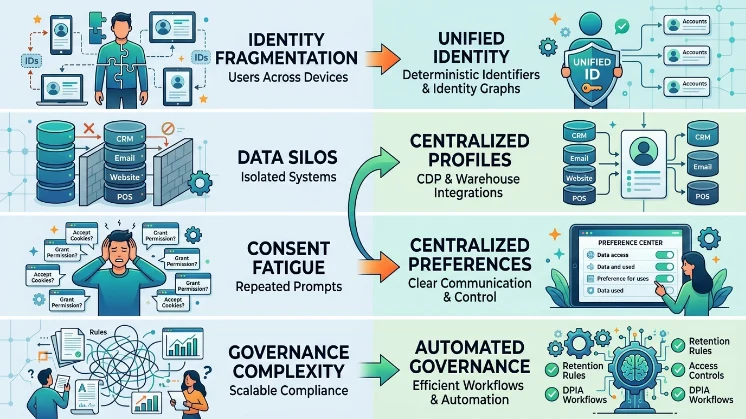
Challenges include identity fragmentation, data silos, consent fatigue, and governance complexity; solutions require unified IDs, centralised platforms, clear privacy communication, and automation.
Identity fragmentation arises from users interacting across devices and channels. Address this with deterministic identifiers and secure identity graphs. Data silos occur when systems do not share unified profiles. Consolidate with CDPs and warehouse integrations. Consent fatigue emerges from repeated prompts; address with concise notices and preference centres. Governance complexity grows with scale; automate retention rules, access controls, and DPIA workflows. Example: a national retailer reduces fragmentation by requiring account sign-in for loyalty rewards and syncing point-of-sale data with online profiles.
What trends will shape first-party data in 2026 and beyond?
Trends include increased legal stringency, wider adoption of privacy-preserving measurement, richer consented profile signals, and stronger integration between first-party data and in-house modelling.
Regulators continue to require transparent processing and stringent consent standards. Privacy-preserving measurement, such as aggregated reporting and differential privacy, becomes standard for cross-channel attribution. Organisations expand consented profile signals through voluntary preference sharing and value exchange mechanisms. In-house modelling replaces many third-party measurement functions. Marketers rely on cohort-level attribution reports instead of individual-level third-party matching.
Get Detailed Information Here:
How to Use Competitor Audience Data to Find Untapped UK Reader Segments
First-party data in 2026 is defined by direct collection, strict consent records, and centralised management for lawful activation. UK marketers prioritise it because it delivers reliable audience insight, lawful targeting, and measurable business outcomes under current regulatory and ecosystem constraints. Organisations build value by unifying identifiers, automating governance, and using first-party signals for personalised experiences and robust measurement.
Check Out the Full Article:
Audience Insight Subscription vs One-Off Report: Which Model Fits Your UK Campaign?