
Contextual targeting places ads based on page content and context rather than tracking individual user cookies, using real-time content signals, taxonomy, and semantic analysis. Contextual targeting analyses the text, metadata, images, and page structure to determine relevant ad placements. Cookie-based retargeting uses third-party identifiers stored in browser cookies to follow individual users across sites and show ads based on their browsing history.
Contextual systems classify content into categories and topics using keyword matching, semantic natural language processing (NLP), and image recognition. Cookie-based systems rely on cookie IDs, match tables, and user-level profiles. Contextual targeting defines the advertising environment cookie retargeting defines the audience.
Why did UK brands move away from cookie-based retargeting by 2026?
Regulatory changes, browser restrictions, and advertiser performance needs eliminated broad third-party cookie usage and accelerated adoption of contextual targeting. The UK implemented stricter data-protection interpretations and enforcement after 2020, increasing requirements for lawful bases and transparency for cross-site tracking.
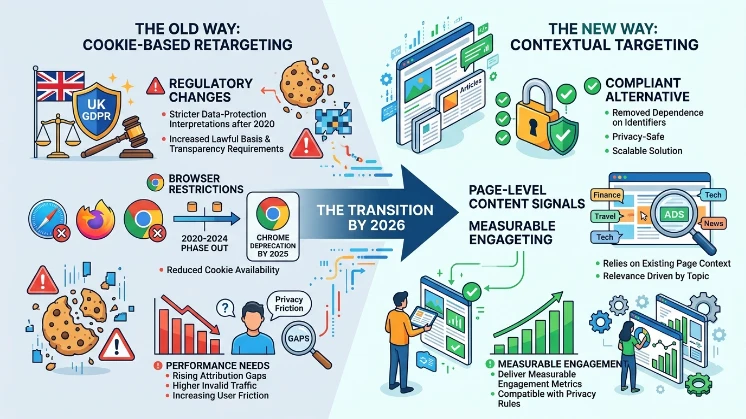
Major browsers phased out third-party cookies between 2020 and 2024; by 2025, Chrome completed its deprecation. As cookie availability fell below operational thresholds, retargeting effectiveness declined. Advertisers reported rising attribution gaps, higher invalid traffic, and increasing privacy friction for users. Contextual targeting offered a compliant, scalable alternative. It removed dependence on identifiers, relied on content signals already accessible at the page level, and delivered measurable engagement metrics compatible with privacy rules.
How does contextual targeting work technically?
Contextual targeting uses content classification engines that combine keyword matching, topic modeling, NLP, and image recognition to map pages to ad taxonomies in real time. At page load, a contextual engine extracts visible text, metadata, headings, and image descriptors. The engine applies tokenisation, stop-word removal, and stemming, then runs classifiers trained on labeled topic data.
Modern systems integrate transformer-based NLP models to capture semantic meaning and sentiment. Image classifiers create contextual cues from visuals and alt text. The outcome is a topical score vector that maps to ad categories and safety labels. Ad decisioning systems then match available creative to the topical vector and publisher inventory slots. Contextual bid optimisation adjusts bids using historical engagement rates per topic, time-of-day, and placement. Systems maintain logs for measurement and frequency capping without storing user-level identifiers.
What components make up a contextual targeting system?
A contextual targeting system includes a content crawler, classification engine, taxonomy mapping, creative matching, bid optimiser, and reporting module. The content crawler fetches page text and metadata in real time or near-real time. The classification engine applies NLP and image models to derive topic labels and safety scores.
The taxonomy maps labels to standardised ad categories used by demand-side platforms (DSPs). The creative-matching component selects suitable ads by format, size, and topic relevance. The bid optimizer uses historical engagement matrices to set bid prices per category and placement. The reporting module aggregates metrics: viewable impressions, clicks, conversions, and contextual performance by taxonomy. Each component operates without third-party cookies by design. Data flows remain aggregate and page-centric to align with privacy regulation.
What measurement and attribution methods work without cookies?
Measurement relies on deterministic first-party signals, aggregated modeling, server-side logging, and conversion APIs for attribution.
Advertisers use server-to-server conversion APIs to receive event data tied to hashed first-party identifiers or order IDs. Aggregated measurement uses cohort-level modeling to estimate lift and reach across topics and placements.
Multi-touch attribution shifts to probabilistic models that use time windows, page topics, and publisher-level data. Publishers supply viewability and placement metadata. Conversion modeling uses algorithmic matching between ad exposure windows and conversion events at the aggregate level, with differential privacy or k-anonymity applied when required. These methods remove the need for third-party cookies and maintain compliance with UK privacy guidance.
What are the performance differences between contextual targeting and cookie retargeting?
Contextual targeting delivers similar or better engagement for intent-aligned content categories, reduces invalid traffic, and improves brand safety compared with cookie retargeting. Studies and campaign analyses across UK publishers show contextual targeting increases view-through rates in topic-relevant environments such as finance, health, and travel. Contextual placements reduce wasted impressions tied to bot traffic that targeted cookies sometimes captured. Click-through rates vary by category, with topical matches delivering 10–40% higher CTRs than non-contextual placements in matched articles.
Conversion rates depend on funnel stage: lower-funnel retargeting that historically used cookies yields higher direct conversion lift for immediate purchase intent, while contextual excels at awareness and mid-funnel engagement. Overall return-on-ad-spend improves when contextual optimisation aligns creative and bid strategies to publisher topics.
What governance and privacy safeguards support contextual targeting?
Contextual targeting avoids cross-site tracking, uses page-level signals, applies content safety labels, and stores only aggregate performance data to protect privacy. Because contextual systems operate on content rather than user identifiers, they avoid personal data processing for ad decisioning.
Classification algorithms produce safety labels (for adult content, hate speech, or misinformation) and topical tags. Publishers implement consent frameworks for first-party data; contextual targeting functions independently of consent gates when it solely uses publicly available page content. Reporting is aggregated by category, date, and publisher to prevent re-identification. UK regulators recommend minimizing retention of any linkage between ad exposure and personal data; contextual systems adhere to this by design.
What are common use cases for contextual targeting among UK brands?
UK brands use contextual targeting for awareness campaigns, topical product launches, local market outreach, and content-aligned promotions in news and lifestyle verticals. A national retailer places fashion ads within articles tagged as seasonal style or event-specific coverage. A financial services advertiser places explanatory content ad formats next to personal finance explainers.
A travel operator uses destination guides to surface banner placements for region-specific offers. Local councils run public-health information within health news sections to improve message relevance. Contextual targeting performs particularly well in editorial environments where topical alignment increases user receptivity.
Explore More Expert Insights:
The UK Holds the World’s Highest E-commerce Retail Share: Why Display Advertising Wins
Generative AI Is Pushing Search Budgets to Display: What UK Advertisers Need to Know
How should UK marketers transition from cookie retargeting to contextual strategies?
Marketers should audit current retargeting plans, map campaign objectives to topical taxonomies, test contextual creative, and measure using aggregated conversion APIs. Begin with an inventory of active retargeting audiences and identify the objectives tied to each segment: awareness, consideration, or conversion.
Translate those objectives into topical targets using a taxonomy aligned with publisher categories. Develop short, topical creative variations tailored to article themes and perform A/B tests across placements. Use server-side conversion APIs and cohort-level measurement to track performance. Adjust bid strategies using topic-level engagement data, not user IDs. Maintain documentation for compliance and vendor selection based on transparency and measurement capabilities.
What limitations should marketers expect with contextual targeting?
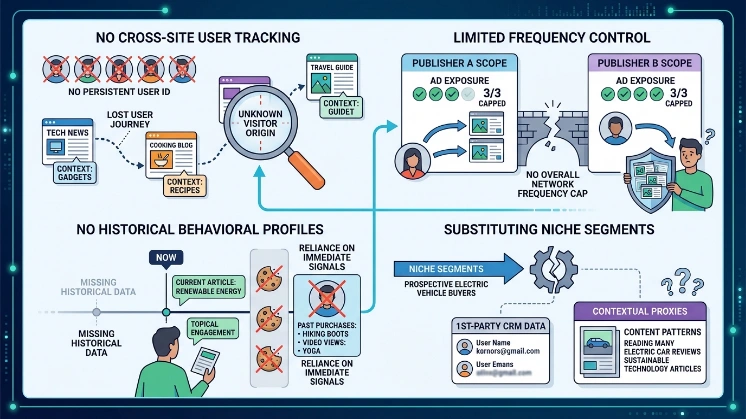
Contextual targeting does not offer persistent user-level frequency control, precise cross-site audience stitching, or historical behavioral profiles; advertisers must rely on publisher inventory and aggregated modeling. Contextual systems cannot reconstruct detailed user journeys across domains.
Frequency capping manages exposures within publisher scopes but not reliably across networks without first-party integrations. Historical behavioral signals tied to cookies are unavailable; advertisers must substitute topical engagement signals and first-party CRM data where lawful. Some niche audience segments defined purely by behavior will require alternative first-party activation strategies or contextual proxies built from content consumption patterns.
Read More to Understand Better:
How to Write Banner Ad Copy Under 10 Words That Converts in a UK News Context
Contextual targeting replaced cookie-based retargeting for UK brands by using page-level content signals, taxonomy mapping, NLP, and image analysis to match ads to relevant environments. The shift followed regulatory changes, browser cookie removals, and advertiser needs for compliant measurement. Contextual systems include crawlers, classification engines, bid optimisers, and reporting modules that operate without third-party cookies. Measurement relies on aggregated modeling and conversion APIs. Performance favors contextual targeting for awareness and content-aligned engagement, while lower-funnel behavioral specificity requires first-party integrations. UK brands transition by mapping objectives to topical taxonomies, testing creative, and adopting server-side measurement.
Get the Full Insights Here:
Banner Advertising Packages for UK Brands: Formats, Placements and Pricing Tiers