
Banner ads are rectangular digital images or HTML elements that display a concise message and link; streaming services use them to highlight free trials, trial length, and viewing features to drive signups.
A banner ad is a defined ad unit placed on web pages, apps, or video players. It includes an image, headline, short copy, and destination URL. Banner dimensions follow industry standards such as 300×250, 728×90, and 320×50. Streaming services place banners on publisher sites, content recommendation widgets, and within apps. The ad presents trial length in days (e.g., 7, 14, 30) and essential qualifiers such as availability by region, device compatibility, and content categories. Banners operate on cost models: cost-per-thousand impressions (CPM), cost-per-click (CPC), and cost-per-acquisition (CPA). Streaming teams select models based on campaign goals: awareness favors CPM, acquisition favors CPA.
How do banner ads fit into the trial acquisition funnel?
Banner ads serve top-of-funnel reach and awareness, introducing trials to large audiences while directing interested users to trial landing pages for signup.
At the top of the acquisition funnel, banners expose audiences to a trial offer. Impressions build recognition across sites with high daily traffic and relevant contexts such as entertainment news, lifestyle blogs, and device review pages. Click-throughs send users to trial-specific landing pages that capture email, payment details, and consent for recurring billing after the trial. Conversion tracking uses pixel-based events and server-side APIs to record trial starts and trial completions. Metrics include impressions, click-through rate (CTR), trial-start rate, and cost per trial start. Campaign teams iterate creatives and placements based on these metrics.
Which targeting methods increase trial signup rates from banner ads?
Targeting uses demographic filters, behavioral segments, contextual signals, and device targeting to reach audiences with high trial propensity.
Demographic targeting includes age bands and household composition typical for streaming consumption. Behavioral targeting uses prior content engagement signals such as frequent visits to film review pages or search queries for series titles. Contextual targeting matches banners to pages discussing TV, films, or entertainment hardware. Device targeting focuses on connected TVs and mobile devices for trial activation ease. Geographic targeting restricts campaigns to service-available regions such as the United Kingdom. Frequency caps limit impressions per user to prevent ad fatigue. Lookalike audiences replicate traits of existing trial starters using first-party data.
What creative elements in a banner ad improve trial signups?
Effective banners present a clear offer (trial length and value), strong visual hierarchy, readable font, and a direct landing link to the trial signup page.
A banner displays the trial duration in numeric form, for example, 14 DAYS FREE. Visual hierarchy places the offer line at the top, supporting copy below, and the link area or button at the bottom-right. Use of high-contrast colors improves legibility on desktop and mobile. Images show representative content types (drama, sport, documentary) using royalty-free or owned visuals. Copy limits to one short sentence and one numeric offer line. Accessibility includes alt text for images and a minimum font size for mobile readability. Designers optimise file size to under 150 KB for fast loading.
How do landing pages linked from banner ads convert trial signups?
Landing pages present the trial offer, required inputs, trust signals, and a concise signup flow to convert banner visitors into trial starters.
Landing pages mirror the banner message to maintain message match. They list trial length, device compatibility, and regional availability in short, factual lines. Forms request essential data only: email, password, and payment method if required by the trial policy. Trust signals include privacy statements and clear billing information explaining charges after trial expiration. Conversion tracking tags record form submissions and trial starts for attribution. Page load time targets under 3 seconds to reduce abandonment. A/B tests compare short-form versus extended-form landing pages to determine which yields higher trial-start rates.
How do streaming services measure the effectiveness of banner-driven trials?
Effectiveness uses conversion metrics CTR, trial-start rate, cost per trial, trial-to-paid conversion, and retention after trial, measured with ad pixels and server-side attribution.
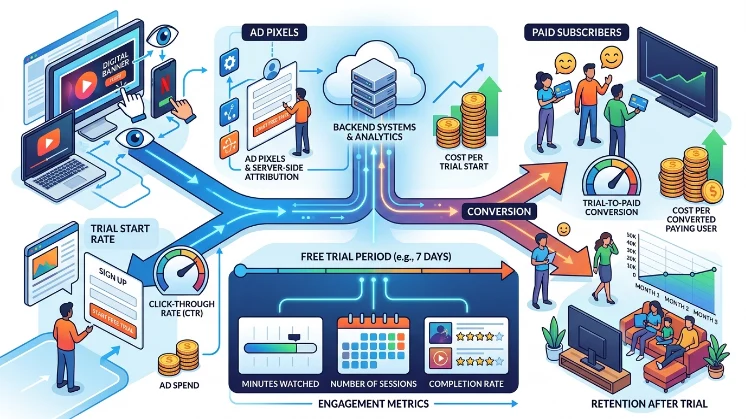
Primary metrics include CTR, percentage of clicks that result in trial starts, cost per trial start, and cost per converted paying user post-trial. Trial-to-paid conversion measures the share of trial starters who supply payment and remain after the trial end. Retention metrics track engagement during the trial: minutes watched, number of sessions, and completion rate of promoted content. Ad platforms supply impression and click data; backend systems supply trial-start and billing data. Ad attribution aligns ad impressions with trial starts using deterministic identifiers (email or user account) when available, and probabilistic models otherwise.
Which campaign structures support scalable trial acquisition with banners?
Campaigns use layered structure, broad-awareness placements, targeted prospecting segments, and sequential retargeting to guide users into trial signups.
Layer one focuses on reach with contextual placements across high-traffic domains. Layer two narrows to interest cohorts and lookalike audiences for improved CTR. Layer three retargets users who clicked but did not sign up; retargeting banners emphasise trial benefits and urgency, for example, “Start your 14-day free trial today.” Frequency caps and creative rotation prevent ad fatigue. Budget allocation shifts toward placements and creatives with the lowest cost per trial start. Automated bidding strategies optimise for trial starts or downstream revenue.
What privacy and compliance considerations apply when promoting trials with banners?
Campaigns must comply with regional data rules, provide transparent billing disclaimers, and secure consent for tracking and recurring payments.
In the United Kingdom, digital advertising must align with data protection rules and cookie consent frameworks. Banners do not store personal data; tracking requires explicit consent for cookies that enable cross-site measurement. Landing pages display clear billing terms: whether payment is required at signup and the date when charges begin after trial. Payment collection follows strong customer authentication (SCA) where required. Consent records and transaction logs maintain audit trails for compliance.
Explore More Expert Insights:
How OTT Platforms Grow Subscribers Using Banner Advertising
How Entertainment Platforms Increase Subscribers With Banner Ads
What are common use cases where banner-driven trial acquisition performs well?
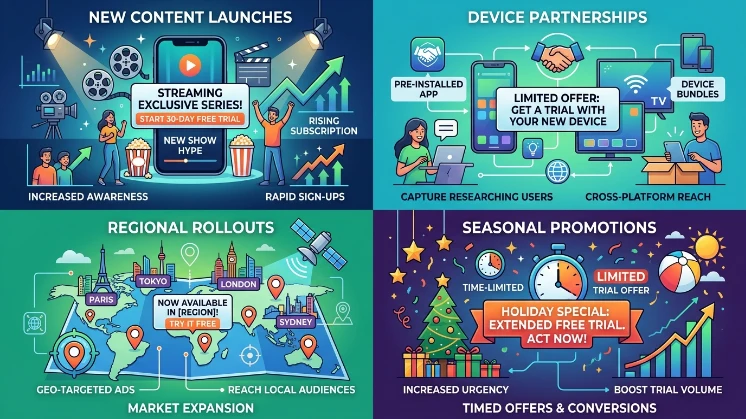
Banner-driven trials perform well for new content launches, device partnerships, regional rollouts, and seasonal promotions that increase user interest and urgency.
When a service releases a high-profile series, banners on entertainment and news sites create rapid awareness across target audiences. Device partnerships place banners within device stores or review pages to capture users actively researching devices. Regional rollouts use geo-targeted banners to reach local audiences during launch windows. Seasonal promotions such as holiday viewing windows use limited-time trial offers to increase trial volume and subsequent paid conversions.
How do banner ads interact with other channels to improve trial signups?
Banner ads provide reach and retargeting signals that integrate with email, social, and in-app messages to nurture trial-ready users into trial starts.
Click behavior from banner ads feeds CRM systems that trigger follow-up emails for users who began but did not complete signup. Retargeting audiences built from banner clickers receive sequential creatives across social platforms and publisher exchanges. In-app messaging and push notifications address users who installed an app after clicking a banner but did not start a trial. Synchronised messaging across channels preserves message match and reduces friction in the signup path.
For deeper exploration of mid-funnel display tactics and conversion-focused display strategies, see the following:
How Streaming Services Increase Watch Intent Using Display Ads
Banner ads act as a scaleable top-of-funnel channel to increase trial awareness and trial starts. They require precise targeting, clear numeric offers, optimised landing pages, and measurable attribution. Campaign success depends on defined metrics CTR, cost per trial, trial-to-paid conversion, and retention and on compliance with regional consent and billing rules.
Get Detailed Information Here:
Streaming Display Ads That Convert Watch Intent Into Active Users