Banner advertising on OTT platforms is static or animated visual ads placed within streaming interfaces to drive awareness and conversions; they appear on home screens, content detail pages, and player overlays.
Banner advertising refers to image-based promotional units delivered inside over-the-top (OTT) streaming environments. Important entities: OTT platform (service delivering video over the internet), streamer interface (user-facing screens: home, category, search, player), ad inventory (slots available for banners), and ad server (system that delivers and tracks banners). Banner formats include hero banners (large, full-width), card banners (thumbnail-sized on grids), and overlay banners (small panels over video). Banner delivery uses programmatic systems or direct insertion and targets viewers by device type, geography, and behavioural segments. Examples: a hero banner on a streaming home screen; an overlay banner during paused playback.
How do OTT platforms use banners to attract new viewers?
Platforms place prominent banners on discovery surfaces to increase impressions and drive first-time engagement by highlighting content value and availability.
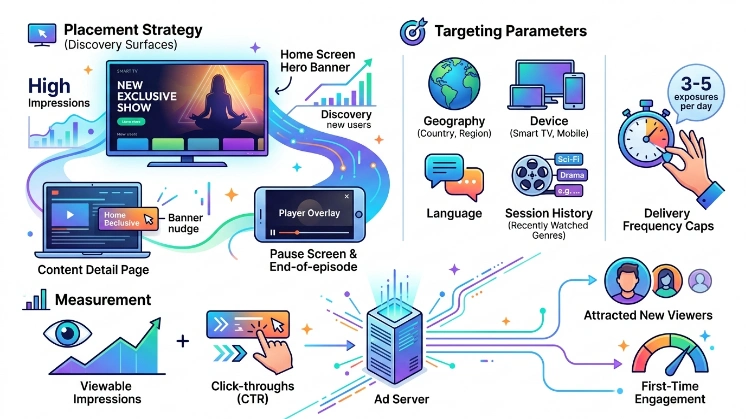
Placement strategy focuses on discovery surfaces where new users browse. Home screen hero banners command the highest visible area and deliver the most impressions per session. Content detail banners provide contextual nudges when users inspect shows and films. Player overlays expose engaged viewers at moments of high attention, such as pause screens and end-of-episode transitions.
Targeting parameters include geography (country, region), language, device (smart TV, mobile), and session history (recently watched genres). Delivery frequency caps limit how often a viewer sees the same banner within a time window, commonly set to 3–5 exposures per day. Measurement uses viewable impressions and click-throughs tracked by the ad server.
What metrics show banners drive subscriber acquisition?
Key metrics include impressions, viewable rate, click-through rate (CTR), engagement rate, conversion rate (trial starts or registrations), and cost per acquisition (CPA).
Impressions count total banner displays. Viewable rate reports the share of impressions meeting viewability standards (minimum 50% of pixels visible for one second). CTR equals clicks divided by impressions. Engagement rate expands CTR to include interactions such as hover and expand actions. Conversion rate tracks actions after a banner click: free trial sign-ups, account creations, or subscription purchases. CPA divides ad spend by number of conversions. Attribution windows commonly span 7–30 days for subscription actions. Lift studies compare exposed and unexposed cohorts to isolate banner impact on acquisition. Real examples include measurement that shows a 0.5–1.5% CTR for hero banners and conversion lifts of 10–25% in exposed cohorts in controlled tests.
How do targeting and personalisation work for OTT banner campaigns?
Targeting uses user attributes (demographics, geography), device type, and behavioral signals (viewing history, search) to personalise banner content and placement.
Platforms ingest first-party signals such as watch history and session frequency to create segments: casual viewers, binge watchers, genre-specific fans. Device targeting differentiates layouts and creatives for smart TVs, mobile apps, and web players. Geographic targeting restricts campaigns to regulatory or licensing territories. Contextual targeting selects banners for specific content pages or genres. Personalisation engines select creatives using rules or machine learning to match recommended content with viewer preferences. Frequency capping and rotation ensure creative freshness. Examples: serving drama-focused hero banners to viewers who watched three drama titles in the past 14 days; showing a compact overlay to mobile users during playback.
What creative elements improve banner performance?
High-performing banners use clear headlines, strong imagery from the show, concise value statements, explicit availability cues, and readable typography tailored to screen size.
Headlines use 4–8 words. Imagery uses key art or stills featuring lead talent. Value statements communicate availability and format: number of seasons, exclusive label, or free trial terms. Call-to-action text uses direct verbs such as “Watch,” “Start,” or “Play” but must be informational in TOFU content. Contrast ensures legibility on TVs and mobile screens. Animated banners use short loops of 2–5 seconds to increase attention without distracting. Localisation adapts language and date formats for regional audiences. A/B testing compares alternative headlines, images, and overlays to determine which creative yields higher CTR and conversion within a 14-day test window.
What technical systems support banner delivery and measurement?
Ad servers, DSPs, SSPs, and analytics platforms coordinate delivery, targeting, bidding, and reporting for OTT banner campaigns.
The ad server holds creative assets and serves banners to registered ad slots. Supply-side platforms (SSPs) expose inventory for programmatic buyers. Demand-side platforms (DSPs) bid on inventory using targeting signals. Identity or hashing systems map device identifiers, hashed emails, or anonymous segments to enable frequency caps and reporting without exposing PII. Analytics platforms collect viewability, CTR, and downstream conversion events from registration and billing systems. Logging uses event timestamps, slot identifiers, and creative IDs to enable deterministic attribution. Server-to-server APIs pass conversion events back to ad systems within the selected attribution window. Standards like VAST and VPAID for video extend to overlay and player-integrated banners when applicable.
What privacy and regulatory constraints affect OTT banner campaigns in the UK?
Campaigns must comply with UK data protection rules, require lawful bases for processing personal data, and implement consent management for targeted advertising.
Important constraints include the UK GDPR and the Data Protection Act 2018. Advertisers must establish lawful basis: consent for personalised advertising or legitimate interests with appropriate balancing tests for non-sensitive profiling. Consent frameworks capture preferences at account creation and within app settings. Anonymisation and hashing reduce exposure to personal data; however, hashed identifiers are still treated as personal data in many interpretations. Opt-out mechanisms and clear privacy notices are mandatory. Measurement must preserve user privacy by using aggregated reporting where required. Advertising frequency and content must also follow ASA guidelines for misleading claims. Examples: requiring explicit consent before using watch history for personalised banner targeting; providing a clear privacy link in account settings.
What benefits do banners deliver for audience growth?
Banners increase top-of-funnel awareness, improve content discovery, reduce time-to-first-play, and create measurable conversion pathways from exposure to trial registration.
Awareness gains stem from repeated exposures on high-traffic surfaces. Discovery improvements reduce friction between finding and starting a show by linking banners to content detail or playback. Measurable conversion pathways allow teams to link impressions to registrations with defined attribution windows. Banner campaigns scale across device types and geographic segments using programmatic or direct buys. Performance data supports optimisation in creative, placement, and targeting to increase acquisition efficiency over time.
Explore More Expert Insights:
How Entertainment Platforms Increase Subscribers With Banner Ads
How Restaurants Grow Revenue Using Targeted Banner Ads
What are common use cases for OTT banners in subscriber growth?
Use cases include launching new content, promoting limited-time windows, re-engaging dormant accounts, and supporting content-led discovery funnels.
For new content, hero banners highlight premieres and season drops. Limited-time window promotions advertise short free-access periods or curated collections. Re-engagement banners target dormant accounts with reminders of new seasons or curated recommendations. Content-led discovery funnels use sequential banners: an initial hero banner followed by a content detail banner and then a player overlay at first playback to encourage immediate viewing. Each use case relies on specific metrics: impressions and CTR for awareness, conversions for acquisitions, and reactivation rates for dormant accounts.
How do teams optimise banner campaigns over time?
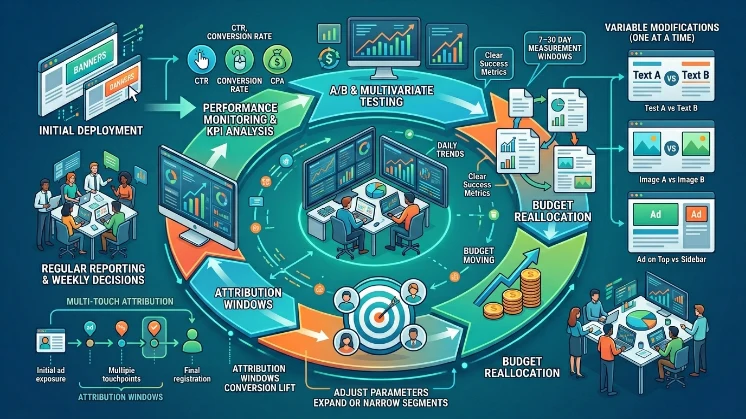
Optimisation uses iterative testing of creatives, placements, targeting parameters, and attribution windows, guided by KPI shifts in CTR, conversion rate, and CPA.
Teams run A/B or multivariate tests with clear success metrics and 7–30 day measurement windows. Optimisation cycles modify one variable at a time: headline, image, or placement. Budget shifts move spend toward high-performing surfaces. Targeting refinements expand or narrow segments based on conversion lift. Attribution analyses test different windows and multi-touch models to assign credit between initial banner exposure and later registration. Regular reporting uses dashboarding to track trends daily and inform weekly optimisation decisions.
For More Details, Explore:
How OTT Platforms Nurture Viewers Using Show-Based Banner Campaigns
Banner advertising on OTT platforms represents a structured method to grow subscriber bases through strategic placement, targeted personalisation, and measurable conversion tracking. Platforms use hero, card, and overlay banners across discovery and playback surfaces. Campaigns require ad server and programmatic systems for delivery and measurement. Compliance with UK privacy rules is mandatory for personalised campaigns. Optimisation proceeds through iterative testing focused on CTR, conversion rate, and CPA to increase acquisition efficiency.
For More Information, Explore:
OTT Campaign Ads That Turn Show Viewers Into Paying Subscribers