An OTT campaign ad that converts viewers directly targets active show viewers with personalised, timed creatives to prompt subscription actions within the platform or via a landing flow. An OTT campaign ad uses over-the-top streaming inventory to reach audiences while they watch shows. It links show consumption signals (episode, genre, watch time) to creative triggers and call-to-action flows. Key entities: OTT platform (streaming app or connected-TV app), ad server, viewer identifier (account ID, device ID), creative (video, banner, interactive card), attribution tag. Conversion means a viewer completes a subscription purchase or completes a subscription activation event tracked by the platform.
How do OTT campaign ads use show-level signals to improve conversion rates?
Campaigns map show-level signals—title, episode, viewing time, completion rate to segmentation and trigger tailored creatives during or after the show. Platforms ingest playback events and assign labels: watched-to-episode X, binge streak Y, paused frequently, rewatch rate Z. Ad decisioning logic matches these labels to creative sets and bid strategies.
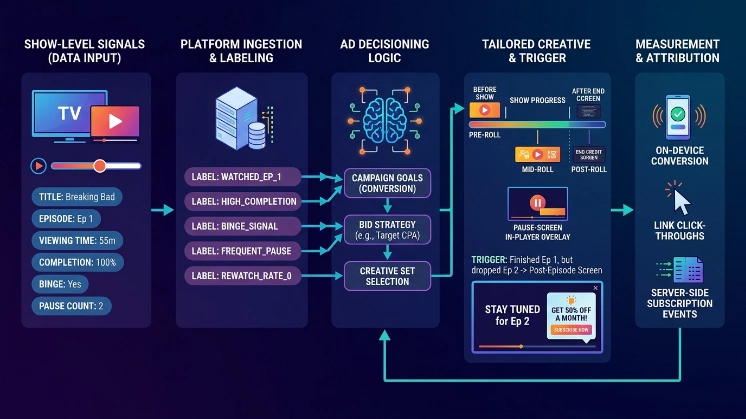
Viewers who finish episode 1 but drop before episode 2 receive a mid-roll offer for a discounted month during the post-episode screen. Creative timing options include pre-roll, mid-roll, post-roll, pause-screen and in-player overlay. Measurement tracks on-device conversion, link click-throughs, and server-side subscription events for attribution.
What components make an effective OTT-to-subscription ad stack?
An effective stack includes identity resolution, real-time decisioning, creative variants tied to show metadata, a fast payment or activation flow, and event-level attribution. Identity resolution links device IDs and logged-in accounts for persistent targeting. Real-time decisioning evaluates viewer state and selects creative within 100–500 milliseconds.
Creative variants use show metadata (title, season, key characters) to create relevance. Payment or activation flows reduce steps: single-click activation inside app, pre-filled account payment, or direct deep link to checkout. Attribution captures impression ID, click ID, and subscription event with timestamp and revenue. Ad server logs, subscription billing API, analytics pipeline exporting daily event-level reports.
Discover More Insights:
How OTT Platforms Grow Subscribers Using Banner Advertising
How do campaign creatives use show context to increase relevance?
Creatives use show context such as genre, characters, and episode moments to craft messaging and visuals that align with the viewer’s current experience. If the viewer watches a crime drama, creatives highlight exclusive crime shows or an ad offering ad-free access to the full crime library. If the viewer watches season finale, creatives reference that final episode and propose a trial to access next-season early. Creative formats include short-form video bumpers, interactive overlays asking “watch next with a trial,” and countdown timers for limited offers. Example: a viewer watching a sports documentary sees an offer tied to live match access available after subscription.
What targeting strategies convert show viewers most efficiently?
High-efficiency targeting uses watch-behavior segments, frequency capping, context cues, and lifecycle stage signals like trial expirations or trial non-activation. Segments include: trial users (trial day 1–7), lapsed subscribers (cancelled within 30 days), high-engagement viewers (average session length >45 minutes), and show-first-time viewers (first episode watched). Frequency caps limit exposures to 2–3 per day per viewer to avoid fatigue. Lifecycle signals trigger reactivation or upgrade creative flows; Trial day 6 sees a discounted-rate renewal creative. Targeting also excludes already-subscribed accounts to prevent wasted impressions. Data refresh cadence runs hourly for near-real-time responsiveness.
What measurement metrics prove ROI for subscription-driven OTT campaigns?
Primary ROI metrics are subscription conversion rate, cost per acquisition (CPA), incremental revenue per user, and churn rate within 30 and 90 days. Subscription conversion rate = subscriptions attributed to campaign impressions or clicks divided by targeted viewers. CPA equals total campaign spend divided by attributed subscriptions. Incremental revenue per user measures additional average revenue directly traced to campaign cohorts versus holdout cohorts.
Churn rates at 30 and 90 days show retention quality. Secondary metrics include view-through rate, click-through rate, and activation funnel completion time. A campaign that achieves a 2.5% conversion rate with £30 CPA and 6‑month retention of 60% yields clearer payback than a campaign with higher conversions but 30% 90-day churn.
Explore the Complete Guide:
How OTT Platforms Nurture Viewers Using Show-Based Banner Campaigns
How does attribution work between ad exposure and subscription events?
Attribution links impression or click IDs to subscription events using deterministic identifiers and server-side reconciliation on a predefined lookback window. Deterministic attribution uses account IDs or login tokens to directly connect an impression to a subscription event. When deterministic linking is not possible, probabilistic models use device signals and time-window heuristics. Standard lookback windows run 1 to 14 days depending on campaign objective.
Attribution must record impression timestamp, creative ID, placement, and revenue event to support incrementality testing. Platform-side server-to-server calls reconcile billing events with ad logs daily. Example: an impression at 20:12 on 2026-05-03 matched to a subscription event at 20:45 on the same day within a 24-hour lookback window.
What pricing and offer structures drive higher conversion for show-viewers?
Effective pricing uses limited-time discounts, tier upgrades with immediate value, and trial-to-paid flows that reduce friction at activation. Limited-time discounts include first-month-for-£1, 7-day free trial, or bundled access to premium shows. Tier upgrades provide concrete value: ad-free playback, early-release access, or exclusive extras for a clear price delta. Trial-to-paid flows require pre-authorisation or single-click billing to minimise steps. Example: a “start 30-day trial with one-tap activation” completes conversion inside the player and increases immediate paid conversions by documented single-digit percentage points compared to external checkout flows.
What creative formats deliver best responses on connected TVs and mobile OTT apps?
Connected TVs perform best with full-screen video ads and interactive overlays; mobile OTT apps perform best with short video, banners in post-roll screens, and deep-link cards. Connected TV creatives must be readable from distance and rely on strong visual cues and short copy. Use post-roll dedicated subscription prompts or single-frame offers during pauses. Mobile OTT benefits from tappable overlays and deep linking to a one-tap checkout. Use 6–15 second creative lengths for pre-rolls and 3–10 second bumpers for in-session messages. Example: a 10-second post-episode offer with a one-tap deep link increases mobile activation rate relative to a multi-step external checkout.
Explore More Expert Insights:
Entertainment Ads That Convert Viewing Interest Into Paid Subscriptions
Mid-Funnel Food Ads That Turn Engagement Into High-Intent Customers
What testing approach produces measurable lift for subscription campaigns?
A/B tests with holdout groups, creative multivariate tests, and channel allocation experiments produce measurable lift when paired with clear KPIs and consistent lookback windows. Holdout experiments require randomised control groups that receive no campaign exposure. Compare subscription rates of exposed cohorts versus holdouts over 14–30 days.
Creative multivariate tests isolate headlines, visuals, and CTA phrasing. Channel allocation tests compare placement types: pre-roll vs post-roll vs pause overlays. Run tests for a minimum of 2–4 weeks or until statistical significance crosses a chosen p-value threshold and minimum sample size. Ensure consistent attribution rules across test and control groups.
What operational steps prepare a platform to run conversion-focused OTT campaigns?
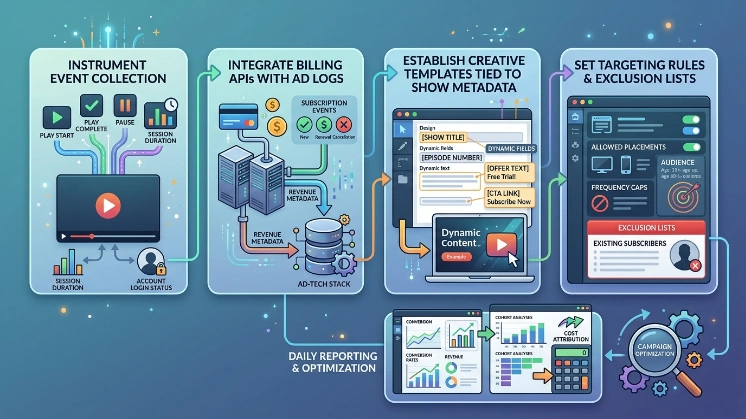
Operational steps include instrumenting event collection, integrating billing APIs with ad logs, establishing creative templates tied to show metadata, and setting targeting rules with exclusion lists. Event collection must capture play start, play complete, pause, session duration, and account login status. Billing API integration exposes subscription events and revenue metadata to the ad-tech stack. Creative templates accept variables: show title, episode number, offer text, and CTA link.
Targeting rules define allowed placements, frequency caps, and audience exclusions (existing subscribers). Daily reporting automates cohort-level performance metrics and cost attribution.