
Banner ads are rectangular digital graphics placed on web pages or apps to promote content; entertainment platforms use them to highlight shows, events, and subscription offers to drive site traffic and subscriber interest.
Banner ads display images, short text, and clickable links. They appear on homepages, article pages, and third-party sites. Sizes follow standard dimensions such as 300×250 pixels and 728×90 pixels. Formats include static JPEG/PNG, animated GIF, and HTML5 rich media. Platforms load banners via ad servers that track impressions and clicks. Placement choices determine visibility and viewability rates. Creative assets include programme titles, episode stills, release dates, and clear visual programme paid access. Inventory planning maps high-traffic pages to premium banner slots.
How do banner ads fit into an entertainment platform’s marketing funnel?
Banner ads serve top-of-funnel awareness by generating impressions and driving users to content pages where subscription conversion paths begin.
Campaigns run across owned properties and external publisher networks. Metrics for funnel placement include reach (unique users), frequency (average exposures per user), and click-through rate (CTR). High reach increases brand recognition; controlled frequency prevents ad fatigue. Ads link to feature pages, trailers, or content previews; those destinations provide further engagement signals. Platforms use first-party data to target cohorts defined by viewing habits, device type, and geographic region. Attribution models commonly use last-click and view-through windows of 1 to 30 days to assign credit for downstream subscription events.
What targeting methods do platforms use for banner ad distribution?
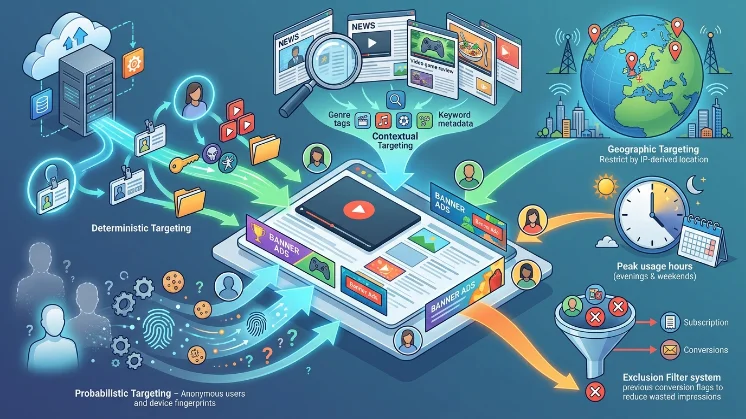
Platforms use deterministic user data and probabilistic signals to target banners by demographics, device, behaviour, and content affinity.
Deterministic targeting uses logged-in profiles and subscription status. Platforms match accounts to interests based on watch history and saved lists. Probabilistic targeting uses cookie and device fingerprinting to infer preferences for anonymous users. Contextual targeting matches banners to page content keywords, genre tags, and metadata. Geo-targeting restricts delivery to specific regions, for example the United Kingdom, using IP-derived location. Time-based targeting schedules ads around peak usage hours, such as evenings and weekends. Exclusion lists prevent serving to current subscribers or previously converted cohorts to reduce wasted impressions.
How do platforms measure banner ad performance and effectiveness?
Platforms measure banner effectiveness using impressions, CTR, viewability rate, engagement time, and downstream conversion metrics such as trial starts and paid subscriptions.
Impressions count served ads; CTR equals clicks divided by impressions. Viewability follows industry standards where at least 50% of pixels display for one second on mobile and two seconds on desktop. Engagement metrics include time on landing page and video plays triggered from the banner click. Conversion metrics include free trial registrations, account creations, payment events, and retention after 30 days. Platforms use tracking pixels and event-level signals to link banner interactions to conversion events. Attribution windows commonly span 7 to 30 days to capture delayed subscription behavior.
What creative components improve the performance of banner ads?
High-performing banners use clear headlines, a single visual focus, readable typography, and concise time or episode cues to drive clicks and engagement.
Headlines state the offer or content in 3 to 6 words. Visuals use a central still or character close-up to convey genre. Secondary text supplies episode number, release date, or exclusive label. Color contrast ensures legibility on small screens. Animation sequences use a 3-second loop to present a hook, then a call-to-action visual. File size stays under 150 KB for fast loading. Alt text and accessible labels support assistive technologies. Variants test different images and copy via A/B experiments to determine lifts in CTR and conversion rates.
How do targeting and creative combine into an effective banner campaign workflow?
Campaign workflows sequence audience definition, creative production, placement selection, trafficking, measurement, and optimisation to deliver measurable subscriber interest.
Teams define target cohorts by demographic and behavioural criteria. Creative teams produce modular assets sized for prioritised placements. Media planners map placements to expected inventory and estimate CPM (cost per thousand impressions). Ad operations upload creatives to ad servers and set targeting rules. Campaigns run for predefined flight dates with daily budgets and pacing controls. Data teams ingest performance logs and produce daily dashboards showing impressions, CTR, and conversions. Optimisation uses rule-driven changes such as reallocating budget to placements with at least 0.2% CTR or pausing creatives below threshold engagement. Iterative testing continues until campaigns stabilise.
What privacy and compliance requirements affect banner ad targeting in the UK?
Banner targeting in the United Kingdom requires adherence to data protection laws, including lawful processing of personal data, cookie consent, and transparent user choice for profiling.
Platforms obtain consent for non-essential cookies through consent management platforms. Logged-in user data uses contract or legitimate interest with clear privacy notices about analytics and advertising. Profiling for behavioural targeting obligates platforms to provide opt-out mechanisms and to respect browser privacy signals such as ITP and ETP. Servers document data retention periods and process access or deletion requests from users. Platforms maintain records of processing activities and perform data protection impact assessments when using sensitive categories for targeting.
What role do A/B tests and experiments play in optimizing banner-driven subscription interest?
A/B tests validate creative and targeting choices by comparing control and variant groups on predefined success metrics such as CTR and trial starts.
Tests randomise users into equal-sized cohorts. KPI definitions include primary metrics (CTR, trial sign-ups) and secondary metrics (time on page, video plays). Statistical thresholds define significance levels, commonly 95% confidence. Experiments run until sample sizes meet power calculations to detect minimum detectable effects, often 5% relative lift. Results inform creative rotation, audience refinement, and placement weighting. Sequential tests refine one variable at a time, for example image swap while holding copy constant, to isolate causal effects.
What operational components support large-scale banner ad programs?
Operational components include ad servers, creative asset libraries, tag management systems, analytics pipelines, and compliance tooling to manage delivery and measurement.
Ad servers schedule delivery and enforce frequency caps. Asset libraries store approved creatives with version control. Tag managers deploy tracking pixels and event triggers across platforms. Analytics pipelines ingest impression and click logs, join with backend subscription events, and compute cohort-based conversion rates. Compliance tooling manages consent statuses and blocks non-compliant ad calls. Monitoring tools detect delivery issues such as latency spikes or creative rendering failures and trigger remediation playbooks.
Explore More Expert Insights:
How Restaurants Grow Revenue Using Targeted Banner Ads
How Food Businesses Improve Visibility Using Banner Ads
What measurable benefits do entertainment platforms see from banner ad campaigns?
Banner campaigns increase awareness, drive traffic to content hubs, generate trial sign-ups, and produce measurable attribution signals that feed subscriber acquisition funnels.
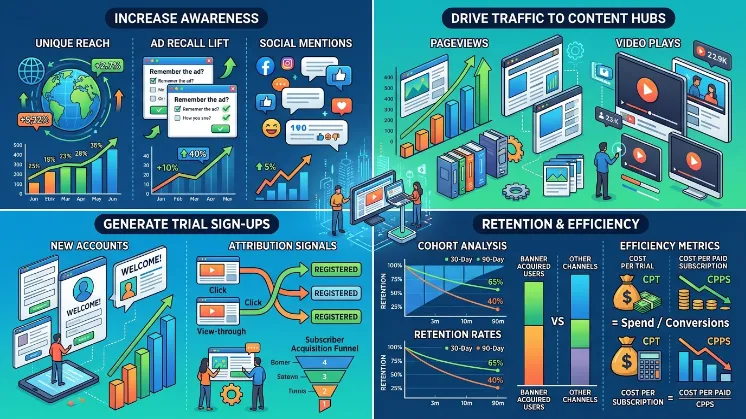
Awareness metrics include unique reach, ad recall lift from survey overlays, and social mentions tied to campaign windows. Traffic increases show percentage lifts in pageviews and video plays for promoted titles. Trial and registration metrics show absolute counts of new accounts attributed via click or view-through paths. Retention analysis compares cohorts acquired through banners to other channels using 30-day and 90-day retention rates. Efficiency metrics include cost per trial and cost per paid subscription calculated from campaign spend divided by conversion counts.
How do platforms use banner ads across content lifecycle stages?
Platforms deploy banners for content discovery, premiere promotion, seasonal events, and catalogue resurfacing to maintain steady audience interest and conversion opportunities.
For new releases, banners highlight premiere dates and episode drops. For seasonal events, banners run thematic creative tied to holidays or sports calendars. For catalogue titles, banners resurface older but high-affinity content to re-engage lapsed viewers. Each lifecycle stage uses tailored targeting, broad reach for launches, narrow affinity segments for catalogue resurfacing, and geo-targeted placements for region-specific premieres.
Explore the Complete Guide:
How Entertainment Platforms Build Subscription Interest Using Banner Ads
Banner ads function as a measurable awareness channel for entertainment platforms. They use standard sizes and formats, deterministic and probabilistic targeting, and well-defined workflows that include A/B testing and compliance controls. Performance tracking links impressions and clicks to downstream trial and subscription metrics. Operational systems support scale and measurement. Together, these elements enable platforms to increase subscriber interest through targeted, measurable, and privacy-conscious banner advertising practices.
Get Detailed Information Here:
Entertainment Ads That Convert Viewing Interest Into Paid Subscriptions