
Mid-funnel food ads target users who demonstrated interest and engagement and guide them toward purchase-ready actions using tailored messaging and measured value propositions.
Mid-funnel food ads sit between awareness and conversion. Top-funnel ads build broad awareness among cold audiences. Mid-funnel ads engage users who viewed content, clicked menus, opened promotions, or visited reservation pages. Bottom-funnel ads address users who added items to cart or initiated booking and require conversion-focused triggers like discounts or booking slots. Mid-funnel ads use richer creative and contextual signals. They present product benefits, menu highlights, limited-time offers, and social proof to raise purchase intent. Mid-funnel targeting relies on engagement events, website behaviour, app activity, and CRM lists. Measurement uses metrics that show intent: repeat clicks, time on menu pages, form starts, and assisted conversions.
What user behaviours indicate readiness for mid-funnel targeting?
Behaviours that indicate readiness include repeat page views, menu interactions, cart starts, promotional clicks, and social engagement from users within the last 7–30 days.
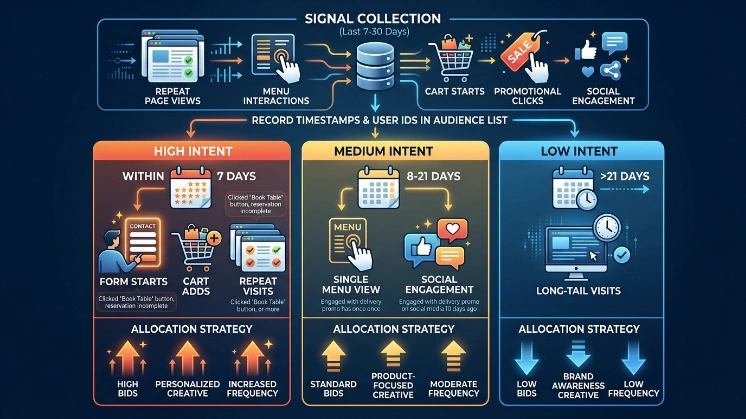
Signal collection must define events precisely. Example signals: a user who viewed the dinner menu twice in 14 days; a user who clicked a “book table” button but did not complete reservation; a user who engaged with a delivery promo on social media 10 days ago. Segment these behaviours into high, medium, and low intent bands. High intent equals form starts, cart adds, or repeat visits within 7 days. Medium intent equals single menu view or social engagement within 8–21 days. Low intent equals long-tail visits beyond 21 days. Use these bands to allocate creative, bid levels, and frequency caps. Record event timestamps and user identifiers in an audience list for precise delivery.
How do you design creatives for mid-funnel food ads?
Design creatives that highlight a single, measurable benefit, use clear value statements, and include a decisive action cue for conversion.
Choose one objective per creative. Examples: “25% off weekday lunches,” “Book a table in 2 minutes,” “Free delivery on orders over £15.” Use product photos focusing on portion and plating. Use short headlines with explicit numbers: “2-course set £12,” “Delivery in 30 minutes.” Include social proof lines: “4.6/5 from 1,200 UK diners.” Match creative to the user segment showcase menu highlights for visitors who viewed menus; show top reviews and booking slots to users who tried to reserve. Test two creative variants per segment for 14 days to compare engagement and assisted conversions. Track click-through rate, add-to-cart rate, and assisted conversion value.
Which targeting and audience strategies work best for mid-funnel food ads?
Best strategies combine event-based retargeting, lookalike layers, and CRM-based audiences filtered by recent engagement and lifetime value.
Event-based lists use specific triggers: menu view, click-to-call, reservation attempt, cart add, and newsletter signup. Create lookalikes from high-intent converters (order placed or reservation completed) at 1% to 3% similarity. Merge CRM audiences with recent engagement windows: only include customers with activity in the last 90 days. Use exclusion lists to remove recent converters and recent bottom-funnel audiences to avoid overspending. Apply frequency caps limit to 3–6 impressions per week per user. Use time decay weighting: assign higher bid multipliers to users with events in the last 7 days and reduce weight at 30 days.
Learn Everything About It Here:
How Restaurants Grow Revenue Using Targeted Banner Ads
What messaging frameworks improve conversion rates in mid-funnel campaigns?
Use a three-part framework: relevance (recent behaviour), value (specific offer), and urgency (time or inventory limit).
Relevance references the user action: “Because you viewed our steaks.” Value states the clear offer: “Starter included with every steak order over £20.” Urgency sets a deadline: “Offer valid this week only.” Present these elements in one sentence or short headline and a supporting line. Test formats with and without urgency and measure conversion lift and cost per conversion. Align landing pages to the same framework to preserve message continuity and lift conversion probability.
How should landing pages for mid-funnel ads be structured?
Landing pages must present the same specific offer, clear action pathways, and at least one social proof element above the fold.
Top elements: headline matching ad copy, one-sentence offer detail with price or savings, a single conversion action (book/order/claim voucher), and a trust signal such as rating or testimonial. Include a secondary information section for menu highlights or delivery details. Reduce navigation friction, remove unrelated links and keep forms to 3 fields or fewer. For reservations, show available slots and an instant confirmation message. For delivery, show estimated lead time and a clear minimum spend. Track assisted conversions using UTM and event tagging to connect mid-funnel influence to eventual sales.
How do bidding and budget allocation differ for mid-funnel ads?
Allocate 20–40% of campaign budget to mid-funnel activity, use CPA or ROAS goals, and apply higher bids for audiences with events in the last 7 days.
Set CPA targets based on historical transaction values. For example, with an average order value (AOV) of £25 and a target ROAS of 3x, acceptable CPA is £8.33. Use bid multipliers by recency: +30% for 0–7 days, +10% for 8–21 days, no uplift beyond 21 days. Use automated bidding when conversion tracking has at least 50 conversions per month; otherwise use manual bids with tight audience segmentation. Reallocate budget weekly toward audiences or creatives that deliver higher assisted conversion value. Pause segments with CPA exceeding target by 20% for two consecutive weeks.
Which metrics prove mid-funnel performance and attribution?
Key metrics include assisted conversions, add-to-cart rate, reservation starts, repeat click-through rate, and conversion path length.
Assisted conversions measure how often a mid-funnel touch contributed to final purchase. Add-to-cart rate shows intent uplift from ads. Reservation starts track form initiation. Repeat click-through rate measures sustained interest. Conversion path length shows number of touchpoints from first interaction to purchase, mid-funnel should reduce path length. Use multi-touch attribution windows of 14 and 30 days to capture influence. Report metrics per audience segment and creative to identify highest-value combinations.
What benefits do food businesses in the UK gain from mid-funnel advertising?
Businesses gain higher-quality leads, lower cost-per-conversion than cold traffic, and increased repeat booking or order rates when campaigns align with purchase triggers.
Must-Read Detailed Guide:
How Food Businesses Improve Engagement Using Mid-Funnel Advertising
Mid-funnel reduces wasted spend on uninterested users. It raises average order value by promoting upsells and set menus. It shortens decision time by presenting timely incentives. It improves lifetime value when used with CRM reactivation. A typical well-structured mid-funnel campaign shows 20–50% higher conversion rates versus top-funnel clicks and reduces cost per sale by 10–30% compared with prospecting traffic.
Explore More Expert Insights:
Review-Based Restaurant Ads That Convert Trust Into First-Time Orders
Food Chain Display Ads That Turn Consideration Into Final Purchases
What UK-specific use cases show mid-funnel success?
Use cases include weekday lunch promotions, reservation recovery for high-demand evenings, delivery incremental offers, and subscription or meal-plan re-engagement.
Weekday lunch promotions target office-area visitors who viewed lunch menus. Reservation recovery retargets users who abandoned bookings for Saturday evenings. Delivery incremental offers present free delivery thresholds to users who added items but did not complete checkout. Subscription re-engagement targets former subscribers who lapsed in the last 90 days with a personalised discount. Measure outcomes by uplift in bookings, delivery orders, and subscription reactivations.
How do businesses connect mid-funnel ads to final sales and CRM workflows?
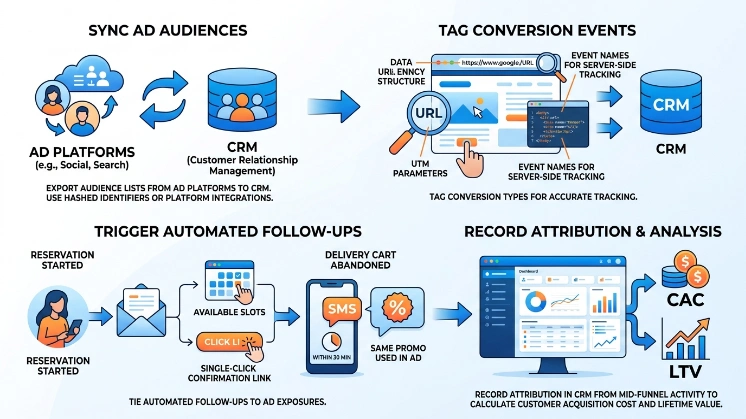
Connect ads to CRM by syncing event audiences, tagging conversion events, and triggering automated follow-up messages tied to ad exposures.
Export audience lists from ad platforms to CRM using hashed identifiers or platform integrations. Tag conversion types with UTM parameters and event names for server-side tracking. When a mid-funnel user starts a reservation, trigger an automated email sequence that includes available slots and a single-click confirmation link. For delivery carts, send an abandoned cart SMS within 30 minutes with the same promo used in the ad. Record attribution in CRM to calculate customer acquisition cost and lifetime value from mid-funnel activity.