Mid-funnel advertising targets users who show interest and evaluates options; it delivers relevant content to increase engagement and move users closer to purchase.
Mid-funnel advertising sits between awareness and conversion. For food businesses identifies people who interacted with top-funnel content (searches, social views, website visits) and provides messages that deepen interest. Audiences (first-party visitors, email lists, lookalikes), ad formats (display banners, native ads, short video), and measurement metrics (engagement rate, click-through rate, time on site). 10,000 recent website visitors segmented by menu page views. Example metric: raise engagement rate from 1.2% to 3.8% within 30 days.
How does the mid-funnel process work?
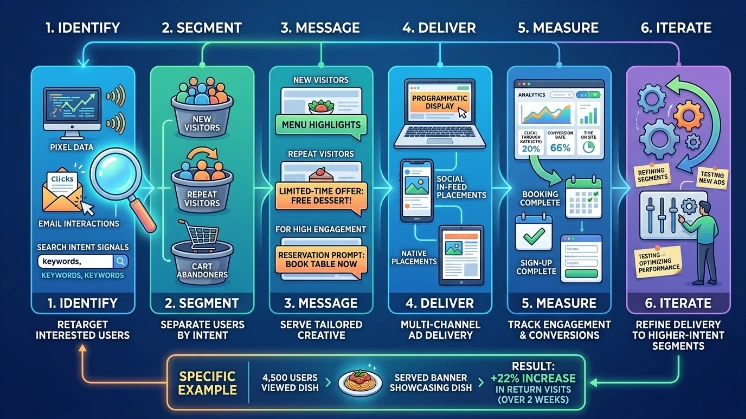
The mid-funnel process retargets interested users, serves tailored creative, measures engagement, and optimises delivery to higher-intent segments.
Process stages: identify, segment, message, deliver, measure, iterate. Identification uses pixel data, email interactions, and search intent signals. Segmentation separates new visitors, repeat visitors, and cart abandoners. Messaging varies by segment: menu highlights for new visitors, limited-time offers for repeat visitors, reservation prompts for high-engagement visitors. Delivery channels include programmatic display, social in-feed placements, and native placements on relevant sites. Measurement focuses on engagement metrics and moving users to lower-funnel actions like booking or sign-up. Segment 4,500 users who viewed a specific dish and served a banner showcasing that dish to increase return visits by 22% over two weeks.
What creative components drive engagement in mid-funnel food ads?
Effective mid-funnel creative links product relevance, clear benefits, and a single measurable action with concise visuals and short copy.
Creative components include imagery (high-quality dish photos, 1200×628 or responsive sizes), headline (8–10 words), body copy (15–25 words), and a contextual visual cue (menu snippet, price, rating). Use dynamic creative that swaps images and copy by segment. Show vegan dish images for users who viewed plant-based menu pages. Include trust signals: review stars, local awards, or delivery time. Ad frequency should limit to 3–5 impressions per user per week to avoid fatigue while maintaining visibility.
Which targeting signals work best for food businesses in the UK?
Primary targeting signals include first-party web events, search intent for dining-related queries, CRM data, and contextual placement on food or local lifestyle pages.
Menu page views, reservation page visits, checkout initiations. Search signals: queries for “nearby restaurants open now,” “best Italian takeaway,” and dish-specific searches. CRM signals: past diners segmented by recency, frequency, and monetary value. Contextual signals: placements on recipe blogs, local event pages, and regional food news. Target users who searched “Sunday roast near me” and visited a venue page within 14 days.
How do you measure mid-funnel engagement for food ads?
Measure engagement using clicks, engaged sessions, dwell time, repeat visits, and assisted conversions across 7–30 day windows.
Click-through rate (CTR), engaged session rate (sessions lasting 15+ seconds), pages per visit, return visitor percentage, assisted conversions (contributions to later bookings), and cost per engaged user. Use attribution windows of 7 and 30 days to track influence. Track incremental lift with holdout groups to quantify impact. KPI target increase engaged session rate from 12% to 28% and reduce cost per engaged user to £1.80 within 30 days.
What optimisation steps improve mid-funnel performance?
Optimise by refining segments, A/B testing creative, adjusting frequency, using sequential messaging, and reallocating spend to high-engagement placements.
Narrow segments by recent behaviour and exclude converted users. A/B tests: compare two headlines, two images, and one call-to-action variation.Cap impressions to avoid ad fatigue while ensuring reach. Sequential messaging: start with product benefit, follow with social proof, then present a conversion prompt. Reallocation move budget from low-engagement placements to top-performing contextual sites. Example optimisation: after testing, shift 30% of spend to a local lifestyle site that delivered a 45% higher engaged session rate.
What role does content play in mid-funnel ads?
Content provides context, nudges consideration, and answers practical questions through menu snippets, short videos, and customer reviews.
Short-form videos (6–15 seconds) highlight signature dishes, kitchen scenes, or chef recommendations. Static ads emphasise menu items, opening hours, and ratings. Copy answers specific user questions: price, dietary options, booking availability. Use localised language and reference neighbourhoods or boroughs in the UK to improve relevance. Content flow a 6-second video introduces the dish, a banner follows with a one-line dietary note, then a native placement presents a testimonial.
How do mid-funnel ads connect to lower-funnel actions?
Mid-funnel ads increase intent by driving site visits, form fills, reservation interactions, and basket completions that feed lower-funnel conversion tactics.
Connect through direct landing pages that contain clear next steps: reservation widget, click-to-call, menu download, or special offer redemption. Pass event data to CRM and ad platforms for lookalike modelling and bid optimisation. Use conversion-focused pages with minimal navigation to lower friction. A Pathway user sees a banner, clicks to a menu page with a fast-book widget, completes a provisional booking, and receives an email reminder.
What compliance and privacy considerations apply in the UK?
Compliance requires clear consent, data minimisation, lawful processing, and transparent opt-outs under UK GDPR and PECR.
Collect consent for cookies and tracking with a compliant CMP. Limit retention to necessary periods and document lawful bases for processing. Provide clear opt-outs in ads and landing pages. Maintain records for data subject requests and support user rights for access and erasure. Store first-party event data for 90 days for retargeting, anonymise after 180 days.
Read the Detailed Explanation:
How Restaurants Grow Revenue Using Targeted Banner Ads
What are practical use cases for mid-funnel advertising in the food sector?
Use cases include driving repeat visits, promoting seasonal menus, reducing booking abandonment, and increasing group bookings for events.
Retarget diners who visited menu pages in the last 60 days. Seasonal menus: promote Christmas or summer menus to segmented audiences. Booking abandonment: follow up users who reached reservation pages but left. Group bookings: target corporate searchers and local event planners with event-specific creative. Each use case pairs a segment with tailored creative and a defined metric, increasing group booking inquiries by 18% in 45 days.
Explore More Expert Insights:
How Restaurants Build Trust Using Review-Based Banner Campaigns
How Food Chains Increase Purchase Consideration Using Display Ads
What budget and timelines suit mid-funnel campaigns?
Allocate 20–40% of the digital ad budget to mid-funnel, run tests for 14–30 days, and scale successful tactics over 60–90 days.
Start with a test budget of £1,000–£3,000 depending on venue size and market. Use 14–30 day test windows to assess engagement metrics and then scale budget by 25–50% for top-performing segments. Reassess monthly to adjust for seasonality. Two-week creative test, two-week optimisation, then eight-week scale phase.
How do you combine mid-funnel ads with organic efforts?
Combine by aligning messaging, reusing creative assets for social posts, and syncing events and menu updates across paid and owned channels.
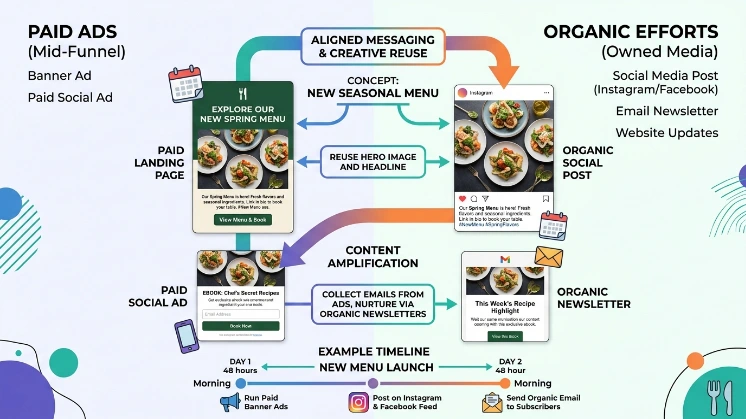
Use the same hero image and headline in ads and on social feeds. Promote mid-funnel content like menu highlights as organic posts to increase earned reach. Collect emails from paid landing pages and nurture through organic newsletters. Run a banner for a new menu and post the same images and copy on Instagram and email within 48 hours.
Complete Details Available Here:
Mid-Funnel Food Ads That Turn Engagement Into High-Intent Customers