Food chain display ads are digital image or rich-media advertisements deployed across web and app inventories to influence purchase decisions at the bottom of the funnel. They deliver product-specific offers, timed promotions, and localisation to convert consideration into sales.
Display ads for food chains are visual placements served on websites, mobile apps, and connected-TV environments. They include static images, animated GIFs, HTML5 rich media, and video assets. Targeting uses first-party customer lists, contextual signals (menu pages, recipe articles), and location data (radius around outlets). Creative focuses on menu items, limited-time bundles, and clear price information. Measurement centers on conversion events: online order completion, in-store redemption, mobile app purchase, and coupon scan.
Key technical components include ad servers, demand-side platforms (DSPs), supply-side platforms (SSPs), and tracking pixels or server-to-server APIs. Data flows connect customer identifiers (email, device ID) to ad delivery systems while preserving consent and privacy compliance. Attribution uses last-click, time-decay, or incrementality testing to tie ad exposure to final purchase.
How do food chains structure display campaigns to convert consideration into purchases?
Campaigns use layered targeting: high-intent audiences, geofencing near outlets, dynamic creative with menu and price, and conversion-focused bidding to maximise completed orders.
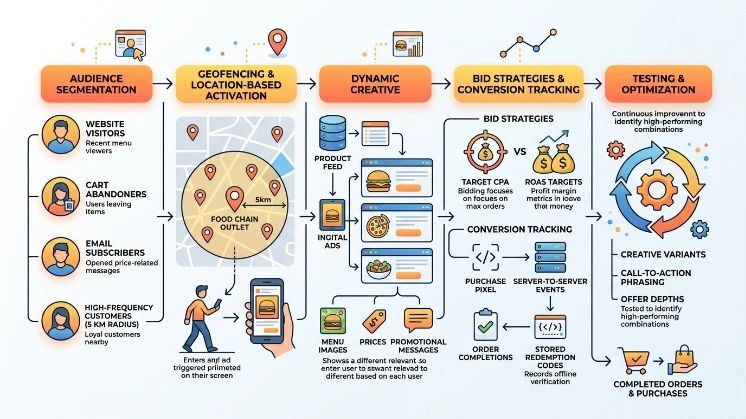
A structured campaign begins with audience segmentation. Segments include recent website visitors who viewed menu items, cart abandoners, email subscribers who opened price-related messages, and high-frequency customers within a 5 km radius. Geofencing activates ads when users enter a predefined perimeter around outlets. Dynamic creative templates pull menu images, prices, and promotional messages from a product feed to show the most relevant item to each user.
Bid strategies align with conversion goals. Examples: target CPA set to the average order value multiplied by profit margin metrics; ROAS targets based on cost-per-order ceilings. Conversion tracking records order completions via purchase pixels or server-to-server events, and stores redemption codes for offline verification. Testing splits creative variants, call-to-action phrasing, and offer depths to identify combinations with the highest conversion rate.
What components must a food chain include in display ad creative to close sales?
Essential components are clear product image, exact price or discount, visible call-to-action with conversion method, outlet availability, and a simple redemption code or deep link.
Product imagery must be high-resolution and cropped for multiple aspect ratios. Price presentation uses specific numbers, e.g., “£6.99” or “£2 off”. Call-to-action directs to a purchase path: deep link to checkout, app order page, or a one-tap voucher claim. Availability notes indicate outlet lists or delivery radius, with precise time windows when the offer applies, e.g., “Lunch 12:00–15:00”. Redeemable voucher codes use short alphanumeric strings to track offline redemptions.
Accessibility elements include alt text and readable typography sized for mobile. Loading performance requires compressed assets and progressive rendering for HTML5 creatives. For measurement, creatives embed unique tracking parameters to identify which design drove the conversion. Real examples include a rotating HTML5 carousel showing a combo meal, price “£8.49”, and a deep link opening the app checkout to the item’s SKU.
How does data and measurement prove display ads cause final purchases?
Measurement combines deterministic conversion events, probabilistic modelling, and incrementality tests to demonstrate causal impact on purchases.
Deterministic tracking links known user identifiers to conversions. Examples: email-hash matching from a CRM to a website order, device ID tied to app purchase. Probabilistic modelling uses aggregated behavior signals to infer conversions when identifiers are unavailable. Incrementality testing runs holdout experiments where a randomly selected control group does not receive display ads while the test group does. Lift is measured as the difference in conversion rates between test and control.
Attribution models allocate credit across touchpoints using rules such as last-click, linear, or algorithmic multi-touch. For gross-lift validation, run an A/B holdout across the same audience segment over a defined period, monitor total orders, and calculate percent lift. Example metric: a 12% lift in completed orders in the test cohort over 30 days, with a corresponding cost-per-new-customer figure.
Privacy-compliant pipelines use consented first-party data, hashed identifiers, and server-to-server event forwarding. Reporting layers include per-offer conversion rate, cost per completed order, and return on ad spend (ROAS) computed from tracked revenue divided by ad spend.
Which bidding and targeting tactics maximise conversion at the bottom of funnel?
Use conversion-optimised bidding, first-party audiences, geotargeted delivery, and time-based scheduling focused on purchase windows to increase completed orders.
Conversion-optimised bidding sets bids around a target CPA or target ROAS derived from historic order values. First-party audiences include recent purchasers and cart abandoners. Geotargeting restricts delivery to areas within delivery radius or walking distance. Time-based scheduling concentrates impressions during high-conversion windows such as lunch (12:00–14:00) and dinner (18:00–21:00).
Bid multipliers adjust for device type and audience recency. Increase bids by 20% for users who opened an order email within 48 hours. Use frequency caps to avoid ad fatigue; set caps to three impressions per user per day for the same creative. Combine CRM retargeting with lookalike segments seeded from top 5% customers to expand reach while preserving conversion intent.
What compliance and privacy requirements apply to food chain display campaigns in the UK?
Campaigns must follow UK data protection laws, use consented first-party data, respect ad preferences, and provide clear opt-outs for personalised advertising.
Compliance rests on the UK GDPR and Privacy and Electronic Communications Regulations (PECR). Collect lawful bases for processing: obtain explicit consent for marketing emails and personalised ads where required and use legitimate interest only with documented assessments. Store hashed email identifiers and minimise data retention to specified business needs, for example, 12 months for retention of retargeting segments.
Provide cookie banners that list purpose-specific choices and granular consent options for advertising cookies. Honour the IAB Transparency and Consent Framework signals where applicable. For cross-device matching, use privacy-preserving methods such as hashed IDs and consented hashed customer lists. Maintain records of processing activities and implement data subject rights processes for access, rectification, and erasure.
What benefits do display ads deliver for food chains at purchase decision time?
Display ads increase conversion velocity, lift average order value through bundles, reduce cart abandonment, and improve offline redemption tracking for promotions.
By showcasing product images and explicit prices, ads shorten decision time from consideration to checkout. Bundles and upsell messaging increase average order value with concrete examples such as meal + drink + dessert bundles priced at a single bundled amount. Targeted offers reduce cart abandonment when abandoned-cart audiences receive a limited-time discount to complete the purchase. Offline benefits include tracked voucher redemptions and unique coupon codes that reconcile in-store sales with ad exposure.
Performance indicators include conversion rate, cost per completed order, average order value, and redemption rate for coupon-driven purchases. Use these metrics to decide budget allocation across creative variants and audience segments.
Explore More Expert Insights:
Cloud Kitchen Ads That Convert Menu Browsers Into Active Orders
Retargeting Restaurant Ads That Turn Past Orders Into Repeat Purchases
What are common use cases and campaign examples for food chain display ads?
Use cases include cart-abandonment recovery, local outlet promotions, app re-engagement offers, and limited-time bundle promotions aimed at securing final purchase.
Cart-abandonment recovery serves users who added items but did not complete checkout. Local outlet promotions target users within a delivery radius to drive immediate in-store or delivery orders. App re-engagement shows returning-customer offers to users who installed the app but did not place orders in 30 days. Limited-time bundle promotions advertise price-limited combos during peak hours to convert consideration into immediate purchases.
Example campaign: send targeted HTML5 display creatives to cart abandoners within 24 hours, offering a specific voucher “SAVE3” for £3 off. Link creatives to the checkout deep link with the voucher pre-applied. Measure completed orders and calculate cost per incremental order attributable to the campaign.
Discover More Insights:
How Cloud Kitchens Boost Demand Using Display Campaigns
How should teams evaluate success and iterate campaigns for better purchase conversion?
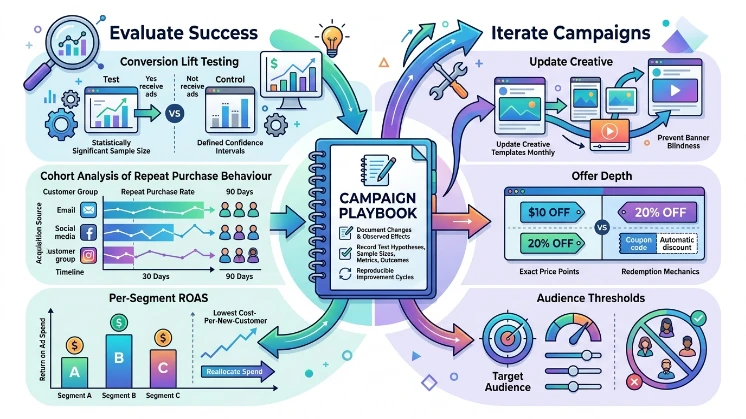
Evaluate using conversion lift testing, cohort analysis of repeat purchase behaviour, and per-segment ROAS, iterate by updating creative, offer depth, and audience thresholds.
Run lift tests with a statistically significant sample size and defined confidence intervals. Analyse cohorts by acquisition source and measure repeat purchase rate over 30 and 90 days. Compare per-segment ROAS and reallocate spend toward segments with the lowest cost-per-new-customer. Update creative templates monthly to prevent banner blindness and refresh offers by A/B testing exact price points and redemption mechanics.
Document changes and observed effects in a campaign playbook. Record test hypotheses, sample sizes, metrics, and outcomes to create reproducible improvement cycles.
Food chain display ads targeting the bottom of the funnel convert consideration into purchases through precise audience segmentation, conversion-focused creative with exact prices and deep links, and measurement that proves incremental lift. Campaigns require compliant data practices in the UK, structured bid strategies, and continuous testing to optimise cost per completed order and average order value.
For tactical guidance on increasing purchase consideration earlier in the funnel, see:
How Food Chains Increase Purchase Consideration Using Display Ads