
A review-based restaurant ad uses verified customer reviews, ratings, or testimonials in creative banner or display formats to influence new customers and drive first-time orders within a short decision window.
A review-based ad places customer feedback as central creative content. It shows star ratings, short quoted lines, review dates, reviewer locations, and proof tokens (order numbers, rating badges). The ad serves on social channels, publisher networks, search display, and programmatic placements. The creative links to a landing page or ordering page that preserves the review evidence and simplifies ordering. Review content undergoes moderation and verification to prevent fraud and to comply with platform policies. Tracking mechanisms include first-click identifiers, UTM parameters, and server-side order-attribution.
How do review-based ads convert trust into first-time orders?
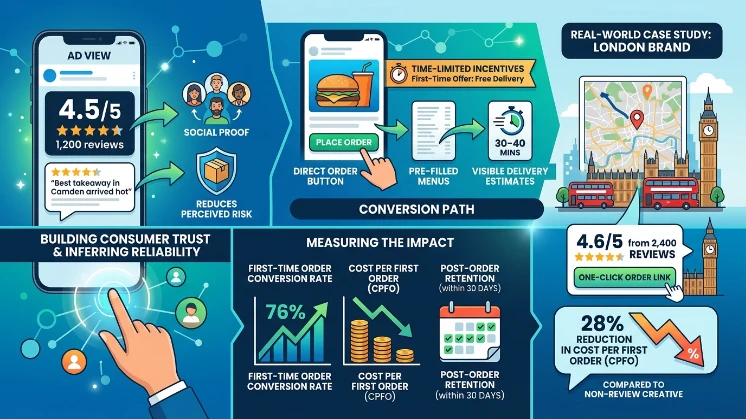
Reviews provide social proof and reduce perceived risk, which increases click-through and conversion rates when ads present clear ordering paths and time-limited incentives.
Customers infer reliability from quantitative ratings and concise review excerpts. When ads show a precise star score (for example, 4.5/5 from 1,200 reviews) and a short quote (for example, “Best takeaway in Camden arrived hot”), viewers assess expected quality quickly. Conversion increases when the ad reduces steps between discovery and checkout: direct order buttons, pre-filled menus, and visible delivery estimates. Measurement uses first-time order conversion rate, cost per first order (CPFO), and post-order retention within 30 days. Real example: a London brand that advertised “4.6/5 from 2,400 reviews” with a one-click order link tracked CPFO reduction by 28% over non-review creative.
What components must a review-based banner campaign include?
A campaign requires verified review data, concise review snippets, clear rating display, trust indicators, a direct action link, and tracking parameters.
Verified review data originates from order platforms, in-store surveys, or third-party aggregators. Snippets must be 10–25 words to fit banner layouts. Ratings use precise numerics and common scales (5-star, 10-point). Trust indicators include verification badges, review counts, reviewer locations, and time stamps. The call-to-action (CTA) must read as a direct ordering action: “Order now,” “Place takeaway,” or “Book table” with the destination URL containing UTM tags and a unique promo code for attribution. Tracking uses click IDs, first-order cookies, and server-side events to attribute orders accurately across devices. Privacy compliance requires explicit consent for tracking in the UK and adherence to platform policies.
How do advertisers verify reviews for banner use?
Verification uses order-linked reviews, purchase receipts, platform APIs, and timestamped internal records to prove authenticity before publication.
Order-linked reviews connect review text to an order ID and delivery timestamp. Platforms expose APIs to export verified reviews with anonymised identifiers. In-house verification cross-checks reviewer emails against order databases without exposing personal data. Third-party aggregators provide verification seals that list sampling methods and fraud-detection protocols. Display networks often require proof of authenticity for review claims that use superlatives or aggregated scores. Advertisers document verification methods for audit trails and regulatory compliance.
How should creative present review information on a banner?
Creative must prioritise legible numerics, one short quote, reviewer context (location or order type), and a visible ordering action in compact layouts.
Legibility requires large font for the main rating and 10–25 word quote for context. The quote must reference a tangible detail: delivery time, portion size, taste, or service. Include reviewer context such as “Verified delivery Camden” or “Dined-in, 14 April 2026.” Use contrast and white space so the rating and CTA remain visible on all devices. Avoid long paragraphs; display only the minimal proof needed to build trust and drive action. Designers test banner variants with A/B experiments on click-through rate and conversion to select the highest-performing creative.
What targeting strategies increase first-order conversions for restaurants?
Target by proximity, intent signals, past visit or ordering behaviour, and lookalike profiles built from high-value first-order customers.
Proximity targeting selects users within a delivery radius using IP, GPS, or postcode data. Intent signals include recent searches for specific cuisines, menu items, or “order near me” queries. Past-behaviour targeting reaches users who viewed the menu but did not order. Lookalike audiences derive from profiles of previous first-time customers who converted. Combine targeting layers with time-of-day delivery windows and high-conversion days (Friday–Sunday dinner windows). Use frequency caps to avoid fatigue and exclude recent converters from the same creative to reduce wasted impressions.
How do landing pages and ordering flows support review-based ads?
Landing pages must surface the referenced review, present a simple menu, show delivery or booking options, and provide one-click ordering to capture first orders.
The landing page duplicates the banner claim same rating, same quote, same verification badge—to maintain message consistency. Place the order button above the fold and minimise form fields to reduce friction. Offer immediate estimated delivery time and transparent fees. Use a promo code for first-time customers to measure incremental effect. Preserve tracking parameters to attribute the order back to the ad. Post-order, display a short confirmation page that invites account creation to enable future retention tracking.
Explore More Useful Information:
How Food Businesses Improve Visibility Using Banner Ads
What metrics prove ROI for review-based banners?
Measure cost per first order, first-order conversion rate, revenue per first order, and 30-day retention rate to evaluate ROI.
Cost per first order divides ad spend by the number of unique customer first orders attributed to the campaign. First-order conversion rate equals first orders divided by ad clicks. Revenue per first order captures average order value at initial purchase. Track retention as percentage of those first-order customers who place another order within 30 days. Supplement with click-through rate and view-through conversions for upper attribution. Use server-side event matching to reconcile ad platform reports with point-of-sale orders for accurate revenue attribution.
Explore More Expert Insights:
Food Chain Display Ads That Turn Consideration Into Final Purchases
Cloud Kitchen Ads That Convert Menu Browsers Into Active Orders
What are effective use cases for review-based restaurant banners?
Use cases include driving first-time takeaway orders, increasing table bookings for new locations, promoting new menu launches, and reactivating lapsed customers with proof-led creative.
For new location openings, run locality-targeted banners that show reviews from nearby branches and include a map snippet and a booking link. For menu launches, showcase customer quotes about the new dish with an order CTA that pre-selects the item. For lapsed customers, display a banner that highlights a high rating and a timed discount code to incentivise a first order after a long gap. Each use case requires tailored tracking to separate new-customer attribution from existing customer orders.
Read More to Understand Better:
How Restaurants Build Trust Using Review-Based Banner Campaigns
How do advertisers test and optimise review-based banners?
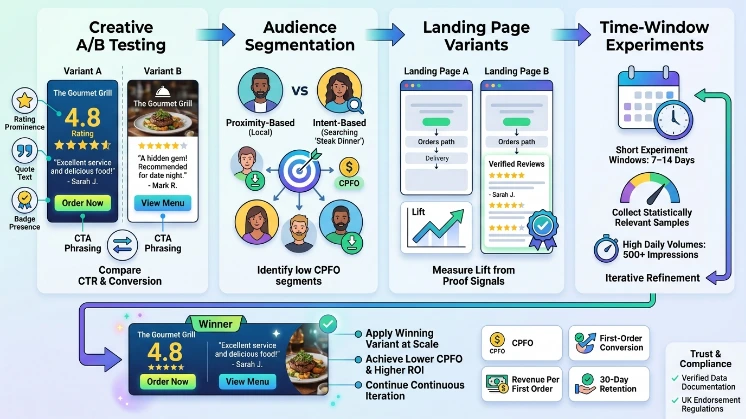
Testing combines creative A/B tests, audience segmentation, landing-page variants, and time-window experiments to isolate what drives first orders.
Run parallel creatives that vary rating prominence, quote text, badge presence, and CTA phrasing. Segment audiences by proximity and intent to identify which groups deliver lower CPFO. Test landing pages that differ only by the presence of verification details to measure lift from proof signals. Use short experiment windows of 7–14 days to collect statistically relevant samples when daily volumes exceed 500 impressions. Apply the winning variant at scale and continue iterative refinements.
Review-based restaurant ads convert trust into first-time orders by presenting verified ratings and short review snippets along with a direct ordering path. Campaigns require verified data, concise creative, precise targeting, consistent landing pages, and robust tracking. Measure CPFO, first-order conversion, revenue per first order, and 30-day retention to prove ROI. Follow UK regulations on endorsements and maintain documentation of verification methods.