A converting cloud kitchen ad focuses on three measurable elements: relevance, clarity, and friction reduction. Relevance shows the right item to the right user by using past behaviour, time of day, and location. Clarity presents item names, prices, and delivery times in short, readable lines. Friction reduction removes barriers by linking directly to the order flow with pre-filled choices. These ads run on food delivery apps, social platforms, programmatic exchanges, and website banners. Example: a late-night banner targeting users who viewed pizzas within the last 24 hours and showing “Margherita — £6, 20 min delivery” with an order button.
How do cloud kitchen ads use menu data to increase conversions?
Cloud kitchen ads use structured menu data to surface high-converting items, display accurate prices, and personalise offers based on user signals. They map item attributes, categories, and stock to ad templates for real-time relevance.
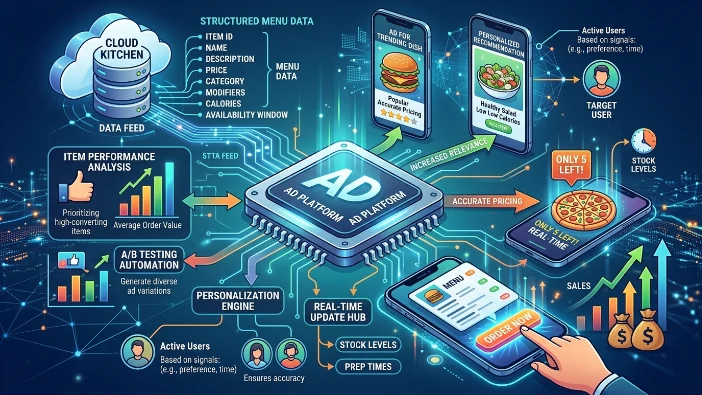
Structured menu data includes item ID, name, description, price, category, modifiers, calories, and availability windows. Ad systems pull these fields to populate creatives and to automate A/B testing at scale. Using item performance metrics such as conversion rate and average order value, marketers prioritise top-performing dishes. When stock or prep times change, the same data feed updates creatives instantly, preventing orders for unavailable items. Promoting a bestselling chicken bowl at lunch windows and switching to desserts after 20:00.
Which behavioural signals improve ad targeting for cloud kitchens?
Behavioural signals include menu views, add-to-cart events, past orders, search queries, session duration, and time of day; these signals guide creative selection and call-to-action timing. Signals segment users into active browsers, dormant customers, and high-value repeaters.
Active browsers are users who recently viewed menu pages or specific items. Dormant customers are users without orders in the last 30 days but with prior engagement. High-value repeaters include users with average order value above a chosen threshold. Ads use recent signals to select item-focused creatives, for example showing discounted combos to dormant customers and loyalty incentives to repeaters. Time-based signals prompt breakfast items in morning windows and comfort foods at night. Example: a user who searched “vegan burgers” within the last 48 hours sees a vegan burger creative with “Order in 2 taps” copy.
What creative elements make menu-focused banner ads effective?
Effective creative elements include item image, concise item name, price, estimated delivery time, and a single clear ordering action. Each element reduces decision friction and supports fast conversion.
Item images require consistent aspect ratios and high contrast to remain legible on mobile. Concise item names use plain language and keywords such as “spicy chicken wrap” or “vegan bowl” for immediate recognition. Price is numerical and upfront, for example “£5.50” rather than “from £5”. Estimated delivery time uses minutes, for example “25 min”. The ordering action is a single verb button like “Order Now” that links to a pre-filled checkout. Mobile creatives prioritise vertical cropping and limit text to three short lines.
Dive Deeper Into This Topic:
How Food Chains Increase Sales Using Banner Advertising
How do cloud kitchens measure ad performance accurately?
Ad performance metrics include click-through rate (CTR), add-to-cart rate, conversion rate to order, average order value (AOV), and return on ad spend (ROAS). Measurement requires consistent attribution rules and shared identifiers between ad systems and order systems.
CTR measures initial engagement. Add-to-cart rate tracks users who move from the ad to the cart. Conversion rate measures completed orders per ad impression. AOV records revenue per order influenced by the ad. ROAS divides revenue attributed to the ad by ad spend. Accurate measurement needs deterministic identifiers such as hashed user IDs or order tokens. Time-window attribution should use short windows for menu-focused ads, typically 0–2 hours. Example: an ad that generates 1,200 impressions, 90 clicks (7.5% CTR), 50 add-to-cart events, and 30 orders yields a 37.5% conversion from add-to-cart to order.
Which bidding and placement strategies drive immediate orders?
Bidding strategies that prioritise conversions and use time-weighted bid adjustments for peak windows drive immediate orders. Placements include in-app top banners, category pages, and programmatic native slots near ordering flows.
Use conversion-focused bidding with automated bid caps tied to target ROAS or cost per order. Increase bids by 20–50% during identified peak windows such as lunch (12:00–14:00) and dinner (18:00–21:00). Place ads on delivery app menu pages, restaurant category pages, and homepage carousels where users already intend to order. Programmatic placements should target inventory with low latency and high viewability metrics. Raise bids 40% for top-performing items during Friday dinner windows to capture impulse orders.
How do personalised offers improve order rates from menu browsers?
Personalised offers use past orders and menu interactions to present relevant discounts, bundles, or upsells that reduce the perceived cost of ordering. Personalisation increases relevance and reduces decision time.
Examples of personalised offers include item-specific discounts for previously viewed items, bundle suggestions based on order history, and one-tap reorder for frequent items. Personalised timing delivers offers when intent signals are strongest, such as a discount push three hours after a user’s typical ordering time. Use capped discount values tied to AOV to protect margins, for example a £2 off voucher for users with AOV under £12 and a 10% off voucher for higher AOV segments. Example: a user who ordered salads twice in two weeks receives a “£1 off your next salad” banner at lunchtime.
What operational components support real-time ad accuracy?
Operational components include live menu feeds, inventory sync, ETA calculators, and tagging for promo eligibility. These components keep creatives truthful and reduce user frustration from failed orders.
Live menu feeds push item availability, price, and modifier changes every 60 seconds. Inventory sync marks items as out of stock to prevent orders. ETA calculators combine kitchen load and delivery partner status to show realistic minutes. Tagging defines promotion eligibility for items and regions. Integrate these components with ad-serving platforms through standardised APIs such as JSON feeds. When an ingredient shortage marks an item unavailable, the feed removes that item from active creatives within one minute.
Explore More Expert Insights:
Retargeting Restaurant Ads That Turn Past Orders Into Repeat Purchases
Food Brand Awareness Ads That Convert Product Interest Into Purchase Intent
Where do cloud kitchen banner ads show the strongest ROI?
Banner ads show the strongest ROI on mobile food delivery apps, restaurant aggregator category pages, and high-intent search results pages. Those placements capture users already in an ordering mindset and convert faster.
Mobile apps capture in-session users with lower friction to checkout. Aggregator category pages place menu ads near competing options, enabling price and preparation time to influence choice. High-intent search results use keyword targeting such as “pizza delivery near me” to match immediate intent. Programmatic native placements in lifestyle apps can also perform when paired with strong behavioural signals. Campaign targeting in-app users during dinner windows doubled conversion rate versus general display placements.
How should decision-focused advertisers allocate budget across channels?
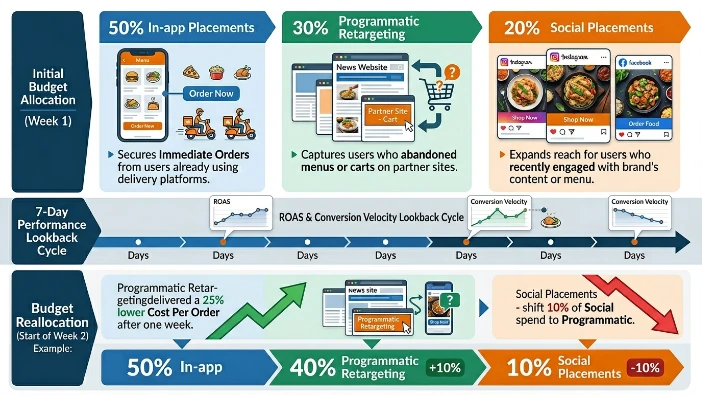
Allocate 50% to in-app placements, 30% to programmatic retargeting focused on recent menu browsers, and 20% to social placements with direct links to ordering. Adjust weekly based on ROAS and conversion velocity.
In-app spend secures immediate orders from users already using delivery platforms. Programmatic retargeting captures users who abandoned menus or carts on partner sites. Social placements expand reach for users who recently engaged with the brand’s content or menu. Reallocate budget every seven days using a 7-day performance lookback for conversion rate and cost per order. Example: if programmatic retargeting delivered a 25% lower cost per order after one week, shift 10% of social spend to programmatic.
For More Details, Explore:
How Cloud Kitchens Nurture Demand Using Menu-Focused Banner Ads