
Menu-focused banner ads are digital display creatives optimised for conversion. They use high-resolution food images, concise text, explicit prices, promotional tags (for example, “£5 off”), and a visible call-to-action (for example, “Order Now”). Cloud kitchens use them to bypass brand-heavy campaigns and present immediate transactional value. These ads link directly to online ordering pages, in-app checkout flows, or landing pages that pre-load selected items for a faster purchase.
How do menu-focused banner ads fit into demand generation for cloud kitchens?
They convert browsing intent into orders by presenting specific menu choices and one-click purchase paths. Demand generation for cloud kitchens relies on reducing friction between discovery and checkout. Banner ads accomplish this by surfacing precise options and incentives at moments when users browse food content, search results, or lifestyle sites. Ads emphasise availability, delivery radius, estimated delivery time, and limited-time prices. Targeting combines behavioural signals, geographic filters, and contextual placements to reach users within the kitchen’s service zone.
The process starts with audience segmentation: location within delivery radius, recent food searches, and engagement with recipe or dining content. Next, creatives highlight menu items that match user signals—comfort food for late-night searches, healthy bowls for morning wellness content. Finally, measurement tracks click-to-order rate, average order value, and repeat purchase frequency to refine placements and menu emphasis.
Click Here to Explore More:
How Food Chains Increase Sales Using Banner Advertising
Which creative elements increase conversion in menu-focused banner ads?
High-quality food photography, clear price display, delivery ETA, and a single-action order button drive higher conversion. Food photography must show the served portion and plating to set accurate expectations. Prices display in local currency (GBP) and include delivery fees when relevant. Delivery ETA shows minutes or hour range to reduce uncertainty. The order button triggers either a deep link to an app cart or a landing page with the selected item pre-added.
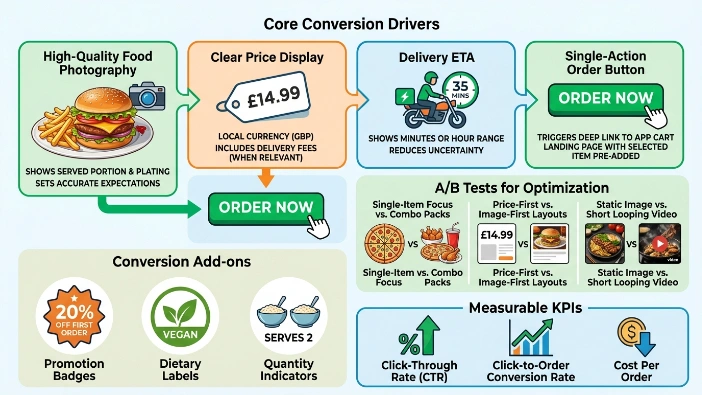
Promotion badges (for example, “20% off first order”), dietary labels (for example, “vegan”), and quantity indicators (for example, “serves 2”). A/B tests compare variants: single-item focus versus combo packs, price-first versus image-first layouts, and static image versus short looping video. Use measurable KPIs: click-through rate (CTR), click-to-order conversion rate, and cost per order.
What targeting strategies work best for these ads?
Geographic radius targeting, recent food intent, and contextual placement in food-related content produce the best reach. Radius targeting limits impressions to users inside a kitchen’s delivery zone, typically within 3–8 miles depending on urban density. Intent signals include recent searches for takeout, restaurant reviews, or recipe pages. Contextual placements on food blogs, local event listings, and commuter apps increase relevance. Combine deterministic data (logged-in users with addresses) with probabilistic signals (IP location, device patterns) for scale.
Time-based targeting improves performance: lunchtime ads run from 11:00–14:00, dinner from 17:00–21:00, and late-night offers from 22:00–02:00. Frequency caps prevent ad fatigue, often set at 3–7 impressions per user per day. Segment audiences by order history: first-time, lapsed (no orders in 30 days), and frequent (3+ orders in 30 days) to set creative messaging and incentives.
How do cloud kitchens measure performance for menu-focused banner ads?
They track click-through rate, click-to-order conversion, average order value, and return on ad spend per campaign. Tracking begins with UTM parameters or post-click deep links to attribute traffic. Conversion pixels capture completed orders and revenue. Primary metrics: CTR to assess creative relevance, conversion rate to assess landing and checkout friction, average order value to evaluate menu mix, and return on ad spend (ROAS) to calculate profitability. Secondary metrics: repeat purchase rate within 30 days and cost per acquiring a new customer.
Attribution models include last-click for direct orders and multi-touch for assisted conversions that start with display impressions and end in app orders. Use cohort analysis to measure lifetime value for customers acquired through menu-focused banners versus other channels.
What landing experiences support menu-focused banner ads?
Landing pages or deep-linked carts that pre-load the selected item and minimise navigation maximise order completions. Best-practice landing flows take one to three screens from click to payment. A deep-linked cart displays the selected item, price, delivery address input, and payment options. Include clear minimum order value and estimated delivery time. For app users, the ad should open the app with the item in cart; for web users, the landing must be responsive and fast, with page load under 2 seconds.
Use progressive data requests: request delivery address early to confirm serviceability, then request payment details. Offer guest checkout and saved payment for returning customers. Show order progress indicators after confirming the order to reassure customers.
What menu and pricing tactics increase ad effectiveness?
Feature single high-margin items, limited-time bundles, and clear percentage discounts to increase order rates and average spend. Single-item focus reduces decision friction. High-margin dishes protect profitability. Bundles such as “main + side + drink” with a lower combined price increase average order value. Time-limited discounts create urgency and improve click-to-order conversion. Price presentation uses whole numbers (for example, “£8”) and displays savings as absolute numbers (for example, “Save £3”) for clarity.
Seasonal menu items and local favourites work well in region-specific campaigns. Display dietary tags and allergens clearly to avoid order cancellations.
What operational components must cloud kitchens align with advertising?
Inventory sync, delivery capacity, and menu availability updates must link to ad creatives in real time. Real-time inventory prevents advertising items that are out of stock. Delivery capacity controls pacing of impressions to match available drivers. Menu availability rules disable ads for unavailable items or replace creatives automatically. Integrate point-of-sale (POS) and order management systems with ad delivery platforms through APIs or middleware for automation.
Set thresholds: pause promos when kitchen backlog exceeds defined minutes, for example, pause discount ads when average delivery time exceeds 45 minutes. Schedule maintenance windows to avoid running live promotions during system downtime.
Which benefits do cloud kitchens gain from menu-focused banner ads?
They increase order volume, reduce time-to-first-order for new customers, and improve average order value through targeted menu promotion. Menu-focused banner ads shorten the path from discovery to transaction. New customer acquisition becomes measurable via ROAS. Repeat orders increase when ads target recent customers with tailored menu items. Ads also reveal high-performing dishes through response data, informing menu engineering and pricing decisions.
Examples of measurable outcomes: uplift in daily orders, percentage increase in conversion from ad impressions, and incremental revenue per campaign measured against baseline daily sales.
What use cases show menu-focused banner ads perform well?
Promoting new menu items, filling slow delivery windows, and reactivating lapsed customers deliver consistent returns. New item launches get immediate visibility. Ads timed for off-peak hours offer discounts to fill delivery capacity. Lapsed-user campaigns use personalised creatives with previous-order reminders and discount incentives. Use geographic micro-campaigns to test menu variants in different neighbourhoods and scale winners across zones.
Example: a kitchen runs a 10-day campaign for a new spicy bowl in two postcode zones, measures daily conversion per zone, and scales to all zones after consistent performance for five days.
Explore More Expert Insights:
How Restaurants Improve Repeat Order Intent Using Retargeting Ads
How Food Brands Educate Customers Using Product Awareness Ads
How should cloud kitchens optimise campaigns over time?
Run short A/B tests, measure with revenue-based KPIs, and scale creatives that show positive ROAS. Test creative variants for 3–7 days using consistent audience segments. Prioritise tests that change only one variable: image, price, or CTA text. Discard variants with lower ROAS and reallocate budget to top performers. Review geographic performance and adjust radius targeting. Use cohort LTV to decide how much to bid for acquiring a new customer.
Document learnings in a central playbook: best-performing dishes by time of day, effective discount levels, and creative formats with highest CTR.
How do privacy and regulation affect these ads in the UK?
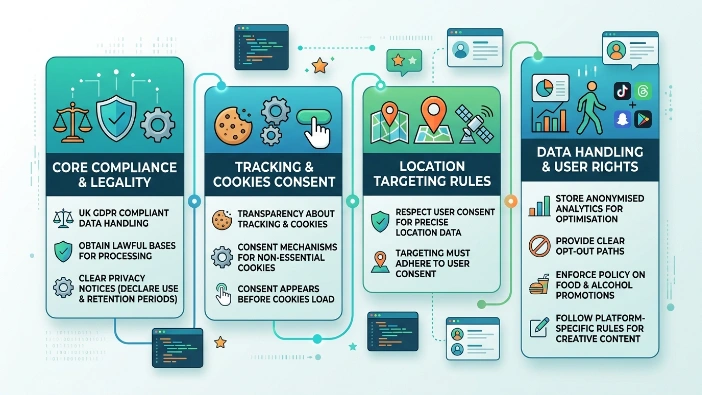
Ads require compliant data handling under UK GDPR and transparency about tracking and cookies. Cloud kitchens that use customer data must obtain lawful bases for processing. Consent mechanisms must appear before non-essential cookies load. Location-based targeting must respect user consent for precise location data. Store anonymised analytics for optimisation and provide opt-out paths. Maintain clear privacy notices that declare advertising use and retention periods.
Ad networks also enforce policy on food and alcohol promotions and follow platform-specific rules for creative content and targeting.
Read More for Better Understanding:
Cloud Kitchen Ads That Convert Menu Browsers Into Active Orders