Food brand awareness ads that convert product interest into purchase intent are targeted campaigns designed to move consumers from initial recognition to a measurable intent to buy through clear messaging, product demonstration, social proof, and conversion-focused creative with tracked outcomes.
Food brand awareness ads start by defining the product and audience precisely. Define the product by ingredients, format, pack sizes, and price range. Define the audience by demographics, purchase occasions, and channel habits. Conversion-focused awareness ads differ from general awareness ads by including elements that trigger intent signals. Intent signals include clicks to product pages, add-to-cart events, voucher claims, and store-locator searches. Measurement ties creative elements to those intent signals.
How do these ads move consumers from interest to purchase intent?
Ads move consumers by presenting product benefits, demonstrating usage, offering time-limited incentives, and linking creative to measurable actions that indicate intent, such as product page visits, voucher redemptions, or clicks to retailer listings.
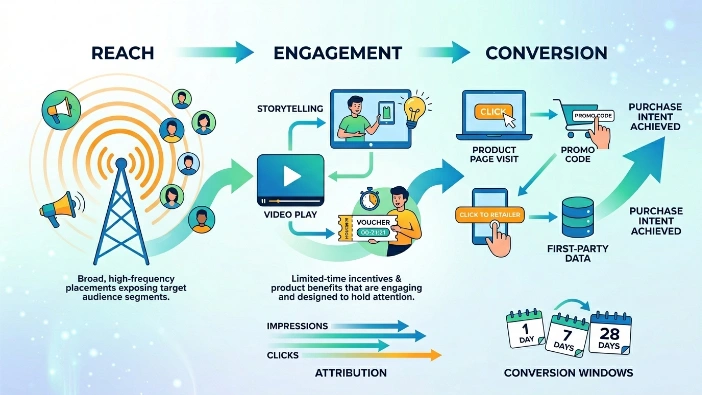
Reach, engagement, and conversion measurement. Reach uses broad, high-frequency placements to expose target audience segments. Engagement uses storytelling and product demonstrations to hold attention for 10–30 seconds. Conversion measurement ties engagement to actions: tracked landing pages, promo codes, retailer click-throughs, and first-party data. Attribution assigns credit across impressions and clicks using last-touch and multi-touch models. Use conversion windows of 1, 7, and 28 days for granular analysis.
What are the essential components of high-converting food brand awareness ads?
Essential components include a clear value proposition, product-visible creative, concise benefit statements, social proof, a measurable call-to-action, audience targeting rules, and tracking pixels or tags for intent measurement.
Value proposition states a specific benefit and numeric detail when possible (for example, “30% fewer calories” or “ready in 2 minutes”). Product-visible creative shows packaging and serving suggestions in the first 3 seconds. Benefit statements list one to two discrete benefits using numbers or concrete claims. Social proof uses quantified endorsements such as ratings (4.5/5), review counts (1,200 reviews), or awards. Calls-to-action use measurable verbs such as “Get voucher,” “Visit product page,” or “Find in store” tied to tracked links and unique promo codes. Tracking uses platform pixels, server-side events, and UTM parameters to capture intent signals.
Which creative formats produce the strongest purchase intent for food products?
Short video (6–30 seconds) showing product use, hero image ads with product + price, carousel ads featuring variants, and interactive ads with instant forms produce strong purchase intent when paired with tracked CTAs.
Short video demonstrates preparation, portion size, and taste cues. Hero image ads highlight packaging and price per unit. Carousel ads allow direct comparison of variants, flavors, or pack sizes. Interactive ads collect intent data through instant forms or voucher claims directly inside the ad. Use high-resolution imagery and 24–30 fps video for clarity. Ensure product shots occupy at least 40% of the visible frame and include legible price or offer text sized for mobile screens.
How should targeting and segmentation be structured for awareness ads?
Structure targeting with layered segments: high-intent audiences (website visitors, cart abandoners), mid-intent audiences (engaged viewers, newsletter subscribers), and lookalike audiences derived from purchasers, with geographic and retailer-availability filters for the United Kingdom.
High-intent segments include past 90-day product page visitors and shoppers who added items to cart. Mid-intent segments include viewers who watched 50%+ of product videos or clicked promo links in the past 180 days. Create lookalikes of purchasers at 1%–3% similarity. Apply UK-specific geo-filters to match distribution footprint and include retailer availability by postcode. Exclude recent purchasers within defined repurchase cycles (for example, 30–90 days) to control frequency and budget. Use frequency caps: max 3 ad exposures per user per day and max 12 exposures per 28 days for ads.
What tracking and measurement setup ensures accurate attribution of purchase intent?
Use a combination of platform pixels, server-side event collection, UTM-tagged landing pages, unique promo codes, and matched first-party CRM data to attribute intent and link ad exposures to purchase actions.
Implement platform pixels for page view and conversion events. Configure server-side tracking to capture events blocked by browser restrictions. Tag creative links with UTM parameters for channel-level reporting. Issue unique, single-use promo codes distributed in ad creative to directly measure redemptions by campaign. Match CRM orders using hashed email or phone identifiers to attribute offline sales. Report using conversion windows of 1, 7, and 28 days, and run a multi-touch attribution model for insight into paths that lead to purchases.
What budget allocation and bidding strategy boost conversion-ready awareness?
Allocate 20%–35% of total funnel spend to awareness, focus bids on conversions and highest-value intent signals, and use value-based bidding where CPA targets align to actual margin per sale.
Set daily budgets relative to campaign reach needs and retailer coverage. Choose cost-per-action (CPA) or cost-per-acquisition bids for tracked voucher redemptions and clicks to retailer listings. Use value-based bidding to bid higher for users with higher predicted lifetime value. Run A/B tests with fixed CPA targets for 14 days and analyse return on ad spend (ROAS) by cohort. Scale successful segments by increasing budget 15% increments weekly while monitoring CPA stability.
What are legal and regulatory considerations for food ads in the UK?
Comply with UK advertising rules: avoid misleading claims, include allergen information where required, follow CAP Code and ASA rulings, and ensure nutrition or health claims are authorised and substantiated with evidence.
Ensure all claims follow the UK Committee of Advertising Practice (CAP) Code. Present allergens and mandatory nutrition information in product pages and linked landing pages. Avoid health claims unless they match authorised EU/UK permitted lists. Retain substantiation documents for claims that reference nutrition, ingredients, or production methods. Record and store consent for personalised targeting under UK GDPR. Provide clear opt-outs for personalised advertising.
Explore More Expert Insights:
Local Cafe Ads That Turn Nearby Searches Into Walk-In Customers
Restaurant Display Ads That Convert Food Interest Into Checkout Orders
What outcomes and KPIs indicate successful conversion of interest into purchase intent?
KPIs include product-page click-through rate, add-to-cart rate, voucher redemption rate, retailer click-to-purchase rate, cost per intent action (CPA), and incremental sales lift measured against control groups.
Explore the Complete Guide:
How Food Brands Promote Offers Using Banner Campaigns
Track product-page CTR as an early intent indicator. Track add-to-cart rate and voucher redemptions as higher intent signals. Track retailer click-to-purchase conversion and revenue per conversion. Calculate CPA for each intent action and ROAS for revenue-linked events. Use incrementality tests with holdout groups to measure net sales lift. Report KPIs weekly for optimisation cycles.
What are practical use cases and campaign examples for awareness ads?
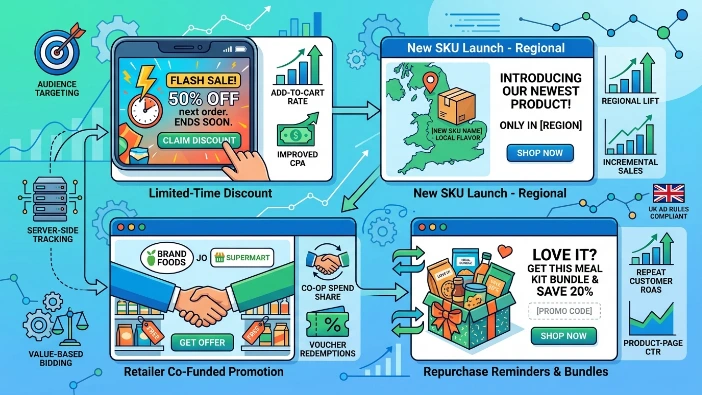
Practical use cases include limited-time discount campaigns, new SKU launches in selected regions, retailer co-funded promotions, and repurchase reminders with product bundles tied to tracked promo codes.
Food brand awareness ads that convert product interest into purchase intent use precise definitions, intent-focused creative, measurable CTAs, layered audience targeting, server-side tracking, and value-based bidding. Follow UK advertising rules and measure outcomes with product-page CTR, add-to-cart rate, voucher redemptions, CPA, ROAS, and incremental sales lift.
For further detail on mid-funnel education tactics, see the following:
How Food Brands Educate Customers Using Product Awareness Ads