
Retargeting for restaurant ads is a digital advertising method that shows ads to users who previously ordered, visited, or engaged with a restaurant’s website or app. It uses first-party data to reconnect with past customers and prompt repeat purchases.
Retargeting uses identifiers such as website cookies, mobile advertising IDs, email lists, and app activity logs. Restaurants create audiences from past order histories, abandoned carts, or menu page views. Platforms then deliver tailored creative and messages to those audiences across display networks, social platforms, and connected TV. Entities involved include the restaurant (data owner), ad platforms (ad delivery), and tracking systems (pixel, SDK, or server-side events). Definitions: a pixel is a small tracking snippet placed on web pages; an SDK is a software kit embedded in mobile apps; a lookalike is an audience modeled from an existing customer set.
What data and tracking elements are required?
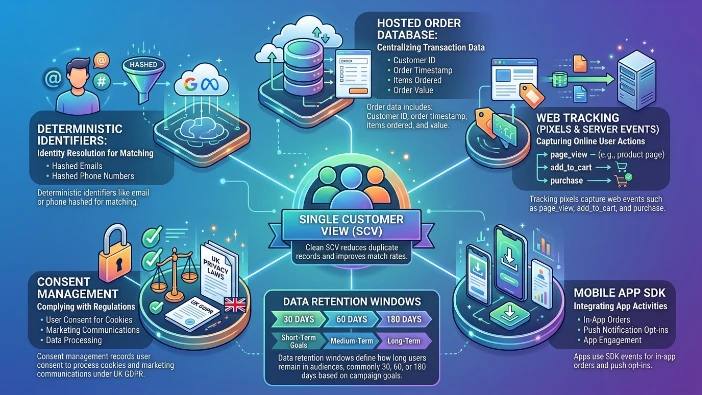
Required elements include a hosted order database, tracking pixel or server events, mobile SDK for app events, consent management for UK privacy laws, and deterministic identifiers like email or phone hashed for matching.
Order data must include customer ID, order timestamp, items ordered, and value. Tracking pixels capture web events such as page_view, add_to_cart, and purchase. Apps use SDK events for in-app orders and push opt-ins. Consent management records user consent to process cookies and marketing communications under UK GDPR. Hashed emails or phone numbers enable Customer Match on platforms that accept hashed identifiers. Clean, single customer view (SCV) reduces duplicate records and improves match rates. Data retention windows define how long users remain in audiences, commonly 30, 60, or 180 days based on campaign goals.
Which audience segments deliver the highest repeat rate?
High-repeat potential segments include recent purchasers (0–30 days), frequent buyers (3+ orders in 90 days), and cart abandoners with intent signals such as delivery address entered.
Recent purchasers respond well to cross-sell and upsell offers within 7–14 days. Frequent buyers respond to loyalty incentives and personalised bundles. Cart abandoners who reached checkout but did not confirm show the highest conversion lift when offered limited-time discounts. Lapsed customers (no orders in 90–180 days) require reactivation messaging tied to new menu items or exclusive deals. Segmentation accuracy improves when order metadata (items, price, time of day) is included. Example: a segment of diners who ordered pizza after 8 PM converts at 18% when retargeted during evening slots.
What creative and messaging strategies work best?
Effective creatives match past order signals, repeat-order prompts for previous items, personalised bundles based on past items, time-sensitive discounts, and loyalty reminders showing earned rewards.
Use clear calls-to-action that reference ordering channels (app or web). Show the exact item image customers ordered when personalisation is allowed. Highlight preparation or delivery speeds when that decision factor is present. For loyalty members, display reward thresholds and the number of points needed for the next reward. Use A/B tests with two variants: one showing a discount and one showing free delivery, then measure incremental repeat orders. Creative duration commonly rotates every 7–14 days to prevent ad fatigue.
How do restaurants set bidding and budget rules for retargeting?
Set bids based on customer lifetime value (LTV) tiers: higher bids for frequent buyers, moderate bids for recent but single-time purchasers, and lower bids for lapsed users. Allocate 20–35% of the display budget to retargeting when repeat revenue is a priority.
Define target CPA as the desired cost per repeat order. Use conversion windows aligned with meal cycles: 1–7 days for quick repeat attempts, 8–30 days for cross-sell, and 31–90 days for reactivation. Cap frequency at 3–6 impressions per user per week to avoid diminishing returns. Employ bid multipliers for high-value ZIP codes and peak meal hours. For app-first restaurants, bid more aggressively for in-app checkout events that have higher conversion rates and lower fraud risk.
How is performance measured and attributed?
Measure performance with repeat order rate, incremental revenue from retargeted users, cost per repeat order, and return on ad spend (ROAS) specific to retargeting campaigns.
Repeat order rate equals repeat orders divided by targeted users. Incremental revenue requires a lift study or holdout group to isolate ads’ effect from organic repeat behaviour. Use matched holdouts with 10% of the eligible audience excluded from ads to estimate true incremental impact. Track time-to-repeat and average order value (AOV) change after retargeting exposure. Combine platform conversion metrics with server-side order logs for accurate attribution. Reconcile platform-reported conversions with first-party sales records weekly.
Discover the Full Information:
How Restaurants Drive Online Orders Using Retargeting Ads
What legal and privacy rules apply in the UK?
UK retargeting requires GDPR-compliant consent for cookies, lawful basis for processing marketing data, clear privacy notices, and opt-out mechanisms for direct marketing.
Obtain explicit consent before using non-essential cookies or personalised advertising. Maintain records of consent and provide granular settings for cookie categories. Use hashed identifiers for customer matching and document data processors and controllers. Follow the Privacy and Electronic Communications Regulations (PECR) for electronic marketing messages and use the UK ICO guidance for targeted advertising. Retention policies must be reasonable, commonly 30–180 days depending on the segment and consent scope.
What are the primary benefits for restaurants?
Retargeting increases repeat orders, boosts average order value, reduces customer acquisition cost by using existing customer data, and improves lifetime value through personalised offers.
Repeat orders drive steady revenue, even a 10% lift in repeat rate can increase monthly revenue significantly for local restaurants. Personalisation increases AOV when restaurants recommend complementary items based on past orders. Using first-party data lowers reliance on broad acquisition channels and reduces cost per order. Retargeting also supports loyalty programs by nudging members toward redemption, improving engagement metrics and retention.
Explore More Expert Insights:
Food Brand Awareness Ads That Convert Product Interest Into Purchase Intent
Local Cafe Ads That Turn Nearby Searches Into Walk-In Customers
Which use cases show the fastest ROI?
Fastest ROI appears in cart abandonment recovery, quick-repeat nudges after positive first orders, and targeted offers to high-frequency customers within 30 days of their last order.
Cart abandonment campaigns that offer a small incentive or remind users of pending checkout typically recover 8–20% of abandoned orders. Quick-repeat nudges for example, offering 10% off a second order within 7 days often convert at 12–25% for customers who enjoyed their first order. High-frequency customer rewards increase order cadence and reduce churn. Measure ROI by dividing incremental revenue from these segments by ad spend allocated to those campaigns.
How should restaurants test and scale retargeting campaigns?
Start with small, segmented experiments: run separate campaigns for cart abandoners, recent purchasers, and lapsed users; measure incremental lift with holdouts; then scale budgets for segments that show positive ROI.
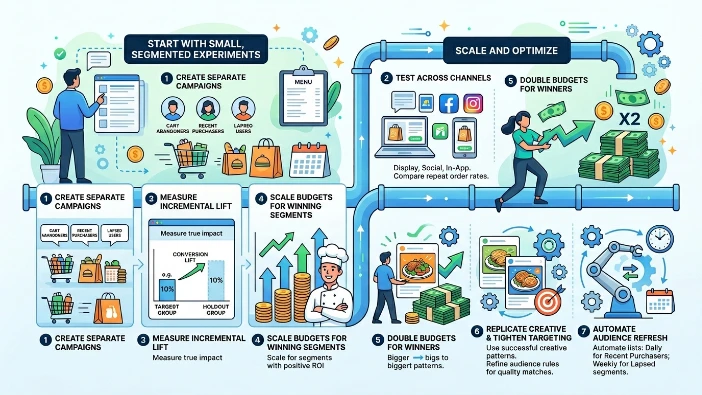
Run tests across delivery channels (display, social, in-app) and compare repeat order rates. Use holdout groups representing 5–15% of each segment to measure true lift. Scale by doubling budgets for winning segments and replicating creative patterns while tightening audience rules to maintain match quality. Automate audience refresh daily for dynamic lists such as recent purchasers and weekly for lapsed segments.
Click Here to Explore More:
How Restaurants Improve Repeat Order Intent Using Retargeting Ads