A cloud kitchen is a delivery-only food production facility that prepares meals for online orders and third-party delivery platforms. It operates without dine-in spaces, uses centralised kitchen infrastructure, and processes orders through app or web channels.
Cloud kitchens rent or own kitchen space divided into units for single or multiple food brands. Staff prepare menu items, package orders, and hand them to delivery partners or in-house couriers. Inventory systems track ingredients; point-of-sale integrations route digital orders to kitchen stations. Turnaround time targets typically range from 15 to 30 minutes per order for hot items. Cost structures remove front-of-house expenses and shift spending toward food preparation, packaging, digital ordering, and delivery logistics.
How do display campaigns function to increase demand?
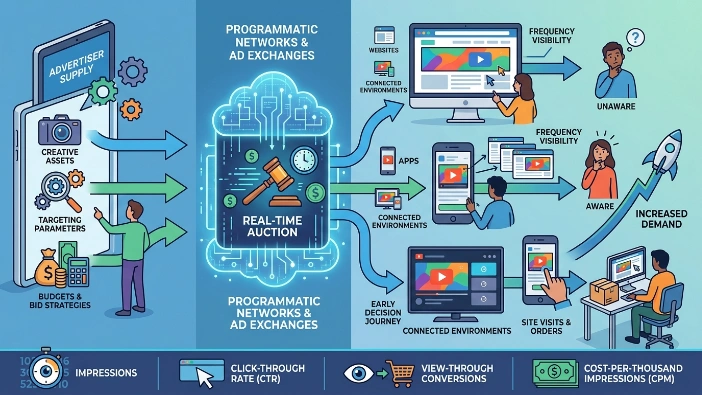
Display campaigns use visual ads shown across websites, apps, and connected environments to create awareness and drive clicks that lead to orders or site visits. Ads run via programmatic networks, ad exchanges, or publisher placements and deliver impressions measured in thousands.
Advertisers supply creative assets, targeting parameters, budgets, and bid strategies. Ad servers deliver impressions based on real-time auctions. Key metrics include impressions, click-through rate (CTR), view-through conversions, and cost-per-thousand impressions (CPM). Display campaigns support awareness by delivering high-frequency visibility to audience segments, capturing potential customers earlier in their decision journey, and sending traffic to landing pages or ordering platforms.
Which components make a display campaign effective for cloud kitchens?
Effective campaigns include targeted audiences, clear visual creative, precise bidding rules, conversion tracking, and delivery-area constraints. Each component integrates with order systems and analytics to measure impact.
Targeting defines the audience by geography, device type, browsing behaviour, and contextual relevance. Creative assets include high-resolution food imagery, short headlines, and concise overlay text. Bidding rules select CPM, CPC, or viewable CPM depending on objective. Conversion tracking links ad clicks to order confirmations, using pixels or server-to-server events. Delivery-area constraints restrict ad exposure to defined postal codes or a radius around kitchen locations to match delivery capabilities. Integration reduces wasted impressions outside serviceable areas and increases measurable return on ad spend (ROAS).
What targeting strategies work best for localised food delivery?
Hyperlocal targeting places ads inside a defined radius or postal-code cluster, combined with demographic filters and time-of-day delivery windows. Examples include targeting residents within a 3–5 kilometre radius and users active during lunch hours.
Geofencing restricts ad delivery to mobile users who enter set perimeters near offices, universities, or transport hubs. Contextual targeting places ads on pages about local events, food blogs, or recipes. Behavioral targeting uses past order data to reach repeat customers or users who searched for cuisines recently. Time-parting schedules ads for peak ordering hours—12:00–14:00 and 18:00–21:00 local time. Combining location, time, and behavior increases relevance and reduces spend on audiences outside the kitchen’s serviceable area.
How does creative design influence display ad performance?
Creative performance depends on high-quality food imagery, clear value propositions, legible typography, and localised messaging aligned to the audience. Use concise headlines, a single visual focal point, and legible type at typical ad sizes.
Static image ads for display environments emphasise plating, portion, and packaging. Animated HTML5 banners show quick transitions: menu item, short offer text, and delivery availability. Size variants include leaderboard (728×90), medium rectangle (300×250), and mobile banner (320×50). Creatives optimised for mobile must be readable at small sizes and fast-loading. A/B tests measure differences in CTR and conversion rates for imagery, copy length, and call-to-action wording. Testing reveals which combinations produce higher engagement and lift in orders from targeted areas.
How do measurement and attribution link display ads to orders?
Attribution uses click-through tracking, view-through windows, and server-side order events to connect impressions and clicks to completed deliveries. Use multiple attribution windows to capture direct clicks and delayed conversions.
Conversion pixels record ad clicks that lead to order pages. View-through attribution assigns credit when a user saw an ad and ordered later within a defined window, often 1–7 days. Server-to-server integration reduces data loss from browser restrictions. Key performance indicators include incremental orders, cost per order, and conversion lift versus control groups. Holdout experiments allocate part of a target area as a control cohort to measure baseline order volume. Comparing exposed and control cohorts yields incremental lift attributable to display campaigns.
What budget and bidding approaches suit cloud kitchens?
Budgets allocate by kitchen location and peak hours, while bidding aligns with campaign goals: CPM for awareness, CPC for traffic, and CPA for orders. Set daily budgets per kitchen and adjust by performance.
Start with CPM bidding to maximise reach within delivery zones. Shift to CPC when landing pages demonstrate high conversion rates. Use target CPA bidding when historic conversion data shows stable cost-per-order metrics. Apply bid multipliers for high-value slots such as mobile prime time or high-affinity publisher sites. Allocate 10–30% of marketing spend to experimentation in new neighbourhoods. Reallocate funds weekly to zones with conversion rates above the median.
What packaging and logistics considerations affect ad performance?
Packaging that maintains food temperature and presentation improves post-click satisfaction and repeat ordering, which increases campaign effectiveness. Measure on-time delivery rates, packaging integrity scores, and order error rates.
Delivery radius must match the advertised promise for accurate delivery-time estimates. Offer clear delivery-time ranges on landing pages. Maintain stock levels for promoted menu items to avoid cancellations. Track courier wait times and kitchen prep throughput to ensure advertised promises align with operational reality. Operational consistency reduces negative reviews and supports higher lifetime value from acquired customers.
What benefits do display campaigns deliver for cloud kitchens?
Display campaigns increase brand awareness, expand reach within delivery zones, and generate measurable incremental orders when paired with proper attribution. Campaigns also support menu launches and time-limited promotions.
Awareness increases recall among local shoppers; measured lift translates to additional weekly orders. Display ads accelerate trial for new menu items by reaching users who search for similar cuisines. Remarketing sequences recapture visitors who viewed menus but did not complete an order. Cross-device measurement allows campaigns to reach users on mobile during commutes and desktop at home, reinforcing recall. Data from campaigns informs menu planning and kitchen placement decisions.
Explore More Expert Insights:
How Food Chains Increase Sales Using Banner Advertising
How Restaurants Drive Online Orders Using Retargeting Ads
What use cases show display campaigns working for cloud kitchens?
Use cases include new-kitchen launches, menu item launches, off-peak demand stimulation, and geographic expansion. Each use case applies specific targeting, creative, and bidding strategies.
For new-kitchen launches, run hyperlocal awareness drives with high-frequency impressions in a 3–5 kilometre radius during the first 14 days. For menu launches, rotate creatives featuring the new item and measure order lift against historic category sales. To stimulate off-peak demand, schedule promotions with time-sensitive overlays during afternoon hours and measure conversion lift. For geographic expansion, deploy phased campaigns in adjacent postal codes to validate demand before committing to new kitchen locations.
Learn More Here:
How Food Chains Increase Purchase Consideration Using Display Ads
How should teams structure campaign operations and data flow?
Teams centralise creative assets, define location-level targeting, implement conversion pipelines, and run weekly performance reviews to optimise. Maintain single sources of truth for order events and creative libraries.
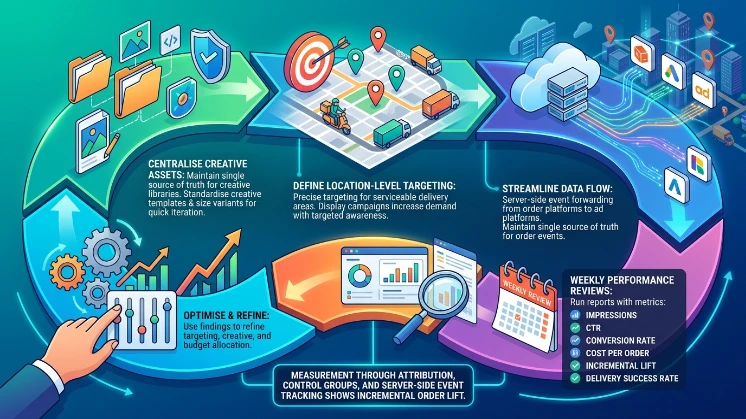
Create naming conventions for campaigns tied to kitchen IDs and launch dates. Standardise creative templates and size variants for quick iteration. Streamline data flow using server-side event forwarding from order platforms to ad platforms. Run weekly reports with metrics: impressions, CTR, conversion rate, cost per order, incremental lift, and delivery success rate. Use findings to refine targeting, creative, and budget allocation.
Display campaigns increase demand for cloud kitchens by delivering targeted, measurable awareness inside serviceable delivery areas. They require precise targeting, optimised creative, integrated tracking, and operational alignment. Measurement through attribution, control groups, and server-side event tracking shows incremental order lift.
Read More About This Topic:
Food Chain Display Ads That Turn Consideration Into Final Purchases