Local banner advertising is digital or physical display ads placed in geographically targeted locations to raise awareness and drive visits among nearby consumers. Local banner advertising includes online display banners, digital out-of-home panels, and printed street or window banners.
It targets users by postcode, radius, or venue proximity. Impressions (ad views), CTR (click-through rate), CPM (cost per 1,000 impressions), geo-fence (virtual perimeter), and creative (visual and copy asset). A 1-mile radius geo-fence around a restaurant, a 300×250 web banner on local news sites, and a bus-stop vinyl banner.
How do restaurants define their target area for banner campaigns?
Restaurants select target areas by travel time, postcode granularity, and customer origin data to match where customers live, work, or commute. Define radius by typical travel time 5–15 minutes for quick-service, 15–30 minutes for casual dining, 30+ minutes for destination restaurants. Use customer-origin data from reservation logs, delivery addresses, and POS receipts to map top postcodes.
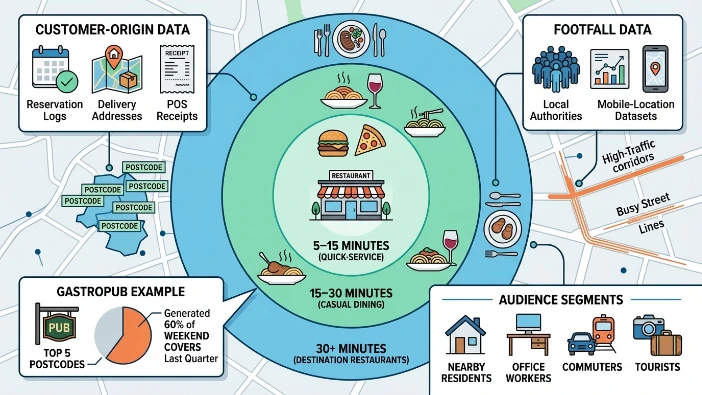
Use footfall data from local authorities or mobile-location datasets to locate high-traffic corridors. Select audience segments: nearby residents, office workers, commuters, tourists. A gastropub uses top five postcodes that generated 60% of weekend covers last quarter.
How do restaurants design effective banner creatives?
Banner creatives use clear headline, single call-to-action phrase, appetising food imagery, and readable typography sized for the display format. Use a single offer or message per creative. Include food photos with 1–2 focal items. Ensure text is legible at intended viewing distance: 24–30 point for printed banners, 14–18 px minimum for web banners.
Use contrasting colors for text and background to maintain 3:1 contrast ratio. Add location cues: neighbourhood name, distance, or map pin. For rotating digital banners, limit animations to 2 seconds per frame and 3 frames total. Example: a digital 728×90 banner shows “Lunch from £6 to 10 mins away” with a photo of the lunch bowl.
How do restaurants choose locations and channels for banners?
Restaurants select channels by audience presence: local news websites, commuter routes, shopping centres, and street-side clusters with proven footfall metrics. Online channels include local publisher websites, programmatic displays targeted by postcode, and social platforms’ local placements.
Offline channels include bus shelters, market stalls, car-park perimeters, and community noticeboards. CPM for online, production and installation cost per square metre for print, and expected daily impressions from footfall counts. Choose channels that align with audience habits: commuters see bus shelters, families see shopping-centre banners, office workers see local news sites. A bakery targets morning commuters with 6–9am shelter displays next to a rail station.
How does audience targeting work for local banner ads?
Audience targeting combines geo-targeting with behavioral and contextual signals to show banners to people likely to visit the restaurant. Geo-targeting restricts delivery to specific postcodes or radius. Time targeting limits exposure to peak decision windows (e.g., 11:00–13:30 for lunch). Contextual targeting places banners on pages about local events, recipes, or neighbourhood news. Behavioral targeting uses past site visits or search queries that indicate food intent. Show brunch banners to users within a 2-mile radius between 09:00–12:00 who viewed brunch menus. Targeting parents attending a weekend market with banners on the market’s event page.
How do restaurants measure local banner campaign performance?
Restaurants measure performance using reach, impressions, CTR, footfall lift, coupon redemptions, and incremental visits compared to baseline periods. Set baseline metrics from past traffic for the same weekdays and hours. Track online metrics: impressions, clicks, CTR, view-through conversions. Track offline impact: unique redeemable codes on banners, promo QR scans, reservation source fields, and POS tagging. Use A/B geographic testing: run banners in test areas and compare to control areas with similar demographics. Calculate cost per incremental visit: (media cost + production cost) / incremental visits. Example: a campaign shows a 12% lift in evening covers in the test area versus control.
How do restaurants link banners to conversion actions?
Restaurants connect banners to conversions through landing pages, unique promo codes, and reservation or ordering links that record referral source. Use a short URL or QR code that maps to a landing page with the offer and booking widget.
Assign unique promo codes for each banner placement to track redemptions. For delivery, include a deep link to the restaurant’s ordering page with a UTM parameter to attribute orders. For walk-ins, use staff prompts to ask customers “How did you hear about us?” and record answers at POS. A vinyl banner includes QR code with code “SUMMER10” tracked in the POS system.
How do restaurants optimise banner campaigns over time?
Restaurants optimise by testing creatives, adjusting geo and time windows, and reallocating spend to top-performing placements using measured KPIs. Run short A/B tests for headlines, imagery, and offers. Pause placements with CTR below campaign average by 30% after a minimum 7-day run. Shift budget to placements showing the highest conversion rate or footfall lift. Tighten geo-targeting around postcodes with the best incremental visit rate. Update creatives every 2–4 weeks to combat ad fatigue. Swapping a dinner-focused banner for a weekday-lunch creative improves midday CTR by 22%.
What legal and local regulations affect banner advertising?
Banner advertising follows planning permission, local council advertising codes, and online data-privacy laws for targeted delivery. Physical banners require council permits if placed on public property. Follow local size, material, and illumination rules. Online targeted ads must comply with the UK data protection framework and cookie-consent requirements for tracking. Ensure claim accuracy in offers and display terms plainly on the landing page. Illuminated fascia banners need council approval in conservation areas.
Explore More Expert Insights:
How Food Delivery Apps Boost Orders Using Banner Ads
How Restaurants Increase Orders Using Banner Ad Campaigns
What are standard creative and technical specifications for banners?
Specifications include resolution, file formats, safe-area margins, and weight limits to ensure readability across devices and placements. Web banners: common sizes include 300×250, 728×90, and 320×50. File types: PNG, JPG, or animated GIF; max size 150 KB for most publishers. Digital OOH provide high-resolution images at the display DPI; use CMYK for print. Include 8–10% safe-area margin around text to avoid cropping. Provide alternate versions for retina displays at 2× resolution. Example: a 300×250 web banner at 600×500 pixels for high-density screens.
What use cases show clear value for local banner advertising?
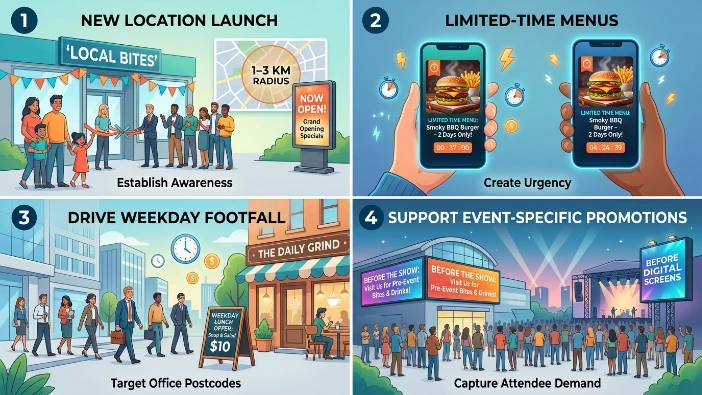
Use cases include launching a new location, promoting limited-time menus, driving weekday footfall, and supporting event-specific promotions. New location launches use wide-reach banners across 1–3 km radii to establish awareness. Limited-time menus use short-run digital banners with time-limited offers to create urgency. Weekday-lift campaigns target office postcodes with lunch offers to increase off-peak covers.
Event promotions place banners near venues and on event pages to capture attendee demand. A new restaurant used a 2-week banner run within a 2-km radius to reach 40,000 residents before opening.
Explore More Expert Insights:
How Restaurants Increase Food Consideration Using Display Campaigns
Local banner advertising combines geographic targeting, channel selection, measurable creative, and clear conversion paths to attract nearby customers. Restaurants define target areas using travel-time and customer-origin data, design single-message creatives, choose channels aligned with audience habits, and measure impact via digital metrics and offline redemption tracking. Testing and iterative optimisation improve ROI while legal compliance ensures permitted placement and data privacy.
Read More for Better Understanding:
Restaurant Display Ads That Convert Food Interest Into Checkout Orders