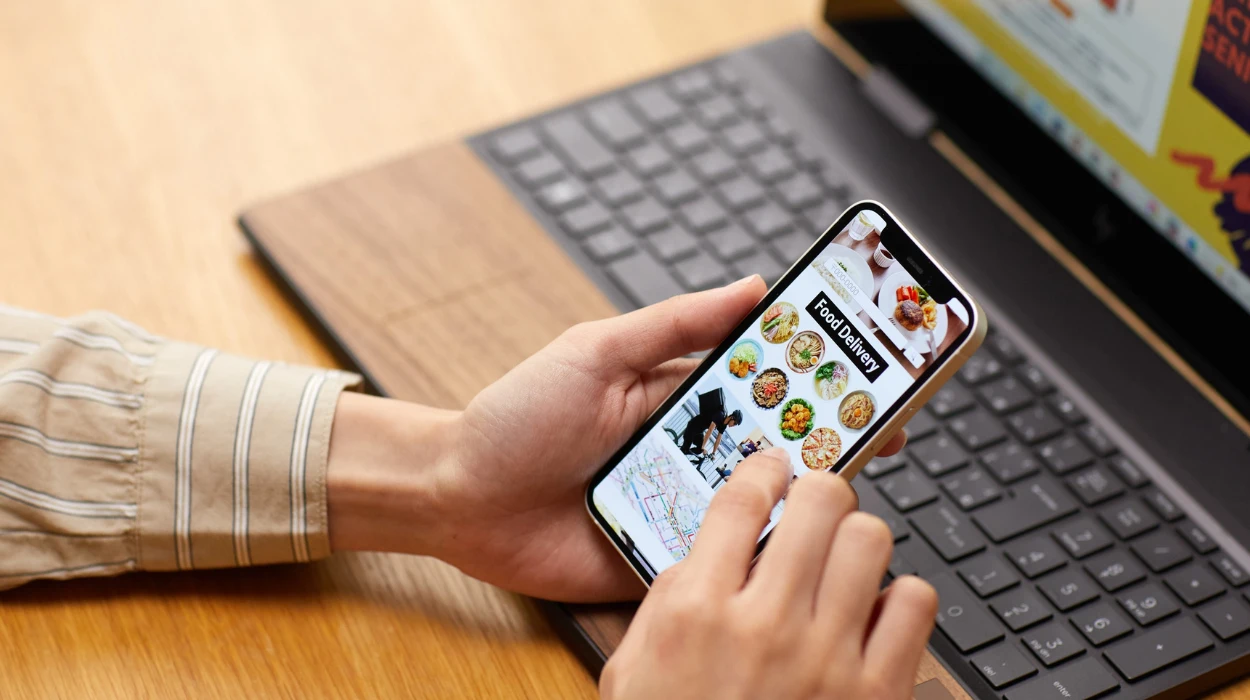
Banner ads are rectangular digital display ads that deliver concise messages; food delivery apps use them inside apps and on websites to promote items, offers, and features to users.
Banner ads are defined as fixed-size graphics displayed on digital screens. Common sizes include 320×50 pixels (mobile leaderboard), 300×250 pixels (medium rectangle), and 728×90 pixels (desktop leaderboard). Food delivery apps place these banners in high-visibility zones: home feed headers, category pages, checkout screens, and push-notification-style in-app slots. Banners carry clear elements: headline text, short description (5–12 words), a visual (product image or icon), and a call-to-action phrase in the creative (for example, “Order now” as UI text). Delivery apps control placement using an internal ad manager or an ad-serving SDK that assigns banners to user segments.
Banner formats include static images (JPEG, PNG), animated GIFs, and HTML5 banners that allow interactivity. Static banners use lower bandwidth. HTML5 banners support simple animations, timers, and click-through tracking. File sizes typically remain under 150 KB for mobile banners to limit load times.
How do banner ads increase order volume?
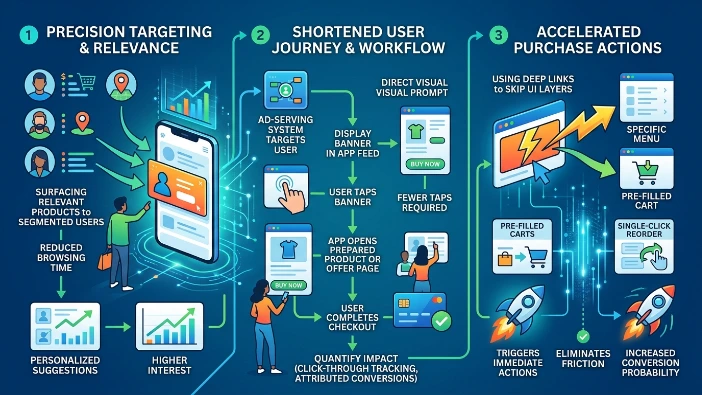
Banner ads increase orders by surfacing relevant products to segmented users, shortening decision time, and triggering immediate purchase actions inside the app.
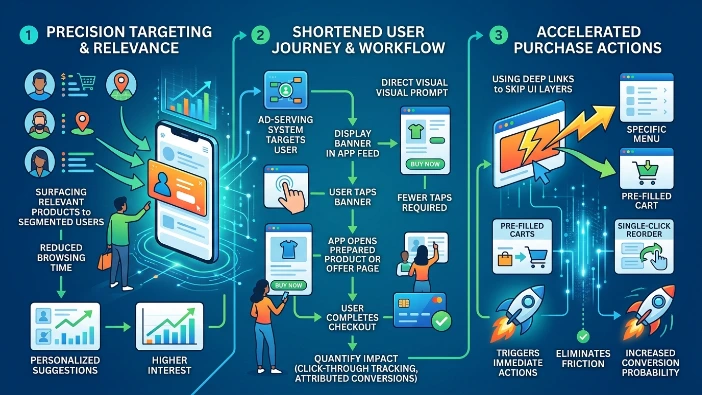
Banners present a direct visual prompt that reduces the number of taps required to reach a product page. Apps pair banner impressions with click-through tracking and attributed conversions to quantify impact. A typical workflow: the ad-serving system targets a user, displays a banner in the app feed, the user taps the banner, the app opens a prepared product or offer page, and the user completes the checkout. Each tap-to-order path eliminates browsing friction and increases conversion probability compared with organic discovery.
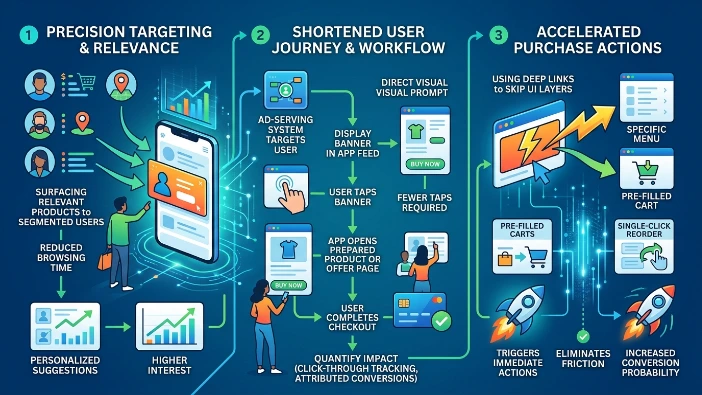
Banners use deep links to open specific menus or cart pages. Deep links skip multiple UI layers. Pre-filled carts and single-click reorder options follow banner clicks to speed checkout.
Which targeting methods improve banner ad effectiveness?
Targeting methods include behavioural targeting, location targeting, time-based targeting, and loyalty-segment targeting; combinations of these yield higher relevance and higher order rates.
Behavioural targeting relies on in-app signals: previous orders, browsing history, saved favourites, and search queries. Location targeting uses GPS or postal code to show restaurants that deliver to the user’s current area. Time-based targeting shows breakfast items in morning hours and dinner bundles in evening hours. Loyalty-segment targeting separates new users, repeat customers, and high-frequency customers into different message flows.
Apps store structured user events with timestamps. Ordered_pizza” event, “viewed_item:chicken_wrap” event, and “added_to_cart” event. Ad logic queries these events to select banners based on rules or models. Rule example: show “10% off first basket” banner when user has zero completed orders and has opened the app three times in the last 7 days.
What metrics track banner ad performance?
Key metrics are impressions, click-through rate (CTR), conversion rate (CR), cost per acquisition (CPA), and revenue per mille (RPM); these metrics measure exposure, engagement, and direct order outcomes.
Impressions count how often the banner appeared. CTR equals clicks divided by impressions. CR equals completed orders divided by clicks. CPA divides marketing spend tied to banner campaigns by orders attributed to the campaign. RPM measures revenue generated per 1,000 impressions. Apps also track lifetime value (LTV) of customers acquired through banner-driven orders to assess long-term impact.
Attribution uses deterministic signals like device identifiers and session IDs or probabilistic windows such as last-click within 30 minutes. Many apps use first-touch and last-touch layered attribution to produce multi-touch models for internal analyses.
What components make an effective banner ad for food delivery?
An effective banner contains a concise headline, clear visual of the food item, a simple value proposition (discount, speed, bundle), and a tappable deep link to the purchase flow.
Headline length typically ranges from 3 to 6 words. Visuals focus on a single dish or a bundle image. Value propositions use specific numbers: “£3 delivery”, “25% off”, “2-for-1”, or “30-minute delivery”. Buttons use short action text: “Order”, “Save £3”, “View menu”. Creative assets follow platform guidelines on resolution and file size to preserve load speed.
Apps perform A/B tests with variations in headline, image, and value copy. Tests run for a minimum sample size of several thousand impressions to reach statistical validity given typical CTRs of 0.5–2% for in-app banners. Resulting data informs creative rotation policies.
How do banner ads fit within the overall order funnel?
Banner ads serve as top-to-mid funnel touchpoints that drive discovery and quick-purchase actions, converting awareness into a purchase intent and then into completed orders.
At the awareness stage, banners introduce new menus and categories. At the consideration stage, banners highlight offers and time-limited bundles that increase intent. At the conversion stage, banners include deep links to pre-populated carts and checkout shortcuts that finalise orders. Banners also participate in retention by re-engaging previous customers with tailored offers.
Banners integrate with push notifications, email reminders, and in-app messaging. A user who sees a banner and does not click might receive a follow-up push message with the same offer, increasing touch frequency while preserving consistency across channels.
What benefits do banner ad campaigns deliver for food delivery platforms?
Banner campaigns deliver increased short-term order volume, higher average order value when bundles are promoted, improved menu discovery, and measurable ROI through direct attribution.
Promoting bundles and combos through banners raises average order value by 10–30% depending on offer structure. Displaying limited-time discounts increases order urgency and average weekly orders among targeted cohorts. Improved menu discovery boosts long-tail restaurant exposure and balances demand distribution across partners.
Banners enable dynamic pricing and inventory-driven merchandising. Apps remove items from rotation when supply is low and insert alternatives with matching offers, reducing order cancellations and maintaining customer satisfaction.
Where are banners most effective in real use cases?
Banner ads work effectively on the app home feed, category pages, checkout screens, and on web landing pages to prompt immediate orders or highlight time-sensitive offers.
Examples include promoting a lunchtime fixed-price meal on the home feed between 11:00 and 14:00, highlighting a “£5 delivery” banner on the checkout screen for users close to completing orders, and surfacing a weekend family bundle in category pages on Friday evenings.
High-frequency users (4+ orders per month) respond to loyalty bundles. New users respond to onboarding offers highlighted in banners. Price-sensitive users respond to delivery-fee discounts presented prominently.
Explore More Expert Insights:
How Restaurants Build Order Intent Using Menu Banner Advertising
How Travel Brands Increase Holiday Consideration Using Banner Campaigns
What privacy and compliance practices apply to banner ad targeting?
Apps must obtain consent where legally required, store minimal personal data, and comply with local regulations such as the UK’s Data Protection Act and GDPR when targeting users.
Consent covers cookies and device-level identifiers for web banners. Apps use consent flags to enable or disable personalised creatives. Data retention policies specify maximum storage durations for behavioural logs, often 13 months for marketing analytics. Pseudonymisation and access controls limit exposure to raw personal data.
Consent records live in a consent management platform (CMP) or an in-app consent flag. Ad servers check this flag before returning personalised creatives. When consent is denied, apps serve contextual or non-personalised banners based on page content instead of behavioural data.
Find Out More:
How Food Delivery Apps Nurture Users Using Offer-Based Banner Ads
How do apps measure long-term value from banner-driven orders?
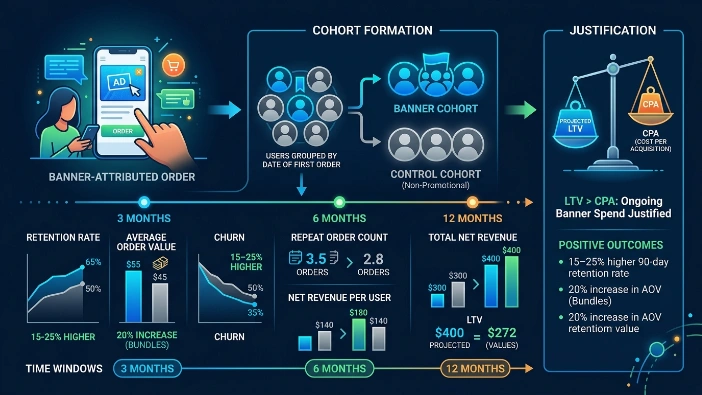
Long-term value measurement uses cohort analysis comparing retention, average order value, and churn over 3, 6, and 12 months for users acquired or reactivated via banners.
Cohorts begin at the date of first banner-attributed order. Analysts track repeat order counts, average basket size, and net revenue per user across windows. Comparing cohorts exposed to banners versus control cohorts that saw non-promotional creatives isolates the incremental LTV impact.
Positive outcomes include a 15–25% higher 90-day retention rate for banner-acquired cohorts or a 20% increase in average order value when bundles were the main promoted asset. CPA must remain below the projected LTV to justify ongoing banner spend.
Read the Full Blog Here:
Food Delivery Ads That Turn Offer Engagement Into Completed Purchases
Banner ads are a focused, measurable method for food delivery apps to increase orders. They work through precise targeting, concise creatives, and friction-reducing deep links. Tracking CTR, CR, CPA, and cohort LTV provides a clear assessment of campaign value. Apps maintain compliance by enforcing consent and minimising data retention. When designed and targeted with specific numbers and rules, banners convert discovery into immediate purchases and support long-term user retention.