Display advertising for restaurants is visual online advertising that presents food images or offers to users to drive clicks and conversions at checkout. Restaurant display ads use images, short text, targeting signals, and landing pages to move users from awareness to purchase.
Display advertising definition. Display ads are image or video creatives delivered on websites, apps, and connected-TV using programmatic or direct placements. Creative (image or video), ad server, demand-side platform (DSP), supply-side platform (SSP), data provider, and landing page. Each entity has measurable metrics: impressions, click-through rate (CTR), view-through conversions, and purchase conversions.
How display ads deliver purchases. Campaigns deliver creatives to targeted audiences. Targeting uses location signals, behavioural signals (food interest), contextual signals (food sections on sites), and first-party data (past visitors). Ads link to order pages or menus optimised for checkout. Conversion tracking records which ad exposure led to a placed order.
A London pizza restaurant uses images of a pepperoni pizza, targets users within 3 miles who searched “best pizza near me,” and routes clicks to an online checkout page. The campaign reports impressions, clicks, and completed orders.
How do restaurants set conversion-focused goals for display campaigns?
Restaurants set specific numeric goals such as 30-day orders, cost-per-acquisition £8, and a 5% checkout conversion rate to measure campaign success. Define measurable objectives aligned to checkout outcomes. Typical goals include orders per week, average order value (AOV), return on ad spend (ROAS), and cost per new customer.
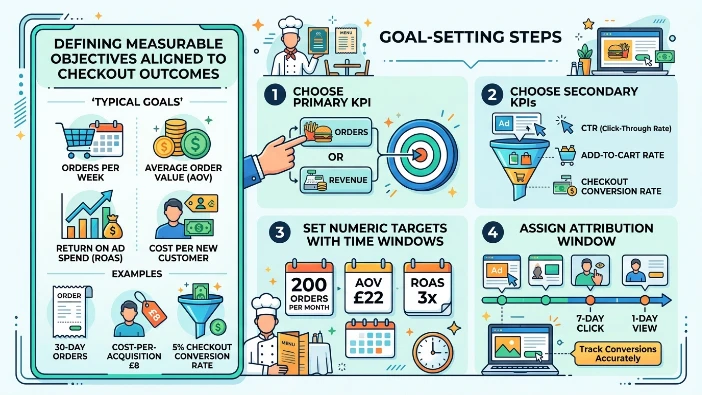
Goal-setting steps. Choose primary KPI (orders or revenue). Choose secondary KPIs (CTR, add-to-cart rate, checkout conversion rate). Set numeric targets with time windows, 200 orders per month, AOV £22, and ROAS 3x. Assign attribution window, for example 7-day click, 1-day view, to track conversions accurately.
What audience signals drive higher checkout conversions for restaurant display ads?
High-value audience signals include recent local search for food, past website visitors who viewed menu, loyalty members, and nearby device locations. Define each signal and its conversion value. Recent local search indicates active intent. Past visitors who viewed menu pages show product interest. Loyalty members show higher average order value. Nearby device locations indicate immediate physical proximity.
How to use signals. Combine signals: target users who searched “takeaway near me” within 7 days and visited menu pages in last 30 days. Use layering: location within 5 km AND visited checkout page previously. Use exclusion: exclude recent converters for acquisition campaigns.
A Cardiff bistro targets users who visited its menu page in past 14 days and are within 10 km, increasing checkout rates by recorded lift in conversions.
What creative elements increase click-to-checkout rates?
Creative elements that raise conversions include clear product images, single-line offers, visible price, and a direct link to the checkout page. Define creative elements. Product image high-resolution food photo sized for ad unit. Offer text: concise value proposition such as “20% off first order.” Price display: shows starting price or AOV. Call-to-action: explicit checkout pathway such as “Order Now” linking to a pre-filled cart. Landing page match: creative and landing page must align.
How to implement creative. Use image templates for consistency. Test 2–4 variations of headline and image in rotation. Use a single promotional message per creative. Ensure the landing page loads in under 3 seconds on mobile and shows checkout flow in two taps. A Manchester dessert shop runs two creatives: one showing product close-up and “£5 dessert” headline, and one showing bundle offer with “Order for two £9.” The close-up creative yields higher add-to-cart rates.
Which targeting and bidding strategies optimise checkout conversions?
Targeting that combines local radius, recent intent, and first-party lists, with conversion-focused bidding (target CPA or ROAS), improves checkout conversion rates. Targeting types. Local radius targeting restricts delivery to users within a set distance. Intent-based targeting uses recent search or browsing behaviour. First-party list targeting uses email or device IDs of past customers. Contextual targeting places ads on food-related content.
Bidding strategies. Use target CPA bidding to optimise towards a fixed cost per order. Use target ROAS when revenue per order is priority. Use enhanced conversions and server-side tracking to feed conversion signals back to bidding systems.
How should landing pages and checkout flows be designed for display-driven orders?
Landing pages must match ad creative, present product options clearly, and enable checkout in two or three taps on mobile. Core landing page elements. Headline that matches ad text. Product images and short descriptions. Clear price and fees. Pre-selected popular options to reduce friction. Prominent checkout button. Minimal form fields; accept guest checkout. Fast page speed and secure payment badge.
Checkout flow metrics to monitor. Add-to-cart rate, cart abandonment rate, and successful payment rate. Reduce abandonment by showing delivery times and estimated total before payment.
What measurement and attribution methods ensure accurate ROI reporting?
Use conversion tracking with server-side events, multi-touch attribution windows, and UTM-tagged landing pages to attribute orders accurately. Define tracking components. Client-side pixels capture clicks and page events. Server-side tracking sends order-confirmation events from the restaurant server. UTM parameters identify campaign, creative, and keyword. Attribution windows set how long after ad exposure a conversion counts. Use last-click for simple internal reporting or data-driven attribution for multi-touch reporting. Reconcile ad platform data with order system data weekly. Track lifetime value (LTV) for repeat customers to calculate long-term ROAS.
What budget allocation and pacing practices drive checkout outcomes?
Allocate budget by channel performance, reserve 20% for audience testing, and pace budgets daily with conversion-based caps. Allocate to highest-converting targets first. Reserve a test pool (20% of total) for new creatives or segments. Set daily caps to avoid overspending early in the day. Use bid multipliers for peak dining hours, for example 17:00–20:00.
Pacing and scaling. Increase budget for segments with CPA below target by 20% weekly. Pause segments with CPA above 30% of target. Monitor frequency to avoid ad fatigue; cap frequency at 3–4 impressions per week per user.
Explore More Expert Insights:
Food Delivery Ads That Turn Offer Engagement Into Completed Purchases
Restaurant Banner Ads That Convert Menu Views Into Online Orders
What are practical use cases and expected outcomes for restaurant display ads?
Use cases include new-location launch, daypart promotions, slow-day demand stimulation, and recovery campaigns for lapsed customers; expected outcomes are orders, higher AOV, and improved ROAS. Use-case details. New-location launch drives local awareness and first orders. Daypart promotions target breakfast, lunch, or dinner windows to fill capacity. Slow-day promotions offer discounts to boost weekday sales. Lapsed-customer campaigns re-engage customers with personalised offers.
Must-Read Detailed Guide:
How Restaurants Attract Customers Using Local Banner Advertising
Expected metrics. First-order conversion rates range from 0.5% to 3% depending on targeting. Average order value lift of 10%–25% when bundling offers. ROAS target typically 2x–4x for efficient campaigns.
How do restaurants scale and optimise campaigns over time?
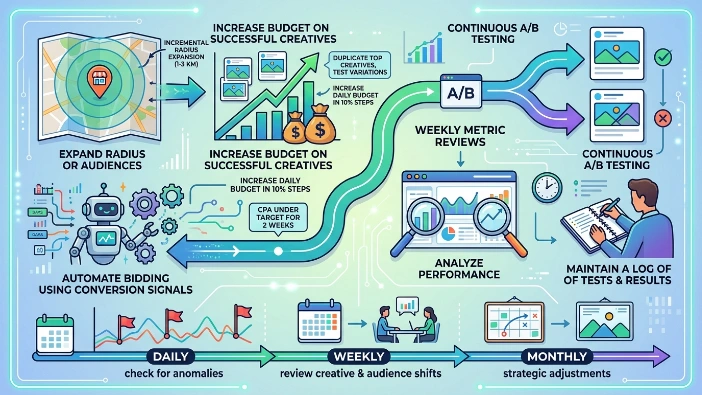
Scale by expanding radius or audiences, increase budget on successful creatives, and automate bidding using conversion signals; optimise by continuous A/B testing and weekly metric reviews. Expand geographic radius incrementally by 1–3 km after stable performance. Duplicate top-performing creatives and test minor variations. Increase daily budget in 10% steps when CPA remains under target for two weeks.
Optimisation cadence. Review performance daily for anomalies, weekly for creative and audience shifts, and monthly for strategic adjustments. Maintain a log of tests and results.
Discover the Full Information:
How Restaurants Increase Food Consideration Using Display Campaigns