A display campaign is a digital advertising programme that places visual ads (banners, rich media, video) on websites and apps to expose audiences to food offers and dining messages. Display campaigns deliver images, text, and tracking pixels to target audiences across the open web and ad networks.
Display campaigns consist of creative assets, audience targeting rules, bidding methods, and measurement tags. Creative assets include static banners (JPEG, PNG), animated GIFs, HTML5 rich media, and short videos (6–30 seconds). Audience targeting uses geolocation, contextual signals, behavioural signals, and first-party data lists.
Bidding methods use cost-per-thousand impressions (CPM), cost-per-click (CPC), or viewable CPM (vCPM). Measurement uses pixels, conversions APIs, and viewability metrics to record impressions and clicks. Publishers include news sites, local blogs, and food-review platforms. Ad networks include open exchanges and private marketplaces.
How do display campaigns increase food consideration?
Display campaigns increase food consideration by repeatedly exposing targeted users to menu visuals and offers, improving brand recall and intent through frequency and contextual relevance. Repeated exposure builds recognition and prompts users to move from unaware to interested.
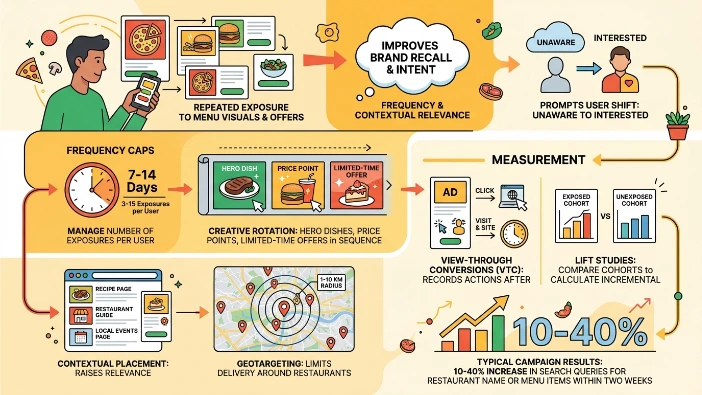
Campaigns use frequency caps to manage the number of exposures per user, typically 3–15 exposures over 7–14 days. Contextual placement on recipe pages, restaurant guides, or local events pages raises relevance. Geotargeting limits delivery to a radius around each restaurant, commonly 1–10 kilometres for urban UK locations. Creative rotates to show hero dishes, price points, and limited-time offers in sequence.
Measurement focuses on view-through conversions (VTC) and lift studies. VTC records actions after an ad impression; lift studies compare exposed vs unexposed cohorts to calculate incremental consideration uplift. Typical campaigns report 10–40% increases in search queries for the restaurant name or menu items within two weeks.
What audience signals should restaurants use?
Use geolocation, interest categories (food and drink), in-market dining intent, and first-party guest lists to reach likely diners. Combine signals to refine reach and prioritise users with higher propensity to visit.
Geolocation uses postal codes, city boundaries, and radius targeting. For UK urban restaurants, set radii between 1 and 5 kilometres around the venue for walk-in traffic and 5–20 kilometres for destination dining. Interest categories include casual dining, fast food, vegan cuisine, and coffee shops. In-market segments identify users actively researching restaurants or menus via recent site searches or food app activity. First-party lists include reservation records, newsletter subscribers, and loyalty members exported as hashed email lists. Create lookalike audiences from top 1%–5% of high-value guests for scaled prospecting. Use household income proxies only where compliant with local privacy rules.
Read the Full Blog Here:
How Restaurants Attract Customers Using Local Banner Advertising
How should restaurants structure campaign creatives?
Structure creatives with a clear primary image of the dish, concise headline, and a visible localising element (postcode, distance, or town). Use sizes that match common placements and ensure images meet file-size limits.
Primary image should show one clear dish on 2–3 second focus for animated ads. Headline length should stay within 20–30 characters for legibility on small screens. Add a localising line such as “10 minutes from Camden” or “NW1 Free delivery” to improve relevance. Recommended sizes include 300×250, 728×90, 300×600, and 320×50 for mobile. Keep file sizes under 150 KB for static banners and 500 KB for HTML5 rich media where networks allow. Use a single callout for specials (e.g., “Fixed-price lunch £12”) without extra promotional language. Include a tracking pixel and alt text describing the dish and location for accessibility and measurement.
Which metrics show increased food consideration?
View-through conversions, branded search lift, and engagement rate (hover or interaction). Secondary metrics: imps per unique user, time-on-site from ad clicks, and assisted conversions. Track both direct actions and upstream signals that indicate intent.
View-through conversions record when a user later visits the restaurant’s menu or reservation page after an impression. Branded search lift measures percentage increase in search volume for the restaurant name or menu items versus a baseline period. Engagement rate for rich media reports interactions such as hover, expansion, or video play, often shown as percentage of served impressions. Impressions per unique user and frequency indicate saturation and fatigue; ideal frequency is 3–7 across two weeks for awareness-to-consideration phases. Time-on-site from ad clicks longer than 60 seconds suggests genuine menu exploration. Assisted conversions attribute offline or later online bookings to previous ad exposures across channels.
How do restaurants combine display with search and social?
Use coordinated creative and shared audiences to move users from awareness to consideration across display, search, and social. Share hashed audiences and synchronise messaging for consistent user journeys.
Export first-party audiences from reservation and CRM systems and upload to display and social platforms as hashed email lists. Use the same hero images and headline theme across channels to create recognisable cues. When a user engages with a display ad but does not convert, serve a follow-up search-targeted creative for relevant keywords like “lunch near me” or the dish name. Use social platforms for high-engagement video versions of the same creative and drive users to menu pages. Measure cross-channel attribution using last-click and data-driven models to assign incremental value to display exposures that precede search and social actions. Track conversions across platforms using a shared UTM schema and central attribution reporting.
What targeting and bidding strategies work for consideration stages?
Use a mix of contextual and audience targeting, apply CPM bidding for reach, and switch to CPC or CPA for lower-funnel retargeting. Adjust bids by time of day, day of week, and distance from the venue.
Contextual targeting places ads on recipe pages, local event listings, and food blogs. Audience targeting uses in-market dining signals and first-party lists. For prospecting, use CPM bidding to maximise viewable reach within a defined radius. For retargeting users who previously visited the menu or reservation page, use CPC or CPA bidding to prioritise actions. Increase bids during peak dining hours: 11:00–14:00 and 17:00–21:00 local time. Reduce bids by 20–40% during low-traffic windows. Apply bid multipliers for users within 1 kilometre of the venue, and for users who opened a reservation confirmation email in the past 30 days.
What legal and privacy rules apply in the UK?
Comply with UK GDPR and the Privacy and Electronic Communications Regulations when using targeting, cookies, and first-party data for display campaigns. Obtain clear consent where required and document processing activities. Collect and store personal data with lawful basis and retention limits. Use consent banners that disclose cookie purposes for advertising and analytics. When exporting first-party lists to ad platforms, hash emails using SHA‑256 and follow platform requirements.
Conduct Data Protection Impact Assessments for large-scale profiling. Respect opt-outs and maintain suppression lists for unsubscribed users. Keep records of third-party processors and ensure contractual data processing agreements exist.
Explore More Expert Insights:
How Food Delivery Apps Nurture Users Using Offer-Based Banner Ads
How Restaurants Build Order Intent Using Menu Banner Advertising
What are practical use cases and examples?
Promoting weekday lunch offers, driving weekend dinner reservations, advertising takeaway menus for delivery windows, and re-engaging lapsed guests with seasonal menus. Run a lunchtime banner rotation showing two fixed-price dishes in central London with a 2 km radius targeting weekend dinner audiences in Manchester with an animated ad highlighting weekend tasting menus and available slots; retarget users who viewed the menu but did not book with a two-day offer banner showing available times.
How to evaluate campaign success after one month?
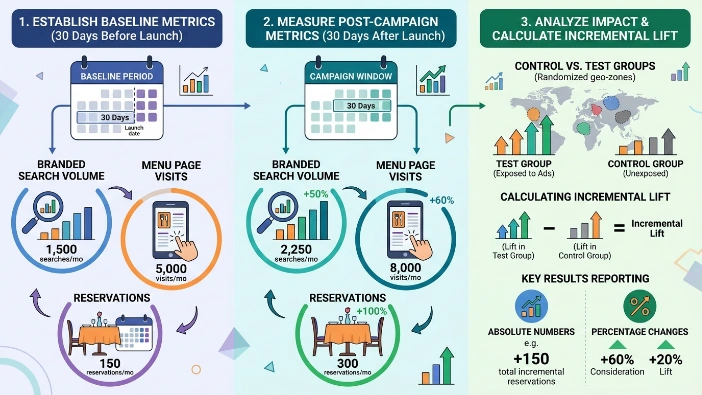
Compare baseline metrics with post-campaign metrics for branded search volume, menu page visits, and reservation lift; calculate incremental visits attributed to ads. Use a defined measurement window and control cohort where possible.
Dive Deeper Into This Topic:
Restaurant Display Ads That Convert Food Interest Into Checkout Orders
Set a baseline for 30 days before launch. Measure 30 days during campaign. Key comparison points: percentage change in branded searches, change in menu page visits, and number of reservations traced to ad clicks or view-through conversions. If using a control cohort, randomise geo-zones or audience segments and compare lift in exposed vs unexposed groups. Report results with absolute numbers and percentage changes to show impact on consideration.