Banner ads display a restaurant’s menu items, details, and ordering pathways within publishers’ sites, food apps, or ad networks. They include static images, animated GIFs, or HTML5 creatives sized for desktop and mobile placements. Key entities: creative (image or HTML5 file), landing page (menu or ordering page), tracking pixel (order attribution), and payment funnel (checkout integration).
How do banner ads convert menu views into orders?
Conversion happens by showing a targeted menu offer, linking to a pre-filled order page, and tracking clicks through an attribution pixel to confirm completed purchases.
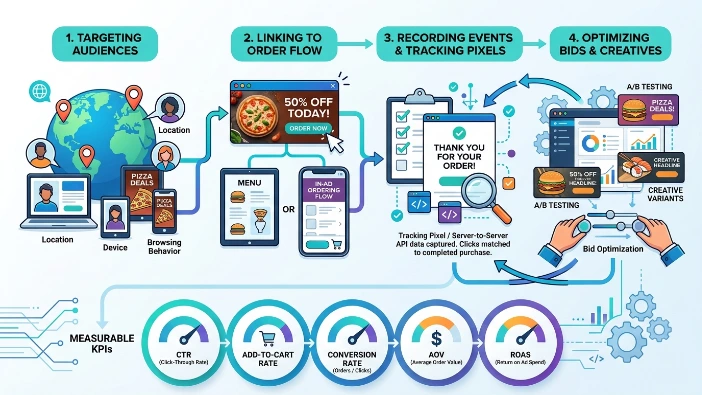
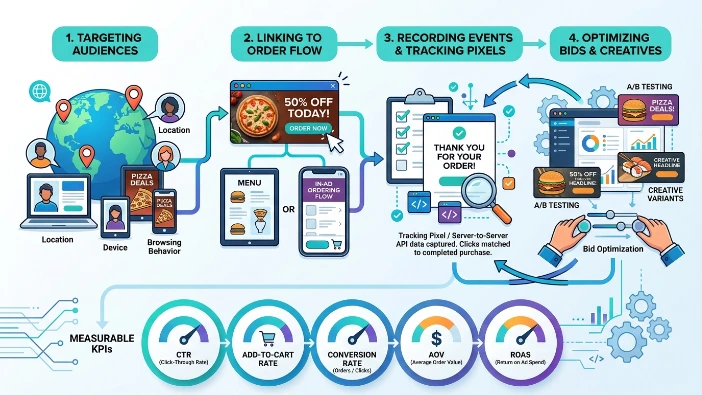
First, an ad targets audiences by location, device, or browsing behaviour. Second, the ad links to a menu page or an in-ad ordering flow. Third, the site or app records events with tracking pixels or server-to-server APIs to match clicks to completed orders. Fourth, conversion data feeds back to optimise bids and creative variants. Measurable KPIs include click-through rate (CTR), add-to-cart rate, conversion rate (orders divided by clicks), average order value (AOV), and return on ad spend (ROAS).
Which components must a banner ad campaign include to convert effectively?
A converting campaign includes targeted audience segments, menu-focused creative, a fast ordering landing page, tracking infrastructure, and bid strategies aligned to order value. Each component maps to measurable outcomes and optimisations.
Targeting defines where impressions appear and which users see the ad. Creative highlights single items or combos with clear pricing and urgency. The landing page pre-fills item selections, displays delivery fee, and supports one-click checkout where legally permitted. Tracking uses pixels and server events to attribute orders. Bidding uses CPA or ROAS goals matching target margins. Use exact sizes for creatives (e.g., 300×250, 320×50, 728×90) and compress images below 200 KB for mobile speed.
When should restaurants use menu-focused banner ads in their marketing mix?
Use banner ads when the goal is to scale online orders quickly in specific catchment areas or during limited-time promotions. Banner ads suit launch periods, new-item pushes, weekday low-demand windows, and retention of high-value customers.
Deploy ads during lunch (11:00–14:00) and dinner (17:00–21:00) windows to match ordering intent. Use geo-targeting to a radius of 1–3 miles for delivery-only venues and 5–10 miles for hybrid dine-in options. Prioritise zip codes with ≥100 monthly local searches for delivery-related keywords to increase relevance.
How should restaurants design creatives to increase clicks and orders?
Design creatives that show one clear menu item, price, delivery time, and a single action button; use high-contrast images and readable fonts across devices. Limit text overlays to three words maximum for legibility on small screens.
Choose photography showing the plated item at 1,200–1,600 px for desktop cropping, then export responsive sizes. Use food item names that match menu labels and include price or discount (for example: “Margherita £7 — 20 min”). Add visible delivery time estimates and a single button labelled “Order Now.” Use brand colours for recognition and a contrasting CTA colour for visibility.
What tracking and attribution are required to measure true conversions?
Implement pixel-based event tracking for clicks and a server-to-server order event that sends order ID, value, and timestamp for accurate attribution. Combine first-party cookies with hashed identifiers to comply with privacy rules.
Tag impressions and clicks with UTM parameters. Fire a click event on ad click and a purchase event at order confirmation. Send order values to campaign analytics to calculate ROAS. Use post-click windows of 1–3 days for delivery orders to capture delayed checkouts. Validate attribution by matching order IDs and hashed emails between ad click and transaction records.
Which technical integrations ensure frictionless ordering after an ad click?
Ensure the landing page supports pre-filled carts, mobile payment options, and a secure checkout with a 1–2 step process; integrate with the POS or order management system to sync inventory. Minimise steps between click and order completion.
Pre-fill the cart using URL parameters that include menu item ID and modifiers. Support Apple Pay and Google Pay to reduce checkout time to under 30 seconds. Use real-time inventory checks to prevent sold-out discrepancies. Confirm orders via email or SMS and send order status updates to reduce cancellations and disputes.
How do pricing and offers in banner ads affect conversion rates?
Clear, time-bound pricing and bundle offers increase conversion rates by providing immediate value; test fixed-price combos and percent discounts to identify highest AOV lift. Track performance at the creative level to find the most effective price point.
Single-item discount (e.g., £2 off Margherita), bundle price (e.g., pizza + drink £10), and free delivery threshold (e.g., free delivery over £15). Compare AOV, conversion rate, and incremental orders. Use statistical tests with at least 1,000 impressions per variant to determine significance.
How should restaurants optimise bidding and budget to prioritise profitable orders?
Optimise bids using cost-per-acquisition (CPA) targets tied to profit margins and shift budget to creatives and placements that deliver orders with a positive ROAS. Use automated bidding where available, seeded by historical order cost data.
Set CPA targets equal to the margin you accept per new order. For example, if average margin is £6 and AOV is £18, set CPA ≤ £6. Increase bids by 10–25% for top-performing placements during lunch and dinner windows. Reallocate 20% of budget weekly from low-conversion placements to high-performing ones for continuous improvement.
Click Here to Explore More:
How Restaurants Increase Orders Using Banner Ad Campaigns
What privacy and compliance steps must campaigns follow in the UK?
Comply with UK data protection laws by obtaining consent for tracking, using first-party data where possible, and anonymising personal identifiers before analytic processing. Provide clear privacy notices and allow users to opt out of personalised advertising.
Use consent management platforms to capture user consent before firing non-essential cookies. Hash email addresses and phone numbers before matching to ad platforms. Store consent logs for 12 months as part of audit readiness. Follow Advertising Standards Authority guidance for clarity in offers and pricing.
Explore More Expert Insights:
Holiday Travel Ads That Turn Seasonal Interest Into Final Bookings
Tourism Ads That Convert Destination Excitement Into Booking Actions
Who benefits from menu banner ad campaigns and how are use cases distinct?
Restaurants of all sizes benefit: quick-service venues increase order frequency; independent restaurants expand local reach; chains optimise cross-store promotions using regional creatives. Examples: a 12-seat café increases weekday lunch orders; a 20-branch chain runs regional combos a dark kitchen scales delivery-only offers.
Quick-service restaurants use single-item promos to drive high-volume transactions. Independent venues use localised creatives highlighting signature dishes. Chains use inventory-aware ads to route orders to the nearest kitchen. Dark kitchens use wide geo-broadening combined with time-limited discounts to saturate demand.
How do restaurants measure success and iterate campaigns?
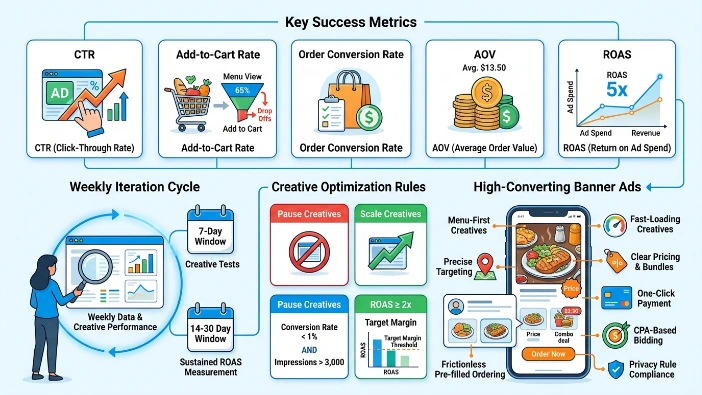
Measure success with a combination of CTR, add-to-cart rate, order conversion rate, AOV, and ROAS iterate weekly based on data and creative-level performance. Use 14–30 day windows for measuring sustained ROAS and 7-day windows for creative tests.
Report CTR and conversion rate per creative. Track add-to-cart to spot drop-offs between menu and checkout. Compare ROAS against target margin thresholds. Pause creatives with conversion rates below 1% after 3,000 impressions. Scale creatives that produce ROAS ≥ 2x the target margin.
Discover the Full Information:
How Restaurants Build Order Intent Using Menu Banner Advertising
Banner ads that convert menu views into online orders combine precise targeting, menu-first creatives, frictionless pre-filled ordering, and rigorous tracking. Implement CPA-based bidding, test pricing and bundles, and follow UK privacy rules. Use fast-loading creatives, clear pricing, and one-click payment options to reduce time from view to order and to improve measurable ROI.