A converting tourism ad turns audience interest into a measurable booking action by using clear offers, precise targeting, and direct booking pathways. It links destination appeal with immediate steps to reserve travel, tours, or accommodation.
A converting tourism ad defines the destination, the audience segment, and the exact booking outcome. Destination (city, region, attraction), ad creative (visual, headline), offer (price, date window), booking pathway (landing page, booking widget), and tracking metric (conversion rate, cost per booking). Converting ads use data: click-through-rate (CTR), conversion-rate (CVR), return on ad spend (ROAS). A coastal resort ad promotes a 3-night package for travel dates with a booking widget that records a 4.2% CVR.
How do converting tourism ads work?
Converting tourism ads work by matching audience intent signals with tailored creative and a frictionless booking flow that captures payments or reservations.
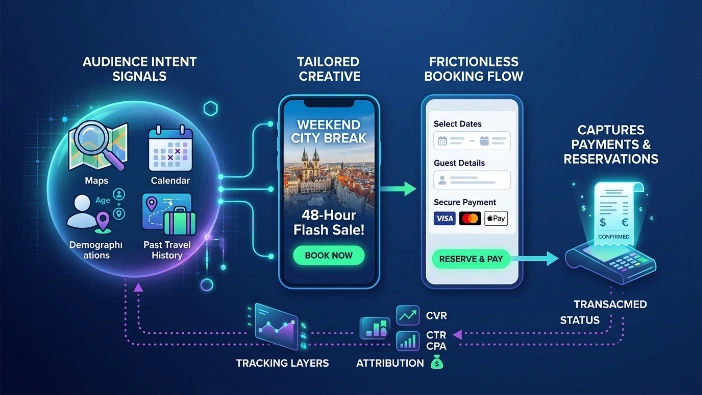
Ad systems identify intent through search terms, past travel behavior, and demographic data. Ads present a specific, time-bound offer and link to a booking endpoint. The booking endpoint captures traveler details and payment information. Tracking layers attribute bookings to ad impressions and clicks. Key metrics: CTR, CVR, cost per acquisition (CPA). Example: a city tour operator runs paid search for “weekend city break,” serves an ad featuring a 48-hour flash discount, and records conversions via a booking API.
What components make a tourism ad convert?
A converting tourism ad includes a destination identifier, a concrete offer, urgency or availability signals, a clear booking pathway, and tracking instrumentation.
Destination identifier names the location and core appeal. Concrete offer states exact price, dates, or inclusions. Urgency signals use inventory counts or fixed booking windows. Booking pathway links directly to a reservation form or booking engine without intermediate steps. Tracking instrumentation installs pixels, UTM parameters, and server-side event capture. Example: a heritage site promotion lists “entry + guided tour, £25, limited to 30 spots” with a one-click booking button.
Which creative elements increase conversion rates?
High-converting creative uses a prominent destination image, a concise headline with the offer, a visible price or savings claim, and a direct call to booking.
Images show the core attraction and travel context. Headlines include destination name and main offer in 6–10 words. Price or savings appears near the headline. Call to booking uses action verbs and exact outcomes, for example “Book 2 nights, save £50.” Video creative runs 15–30 seconds and displays the booking step at the end. Example: a regional airline ad uses a 20-second clip of landscapes and ends with “Book now — fares from £29.”
How is audience targeting structured for bookings?
Targeting focuses on intent signals, past purchase behaviour, geographic proximity, and travel window alignment to match likely bookers.
Intent signals include searches for destination names, accommodation types, and travel dates. Past purchase behaviour includes prior bookings and site interactions. Geographic proximity segments audiences within relevant origin markets. Travel window alignment targets users planning travel within 7–90 days for short breaks and 90–365 days for long-haul bookings. Lookalike audiences derive from existing bookers. Example: a UK-based lake district tour targets residents within 200 miles and users who searched “UK weekend breaks” in the last 30 days.
What booking pathways produce the best outcomes?
The best booking pathways are single-page reservation flows, native booking widgets, or direct phone-to-book options with confirmed availability shown instantly.
Single-page reservation flows reduce steps and auto-fill returning-user data. Native booking widgets embed availability and payment without leaving the ad ecosystem. Phone-to-book uses click-to-call with immediate availability checks for high-value or complex bookings. Confirmation pages include booking reference and next steps. Server-side tracking logs successful reservations and payment authorisations. Example: a coastal B&B offers a one-step booking form with saved card options that increases CVR by 25% versus multi-page flows.
How should offers and pricing be structured to drive bookings?
Offers must state exact savings, clear inclusions, and explicit booking windows to convert.
Use specific price points, e.g., “From £129 per room, 2 nights.” State inclusions: breakfast, transfers, taxes. Use fixed booking windows such as “Book by 30 June for travel 1 July–30 September.” Show inventory limits where applicable, for example “Only 12 rooms left.” Bundled offers combine accommodation and activities to increase perceived value. Example: a national park lodge advertises “Family package £399, includes guided hike and meals, valid 15 July–31 August.”
Which measurement and attribution methods ensure accuracy?
Use multi-touch attribution, server-to-server event capture, and booking-level reconciliation to attribute bookings to ads accurately.
Multi-touch attribution records ad impressions and clicks across channels. Server-to-server event capture reduces ad-blocker loss and records conversion events directly from the booking system. Booking-level reconciliation matches payments and booking IDs with ad campaign IDs. Use unique booking codes in ads to isolate ad-driven bookings. Report on CPA, CVR, ROAS, and lifetime value (LTV) where repeat bookings occur. Example: a tour operator uses UTM parameters and server-side postbacks to reconcile 98% of ad-driven bookings.
What landing page elements support conversion?
Landing pages must display the destination, the offer, real-time availability, a short reservation form, and trust signals such as secure payment and verified reviews.
Destination content includes one headline and one main image. Offer repeats clearly with price and dates. Real-time availability uses calendar widgets. Reservation forms request a minimum number of fields: name, email, dates, payment. Trust signals list secure payment badge, booking cancellation policy, and verified review count. Page load time must be under 3 seconds for mobile. Example: a boutique hotel landing page shows “£139, 2 nights” above a calendar and secure checkout button.
Which bidding and budget strategies optimise bookings?
Use conversion-optimised bidding, time-based bid adjustments, and allocation by booking window to maximise conversions within budget limits.
Conversion-optimised bidding targets CPA or target ROAS based on historical data. Increase bids during peak booking hours and reduce bids for audiences with low CVR. Allocate budget to campaigns for near-term travel windows if the booking window is 7–30 days. Reserve a portion of budget for remarketing to recent site visitors within 7 days. Example: a city attraction shifts 40% of weekly budget to last-minute booking audiences and records a 15% lift in weekly bookings.
How does remarketing increase final bookings?
Remarketing targets users who interacted but did not complete booking with reminders, price drops, and limited availability messages to convert them into bookers.
Segment audiences by action: viewed price, started booking, abandoned cart. Serve tailored creative: price reminder, new availability, or limited spots. Use dynamic ads that show the exact room or tour the user viewed. Frequency caps avoid ad fatigue by limiting impressions per user per day. Example: an attraction uses dynamic remarketing to show the exact ticket type a user viewed and increases completed bookings by 20%.
Dive Deeper Into This Topic:
How Tourism Services Increase Engagement Using Banner Ads
What legal and compliance elements are required for booking ads in the UK?
Booking ads must disclose total price including taxes and fees, provide cancellation terms, and protect personal data under UK GDPR.
Display total price up front, not just starting fares. Provide accessible cancellation and refund policies on the booking flow. Implement data protection measures: explicit consent for marketing, secure payment processing, and a privacy policy with processing details. Comply with ASA rules on misleading claims and pricing. A UK hotel ad lists the total “£199 including taxes” and links to cancellation terms on the booking confirmation.
Explore More Expert Insights:
Mid-Funnel Travel Ads That Turn Planning Interest Into Confirmed Trips
Resort Experience Ads That Convert Visual Interest Into Paid Stays
What are typical use cases and expected outcomes?
Use cases include last-minute short breaks, seasonal packages, guided tours, and bundled experiences; expected outcomes are improved CVR, reduced CPA, and measurable ROAS.
Last-minute short breaks convert fast when combined with urgency signals. Seasonal packages convert well when tied to known travel windows, e.g., school holidays. Guided tours convert with clear seat counts and limited availability. Bundled experiences increase average order value (AOV). Typical performance baselines: CVR 2–6% for standard offers; CPA varies by product type, e.g., £10–£80 per booking for low-cost attractions, £80–£400 for multi-day packages.
How do you scale converting tourism ads?
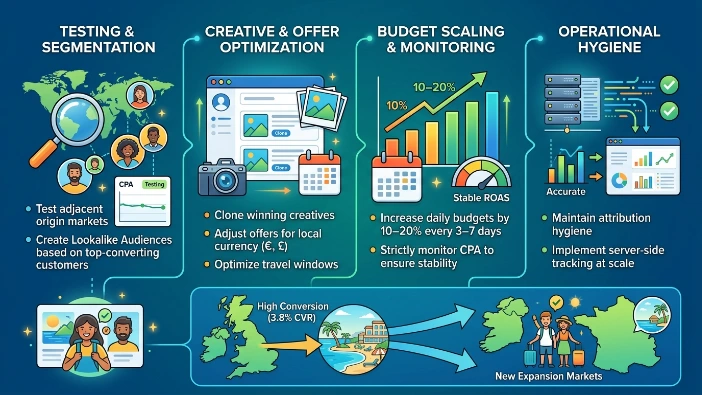
Scale by expanding geographic origin markets, duplicating high-performing creatives across similar audiences, and increasing budget on campaigns with stable ROAS.
Test adjacent origin markets and lookalike audiences based on top-converting customers. Clone winning creatives and adjust offers for local currency and travel windows. Increase daily budgets by 10–20% every 3–7 days while monitoring CPA. Maintain attribution hygiene and server-side tracking at scale. Example: a coastal resort expands from UK domestic markets to Ireland and France after observing a 3.8% CVR in the UK.
Converting tourism ads ties clear destination messaging to a frictionless booking flow, explicit offers, precise targeting, and robust tracking. Implement concrete prices and booking windows, use conversion-optimised bidding, and maintain legal disclosures. Track bookings with server-side reconciliation and scale by expanding origin markets and duplicating proven creative.
For deeper guidance on building excitement earlier in the funnel, see: