Display campaigns are digital advertising efforts that show visual ads (banners, native images, or rich media) across websites, apps, and connected TV to raise awareness and prompt search or purchase.
Display campaigns use graphical assets and targeting signals to reach users who fit travel intent profiles. Advertisers upload creatives, select audiences, set budgets, and choose metrics such as viewable impressions, clicks, or conversions. Common ad formats include static banners (JPEG/PNG), animated GIFs, HTML5 rich media, and responsive native units. Ad exchanges and demand-side platforms (DSPs) handle real-time bidding to place impressions on publisher inventory. Measurement uses tracking pixels, server-side events, and media-viewability standards to attribute outcomes.
How do airlines target audiences with display ads?
Airlines segment audiences using demographic data, behavioral signals, contextual cues, and first-party travel intent data to deliver relevant ads to potential travelers. Targeting reduces wasted impressions and raises conversion probability. Demographic targeting uses age, gender, and household income when available.
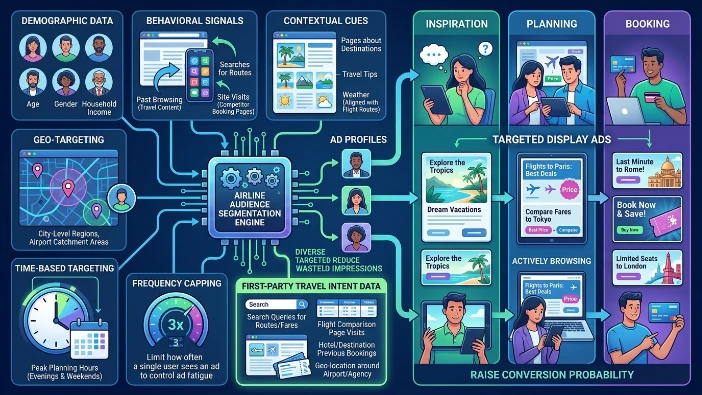
Behavioral targeting uses past browsing for travel content, searches for routes, or site visits to competitor booking pages. Contextual targeting places ads on pages about destinations, travel tips, or weather in regions that align with flight routes. Geo-targeting restricts delivery to users in specific locations, such as city-level regions or airport catchment areas. Time-based targeting schedules ads during peak planning hours, such as evenings and weekends. Frequency capping limits how often a single user sees an ad to control ad fatigue.
Search queries for routes or fares, visits to flight comparison pages, hotel or destination content consumption, previous bookings, and geo-location around an airport or travel agency.
How do airlines design creatives for display campaigns?
Airlines create simple, high-contrast visuals with clear fare messages, destination images, and single callouts such as price or booking window to drive attention and comprehension.
Creative teams define a primary objective (awareness, consideration, or conversion) and adapt creative size and message accordingly. For awareness, creatives use destination photography plus a short headline and fare highlight. For mid-funnel consideration, creatives include dynamic elements such as route-specific fares or countdown timers. For lower-funnel retargeting, creatives show previously viewed flights and a clear price. Rich media and animated HTML5 units increase engagement by revealing additional information on hover or tap. Dynamic creative optimisation (DCO) swaps headlines, images, and price variables in real time based on user signals and inventory context. All creatives must meet publisher technical specs: file size, dimensions, and viewability requirements.
Concise headline, visible price or fare class, clear date or seasonal window, legible font at small sizes, and fallback static image for limited environments.
How do airlines use data and measurement to optimize campaigns?
Airlines rely on first-party booking data, conversion tracking, and third-party audience insights to analyze performance and optimize bids, creatives, and targeting.
Marketers map ad events to conversion events such as “search initiated,” “fare viewed,” and “booking completed.” They use pixels or server-to-server tracking for reliable attribution. Data clean rooms or privacy-safe matching link ad exposure to booking records without exposing raw PII. Key performance indicators include viewable CPM, click-through rate (CTR), cost per acquisition (CPA), and return on ad spend (ROAS). Campaigns run A/B tests across creatives, landing pages, and audience segments. Algorithms shift budget toward high-performing combinations. Frequency and recency analyses determine optimal exposure windows. Post-campaign, marketers perform lift studies using holdout groups to isolate ad impact on booking lift.
Viewable impressions, CTR, engagement rate for rich media, conversion rate, CPA, ROAS, and incremental lift from holdout testing.
How do airlines use targeting across the funnel?
Airlines create layered funnels: broad awareness using contextual and demographic targeting, mid-funnel consideration using interest and behavioral signals, and retargeting for users who visited booking funnels or searched routes.
Top-of-funnel display focuses on destinations and brand presence. Middle-of-funnel uses fare-awareness banners and dynamic content to push users toward flight search. Bottom-of-funnel uses personalised retargeting where creatives show exact routes, dates, and fares the user viewed. Cross-device identity graphs and probabilistic matching allow consistent messaging across phone, tablet, and desktop.
How do airlines combine programmatic and direct buys?
Airlines blend programmatic buying for scale and real-time optimisation with direct buys for premium placements and guaranteed inventory control.
Programmatic channels include open exchanges, private marketplaces (PMPs), and programmatic guaranteed deals. Open exchanges provide scale and lower CPMs. PMPs offer curated publisher environments and audience packages. Programmatic guaranteed secures reserved impressions with automated delivery. Direct buys include sponsorships, homepage takeovers on travel sites, and custom placements for high-impact visibility. Measurement consistency between programmatic and direct buys uses common tracking standards and unified reporting to attribute impressions and conversions across channels.
They choose direct buys for guaranteed premium inventory, event-based promotions, or high-visibility seasonal launches where placement certainty matters.
What are the compliance and privacy considerations?
Airlines follow regional privacy laws and ad platform policies by obtaining consent for cookies and using privacy-preserving measurement methods for campaign attribution.
In the United Kingdom, marketers follow UK data protection standards that align with GDPR principles. Consent management platforms record and pass consent signals to ad partners. Advertisers use aggregated reporting and differential privacy when sharing performance data. Server-to-server event tracking reduces client-side loss and respects user privacy settings. Data retention policies limit storage of personal identifiers. Vendors must document lawful bases for processing travel-related data, especially when matching user records for personalisation.
They use first-party data, cohort-based targeting, contextual targeting, and privacy-safe clean room matching to link ad exposure with booking outcomes.
Explore More Expert Insights:
How Hotels Increase Reservations Using Banner Ads
How Travel Brands Boost Bookings Through Banner Advertising
What are typical benefits of display campaigns for airlines?
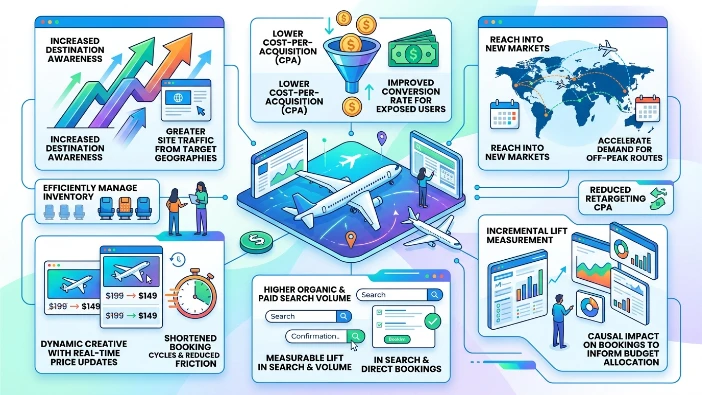
Display campaigns increase destination awareness, grow site traffic, lower cost-per-acquisition when optimised, and create measurable lift in search and direct bookings.
Well-targeted display can expand reach into new markets and accelerate demand for off-peak routes. Display ads support seasonal promotions and inventory management by shifting demand across dates or routes. Dynamic creative with real-time price updates reduces friction and shortens booking cycles. Incremental lift measurement demonstrates causal impact on searches and bookings, informing budget allocation across channels.
Higher organic and paid search volume for promoted routes, increased site sessions from target geographies, improved conversion rate for users exposed to ads, and reduced CPA for retargeted segments.
What use cases show display campaigns’ effectiveness?
Airlines use display to drive route launches, fill mid-week seats, promote seasonal fare sales, and retarget cart abandoners with route-specific fares.
Route launches benefit from broad reach and contextual placement on travel editorial sites. Mid-week seat fill uses geo-targeted offers to local markets with lower demand. Seasonal fare sales use countdown creatives to accelerate purchases within a limited window. Cart abandonment retargeting shows previously viewed itinerary and price, increasing completion rates. Cross-sell campaigns use display inventory to promote ancillaries such as seat upgrades or baggage when a passenger books a flight.
Cart abandonment retargeting with dynamic price creatives generates the fastest conversion lift because intent signals are strongest at the point of abandonment.
Display campaigns use visual ads, audience signals, and programmatic systems to move travelers from awareness to booking. Airlines combine contextual and behavioral targeting, dynamic creatives, and privacy-safe measurement to optimise spend and prove incremental impact. Key activities include defining audience segments, testing creative variants, aligning frequency and lookback windows by funnel stage, and documenting outcomes in unified metrics.
For readers wanting deeper tactical guidance, explore the following:
How airlines nurture travelers using targeted fare awareness banners for mid-funnel steps.
Get the Full Insights Here:
Airline Fare Ads That Convert Searchers Into Ticket Purchases