
Banner advertising is a visual online ad format that displays images or short animations on web pages to promote destinations or offers and drive clicks that lead to booking-related pages.
Banner advertising uses static images, animated GIFs, or HTML5 creatives placed on websites, apps, and ad networks. Important entities: ad creative (visual asset), impression (single display), click-through rate (CTR, clicks divided by impressions), cost-per-thousand impressions (CPM), cost-per-click (CPC), and landing page (the URL the ad directs to). Publishers include travel sites, news sites, and ad exchanges. Advertisers include travel brands, destination marketing organisations, and online travel agents. Ad servers deliver creatives and log performance. Real example: a destination ad creative showing a city skyline served on a national news site with 100,000 impressions.
How does banner advertising work to increase travel bookings?
Banner advertising increases bookings by generating demand, driving qualified traffic, and retargeting visitors to move them through the booking funnel.
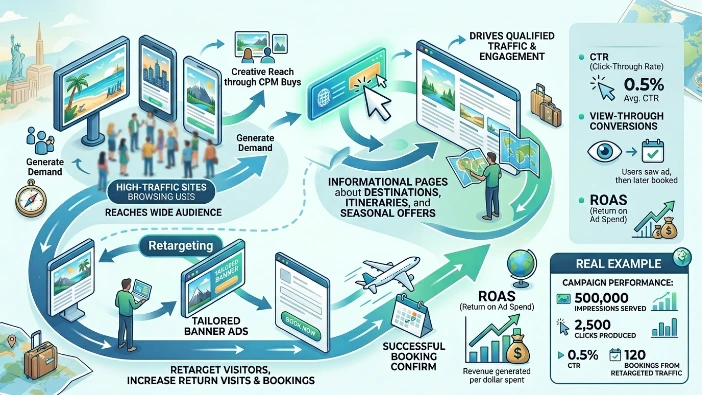
A typical process follows three phases. First, awareness: creatives reach a wide audience through CPM buys on high-traffic sites. Second, interest: clicks lead users to informational pages about destinations, itineraries, or seasonal offers. Third, conversion: retargeting shows tailored banners to users who viewed pages but did not book, increasing return visits and conversions. CTR, view-through conversions (users who saw the ad then later booked), and return-on-ad-spend (ROAS). A campaign that served 500,000 impressions, produced 2,500 clicks (0.5% CTR), and recorded 120 bookings from retargeted traffic.
What creative elements make banner ads effective for travel?
Effective travel banners include a clear destination image, concise headline, visible offer, brand or source cue, and a specific call-to-action on the landing page.
Images drive attention; choose high-resolution photos that show scale, activity, or unique landmarks. Headlines use 3–6 words and highlight the main benefit, for example “Weekend Breaks from £99.” Offer details use specific numbers and dates. Use accessible fonts and contrast for legibility. Include a single visual focal point and avoid clutter. Animated creatives use 3–5 frames and run for 5–10 seconds to maintain load performance. File sizes stay below 150 KB for display networks. Real example: a 300×250 HTML5 creative showing a landmark, headline “4 Nights £249”, and a short looping animation highlighting “Book by 30 June.”
Where should travel brands place banner ads to reach UK audiences?
Place banner ads on high-reach news sites, travel information sites, lifestyle blogs with travel sections, and programmatic exchanges that target UK audiences by geography and interest.
Select publishers with UK audience share and relevant topic alignment. Use contextual targeting to place ads near travel content such as destination guides, flight search pages, and weather reports. Use programmatic buys with geo-targeting set to the United Kingdom and hour-of-day delivery aligned to peak browsing times (18:00–22:00 local). For specific segments, use affinity or in-market audience lists that indicate recent travel research activity. Real example: targeting users in London and Manchester who viewed destination guides in the past 30 days.
How do advertisers measure banner ad performance for bookings?
Advertisers measure bookings from banners with metrics such as CTR, CPC, view-through conversions, last-click conversions, ROAS, and conversion rate from ad-driven sessions.
Set up tracking with UTM parameters and server-side event tracking when possible. Use analytics to attribute conversions: last non-direct click, view-through within 30 days, and assisted conversions. Calculate ROAS as revenue from bookings attributed to the campaign divided by ad spend. Monitor funnel metrics: impressions, clicks, landing-page bounce rate, pages per session, and booking conversion rate. Compare campaign cohorts by creative type, placement, and audience segment. Real example: a campaign with £10,000 spend that drove £50,000 in booking revenue reports ROAS of 5.0.
What targeting strategies increase booking likelihood?
Use audience segmentation by intent, demographic, and past site behaviour, combined with geo-targeting and frequency caps to increase booking likelihood.
Define intent segments: search-driven visitors, itinerary planners, and leisure researchers. Build custom intent lists from keyword searches and page visits. Use demographic filters such as age brackets (e.g., 25–34) where relevant. Implement dynamic retargeting: show tailored banners with previously viewed destinations, dates, or prices. Set frequency caps to 3–5 exposures per week to avoid ad fatigue. Use lookalike audiences based on converters to expand reach to similar users. Retargeting users who viewed a specific resort with a banner displaying that resort and a discounted price.
Dive Deeper Into This Topic:
How Travel Brands Inspire Bookings Using Destination Banner Ads
How does creative testing improve booking outcomes?
A/B testing creatives and landing pages identifies combinations that yield higher CTR and conversion rates, enabling data-driven budget allocation.
Test image variations, headline copy, offers, and CTA treatment. Run multivariate tests for creative elements and separate landing-page tests for form length and booking flow. Use statistical significance thresholds (95% confidence) to decide winners. Allocate more budget to top-performing creatives and scale via programmatic. Monitor secondary metrics like bounce rate and time on page to ensure quality traffic. Real example: swapping a panoramic image for an action shot increased CTR from 0.4% to 0.7% and improved conversion rate from 1.6% to 2.2%.
What are the technical components required to run travel banner campaigns?
Technical components include an ad server, creative assets (HTML5/PNG/GIF), tracking pixels or server-side tracking, audience data segments, and reporting dashboards.
Ad servers host creatives and manage delivery rules. Creative assets require multiple sizes: 300×250, 728×90, 160×600, 300×600, and responsive HTML5 versions. Tracking pixels record impressions and conversions; server-side tracking captures bookings and reduces pixel-blocking loss. Data management platforms (DMPs) store audience segments. Reporting integrates with analytics platforms to unify spend and conversion data. Real example: a campaign used a tag manager and server-to-server conversion endpoint to log bookings and reduce attribution discrepancies.
Explore More Expert Insights:
How Finance Companies Improve Conversions Using Display Ads
How Financial Institutions Drive Awareness Using Banner Campaigns
What privacy and compliance rules affect banner advertising in the UK?
UK ad campaigns must follow data protection rules under the UK GDPR and PECR, requiring lawful bases for personal data processing and consent for non-essential cookies.
Collect consent for tracking cookies and store consent records. Use consent management platforms to present clear choices. Anonymise or aggregate data when possible. Respect user signals such as global privacy controls and do-not-track headers. Ensure third-party vendors comply with UK regulations. Real example: a campaign blocked third-party tracking until users consented via a consent banner and recorded the consent timestamp.
What are common use cases where banner ads drive bookings?
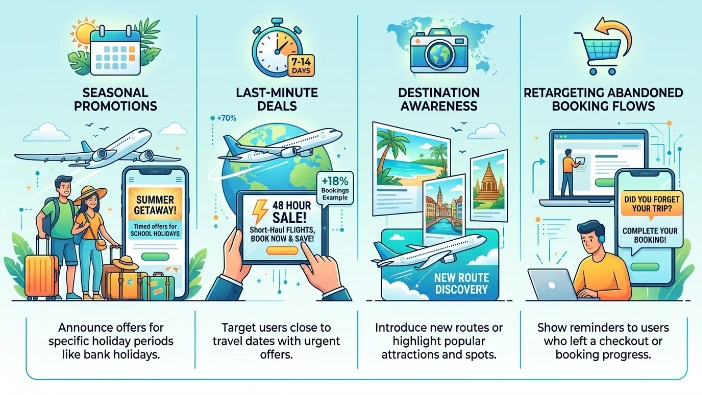
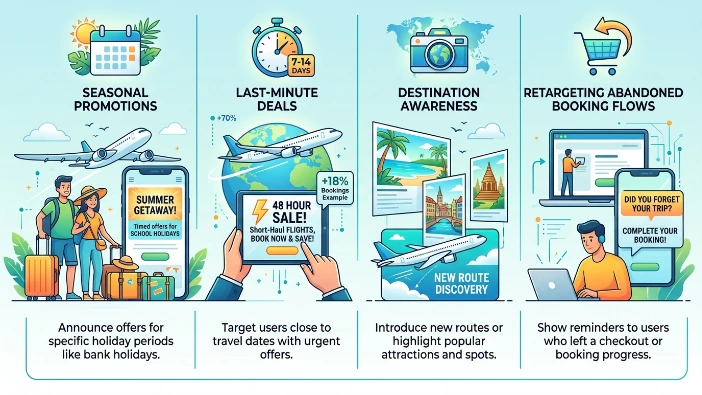
Common use cases include seasonal promotion launches, last-minute deals, destination awareness campaigns, and retargeting abandoned booking flows.
Seasonal promotion banners announce timed offers for school holidays or bank holidays. Last-minute deal banners target users within 7–14 days of travel dates. Destination awareness campaigns use large-format banners to introduce new routes or attractions. Retargeting banners show booking progress reminders to users who abandoned a checkout. Real example: a last-minute deals campaign ran 48 hours before departures and increased bookings for short-haul flights by 18% for the promoted dates.
Explore the Complete Guide:
Travel Banner Ads That Convert Trip Interest Into Confirmed Bookings
How do banner ads fit into a broader travel marketing funnel?
Banner ads create top-of-funnel awareness, support mid-funnel consideration through targeted creatives, and assist conversions via retargeting tied to booking pages.
At awareness, large-reach creatives show destinations and offers. At consideration, tailored banners present itineraries, user reviews, and price anchors. At conversion, retargeting banners with concrete prices, dates, and limited-time offers prompt return visits to booking flows. Align creative messaging and landing pages across stages to reduce friction and maintain message continuity. A three-stage campaign first introduced a destination, then promoted specific itineraries, then retargeted users who viewed itineraries with a “complete booking” banner.
Banner advertising delivers measurable booking outcomes when campaigns use targeted audience segments, strong creatives with clear offers and tracking, and structured testing and attribution. Implement technical standards for creatives and measurement, respect UK privacy rules, and align banner messaging to funnel stage to convert awareness into confirmed bookings.