
Banner ads are static or animated rectangular ads served on web pages to drive visibility and clicks hotels use them to showcase room features, promotions, and location to increase booking intent among targeted audiences.
Banner ads are digital display advertisements placed on websites, apps, and ad networks. They contain visuals, concise text, and a call-to-action element. Hotels select sizes (for example, 300×250, 728×90, 160×600 pixels) and formats (JPEG, PNG, GIF, HTML5). Ads deliver impressions and click-throughs measured by standard metrics: impressions, clicks, click-through rate (CTR), and conversions. Hotels place banners on travel sites, local news sites, and content networks to reach travellers during research phases.
Hotels place banners on publisher sites, programmatic networks, and contextual placements. Publisher placements target specific websites. Programmatic placements use automated bidding across exchanges. Contextual placements match page content to ad themes.
Creatives include room images, price overlays, and short headlines. Animation length often stays under 15 seconds. File sizes stay below 150 KB for faster load. Use of HTML5 enables responsive scaling across devices.
How do banner ads fit into a hotel’s marketing process?
Banner ads enter the marketing process during audience awareness and research stages and connect visual exposure to downstream booking actions via tracking pixels and UTM tags.
Campaigns begin with audience definition, budget allocation, creative development, placement selection, and tracking setup. Hotels define audiences by intent signals (search history for hotel stays), demographics (age 25–54), and geography (within 50–500 miles). They allocate budgets across awareness and retargeting phases. Tracking uses pixels and UTM parameters to record user behaviour and attribute conversions. Data flows into analytics platforms for measurement and optimisation.
Audience targeting methods
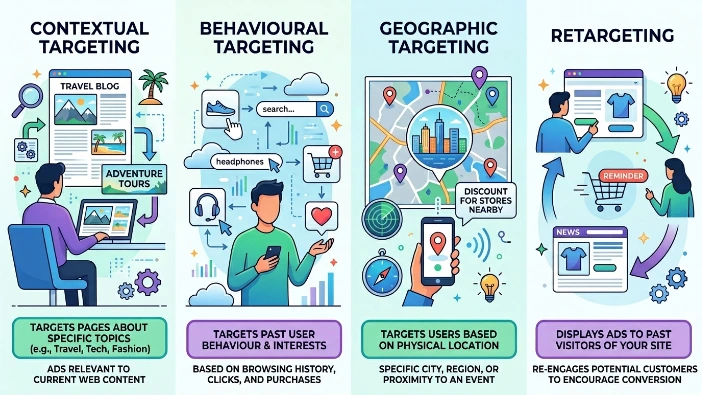
Targeting includes contextual targeting, behavioural targeting, geographic targeting, and retargeting. Contextual targets pages about travel; behavioural targets past visitors; geographic targets users near an event or city.
Measurement and attribution
Measurement uses first-click, last-click, and data-driven attribution models. Hotels track on-site metrics: sessions, pages per session, and booking completions. Conversion value equals average booking revenue multiplied by confirmed bookings.
What components make a hotel banner ad effective?
Effective banner ads include a clear image, concise headline, visible price or offer, brand identifier, and a single action cue to increase click-through and booking rates.
Images show room type or property feature with 1–2 focal points. Headlines use 3–7 words with specific claims like “Rooms from £79.” Offer text states exact discounts or package components, for example “20% off advance bookings.” A visible brand identifier ensures recognition. Action cues use verbs: “Check availability,” “View rooms.” Landing pages match the creative to preserve message continuity and reduce drop-off.
Files stay under 150 KB. Headline length remains under 30 characters for legibility. Font size uses at least 16 px for body text on desktop. Contrast ratio follows accessibility guidelines for readability.
Landing pages present the same room image, price, and booking form. Use a single booking flow to reduce friction. Include clear cancellation and taxation details to avoid later abandonment.
How do hotels target audiences with banner ads?
Hotels target audiences by geography, travel intent, lifecycle stage, and past interactions using audience lists, geofencing, and contextual signals to increase relevance and conversion probability.
Geographic targeting restricts delivery to users in specific cities or regions, for example London, Manchester, or within 100 km of a conference venue. Travel-intent targeting uses site visits to competitor pages, search queries, and hotel-related content consumption. Lifecycle targeting segments new visitors, returning visitors, and known bookers for cross-sell. Retargeting lists include users who viewed room pages, started bookings, or abandoned carts.
Geofencing and event targeting
Geofencing delivers ads to devices within defined coordinates around airports, conference centres, or tourist attractions. Hotels use event calendars to target attendees before event dates.
Frequency and sequencing
Set frequency caps at 3–7 impressions per user per day to balance exposure and ad fatigue. Sequence creative to progress from awareness images to offer-focused messages over multiple exposures.
How do hotels measure success from banner ad campaigns?
Success measures include CTR, view-through conversions, on-site conversion rate, cost per acquisition (CPA), and return on ad spend (ROAS) tracked through analytics and server-side attribution.
CTR indicates initial engagement. View-through conversions capture users who saw an ad and converted later. On-site conversion rate equals bookings divided by sessions from ad clicks. CPA equals ad spend divided by attributed bookings. ROAS equals revenue from bookings divided by ad spend. Attribution requires link tagging and pixel events to tie bookings to banners.
Discover More Insights:
How Hotels Build Stay Interest Using Experience-Focused Campaigns
Benchmarks and targets
Benchmarks vary by market. For travel in the UK, CTR often ranges from 0.05% to 0.25% on display; retargeting CTRs reach 0.3% to 1.2%. CPA targets hinge on average booking value; for example, target CPA = £40 when average booking revenue equals £200 and desired ROAS equals 5.
Incrementality testing
Run holdout tests with a control group excluded from banner exposure. Compare booking rates between exposed and control groups to measure incremental bookings attributable to banners.
What benefits do banner ads deliver for hotels?
Banner ads increase visibility during planning, reinforce brand recall, capture high-intent audiences through retargeting, and drive measurable booking lifts when creatives and targeting align.
Display campaigns create repeated exposures that influence consideration. Retargeting recaptures users who left booking flows. Localised banners attract last-minute travellers near a property. Programmatic buying optimises delivery toward audiences that show higher conversion probability.
Cost-efficiency and scale
Programmatic networks scale reach while maintaining cost-efficiency through real-time bidding. Use of dynamic creative for price and inventory updates reduces creative build overhead and improves relevance.
Cross-device continuity
Use deterministic or probabilistic matching to link impressions across devices. Cross-device strategies preserve message continuity for travellers researching on mobile and booking on desktop.
What are practical use cases for hotel banner ads?
Common use cases include promoting advance-purchase discounts, filling last-minute inventory, targeting event attendees, and retargeting users who abandoned booking flows to convert more reservations.
Advance-purchase campaigns display early-bird rates and package dates for low-demand periods. Last-minute inventory campaigns advertise same-day or next-day availability with reduced rates to fill rooms. Event-targeted campaigns promote city-centre hotels during conferences and festivals. Cart-abandonment retargeting shows specific room types users viewed with a limited-time price to recover lost bookings.
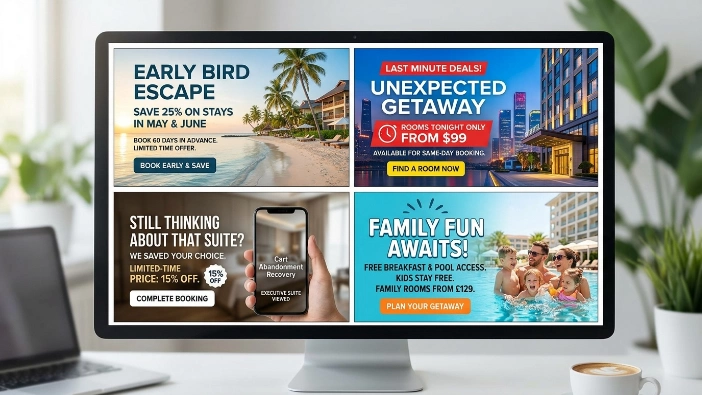
Seasonal campaigns align with holidays and school breaks. Event campaigns align timing to the event schedule and adjust audience radius and budgets to match expected search intensity.
Tailor messaging to traveller segments: business travellers focus on location and Wi-Fi; leisure travellers focus on amenities and family rooms. Use precise claims such as “Free Wi‑Fi and work desk” or “Family rooms from £129.”
How do hotels optimise banner ad performance over time?
Optimisation uses A/B testing for creatives and landing pages, bid adjustments by device and time, and refinement of audience segments based on conversion data to lower CPA and increase ROAS.
Test headline variations, image choices, and offer phrasing. Test landing page layouts: one-click booking versus multi-step booking. Adjust bids up by 10–40% for high-value segments and down for low-performing placements. Exclude low-quality sites and adjust frequency caps to reduce wasted spend.
Explore More Expert Insights:
How Travel Brands Boost Bookings Through Banner Advertising
How Finance Companies Improve Conversions Using Display Ads
Data-driven creative rotation
Rotate top-performing creatives more frequently. Pause creatives with CTR below campaign median and replace with new variants showing different images or explicit prices.
Budget allocation rules
Allocate 60–80% of budget to high-performing retargeting and 20–40% to prospecting. Reallocate weekly based on conversion velocity and inventory needs.
Banner ads are a measurable channel hotels use to raise visibility, recapture interested users, and convert research into direct bookings. Effective campaigns use precise targeting (geographic, intent, retargeting), tight creative rules (clear price and action), and rigorous measurement (CTR, CPA, ROAS, and incrementality tests). Practical deployments include advance-purchase, last-minute, event-specific, and cart-recovery campaigns, each with tailored creative and landing-page alignment. Use testing and data-driven adjustments to improve efficiency and booking outcomes.
Learn More Here:
Hotel Experience Ads That Turn Stay Interest Into Direct Reservations