
Display ads are visual online advertisements banners, images, videos served across websites and apps to raise awareness and drive clicks; finance companies use them to introduce products, explain features, and attract qualified traffic at scale.
Display ads are digital creative units shown on publisher sites, ad networks, and programmatic exchanges. Common formats include static images (JPEG/PNG), animated GIFs, and HTML5 rich media. Finance entities place these units to reach segmented audiences by demographics, interests, behaviours, and contextual content. Delivery occurs through direct buys, ad networks, or programmatic real-time bidding. Metrics tracked include impressions, click-through rate (CTR), viewability, and conversions measured by tracked actions such as form fills or account sign-ups.
Key targeting inputs include age, location, device type, browsing behaviour, and finance intent signals (searches for mortgages, loans, credit cards). Creative messaging focuses on clear product attributes, regulatory disclosures, and visual trust signals such as licensing identifiers. Campaign frequency and pacing control exposure across the user journey to balance awareness and ad fatigue.
How do finance companies define conversion goals for display campaigns?
Conversion goals are explicit user actions that indicate progression in the customer journey, such as newsletter sign-ups, calculator use, quote requests, or completed applications; finance companies set numeric targets and tracking methods for each action.
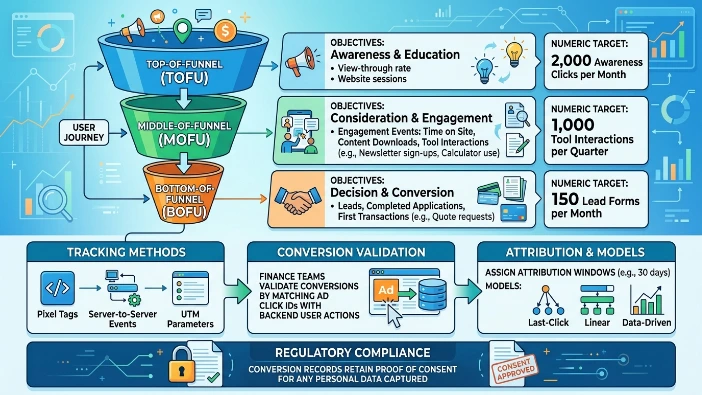
Conversion goals align to funnel stages. Top-of-funnel objectives focus on awareness and education, using metrics like view-through rate and website sessions. Middle metrics include engagement events: time on site, content downloads, and tool interactions. Bottom-of-funnel metrics include leads, completed applications, and first transactions. Each goal receives a numeric target examples: 2,000 awareness clicks per month, 1,000 tool interactions per quarter, 150 lead forms per month.
Tracking uses pixel tags, server-to-server events, and UTM parameters. Finance teams validate conversions by matching ad click IDs with backend user actions. They assign attribution windows (e.g., 30 days) and select models last-click, linear, or data-driven to value each touchpoint. Regulatory requirements dictate that conversion records retain proof of consent for any personal data captured.
What targeting strategies increase conversion rates for finance display ads?
Targeting strategies use audience segmentation, contextual placement, and device-specific delivery to place relevant creative in front of users who demonstrate finance intent or fit defined profiles.
Audience segmentation divides users by lifecycle stage, intent signals, and financial status. Intent signals include recent searches for “mortgage rates”, visits to mortgage calculator pages, or comparisons of savings accounts. Finance companies build segments: renters searching mortgages, small business owners seeking loans, and savers comparing accounts. Each segment receives tailored creative and messaging.
Contextual placement targets pages about finance topics, personal finance blogs, or news sections covering interest rates. Contextual targeting preserves privacy and improves relevance when behavioural data is limited. Device-specific delivery adjusts creative size and callouts for mobile versus desktop; mobile creatives include tap-friendly buttons and short headlines. Time-of-day and day-of-week bidding increases bids during high-conversion periods, such as weekday evenings for personal finance research.
Examples: targeting UK renters aged 25–40 searching mortgage information; placing creatives on regional news sites covering property market trends; increasing bids on weekend property-search hours. These tactics reduce wasted impressions and increase qualified clicks.
How does creative design affect conversions in finance display ads?
Creative design uses clear headlines, concise benefit statements, prominent trust signals, and accessible calls to action to drive clicks and downstream conversions.
Design follows a visual hierarchy: headline, value proposition, evidence, and action prompt. Headlines state the primary benefit in 5–10 words. Value statements use one short sentence or bullet-equivalent phrasing. Evidence includes numeric facts—interest rates, savings percentages, timeframes—and regulatory disclaimers in legible text. Trust signals display licensing, accredited logos, or regulated entity statements.
Ad variants test contrast, imagery, and copy length. For example, one variant uses a numerical rate headline “Fixed rate 3.5% for 2 years”; another uses a feature headline “Calculate your mortgage in 3 minutes”. Finance creatives keep font sizes readable, use high-contrast CTA buttons, and limit text to comply with platform policies. Video creatives use 6–15 second cuts focused on a single message. Strong creative reduces cognitive friction and increases the likelihood of a click that leads to conversion.
What measurement and analytics practices prove display ad impact?
Measurement uses a combination of pixel-based tracking, server-side event capture, controlled experiments, and multi-touch attribution to quantify contribution to conversions.
Finance teams deploy tracking pixels to record ad impressions and clicks. Server-to-server event capture sends conversion events from backend systems to analytics platforms to avoid client-side loss. Teams set up conversion funnels with event sequencing: ad click → landing page view → product tool use → lead form submission. They calculate conversion rates at each step and monitor drop-off points.
Controlled experiments include A/B tests and geo-based lift tests. A/B tests compare creative or landing page variants with randomized traffic splits. Geo-lift tests hold certain regions as control and expose other regions to increased ad spend to measure incremental conversions. Incrementality analysis isolates ad-driven conversions from organic uplift.
Attribution uses first-touch, last-touch, and data-driven models to assign credit. For compliance, finance firms retain event logs and consent records for a minimum retention period, often 12–24 months depending on local regulations. Teams report KPIs weekly and run monthly deep-dives to optimise budget allocation across campaigns.
What landing page and flow components increase conversion rates for finance ads?
Landing pages must match ad messaging, present a clear value proposition, minimise required inputs, and provide trusted verification to convert display ad traffic into qualified leads.
Message match reduces friction: headline and offer on the landing page mirror ad copy. Forms use progressive profiling: request minimal fields initially (name, email, postcode) and capture further details later in the journey. Tools like calculators capture engagement and produce qualified leads by asking three to five quick inputs. Page load time remains below 3 seconds to prevent abandonment; finance pages often prioritise server-side rendering and image compression.
Compliance content displays required disclosures and privacy notices prominently. Verification elements include secure badges, regulatory registration numbers, and accessible contact options. For UK audiences, include guidance on regulated status where applicable and links to clear guidance pages. A successful flow routes high-intent users directly to application steps and sections with clear documentation requirements.
What optimisation techniques reduce waste and increase conversions?
Optimisation uses creative rotation, bid adjustments, audience pruning, and conversion-rate-focused landing page tests to improve efficiency and conversion yield.
Rotate creative using performance-based rules: pause creatives below threshold CTR or conversion rate. Adjust bids by audience segment, time-of-day, and device to allocate budget where conversion probability is highest. Regularly prune underperforming placements and publishers using placement reports. Use frequency caps to limit ad fatigue to a set number of exposures per user per week, often 3–7 exposures for campaigns.
Run landing page experiments using A/B and multivariate tests. Test headline clarity, form length, and CTA color. Apply winner rules based on conversion lift and statistical significance thresholds (commonly p < 0.05). Use audience lookalike modeling seeded by highest-quality converters to find similar users at scale. Monitor cost-per-acquisition (CPA) against predefined targets and reallocate spend to channels and creatives that lower CPA while maintaining lead quality.
Explore More Expert Insights:
How Finance Companies Build Trust Using Security-Focused Banner Ads
How Loan Providers Nurture Applicants Using Mid-Funnel Display Ads
What risks and compliance requirements affect finance display campaigns?
Finance display campaigns must follow advertising regulations, data protection laws, and platform-specific policies to avoid fines and reputational harm.
In the UK, advertising for financial products requires clear, fair, and not misleading content. Firms must display required risk statements and regulatory identifiers where regulation applies. Data protection obligations under UK GDPR require lawful basis for processing, explicit consent for marketing cookies, and secure handling of personal data. Platforms enforce policies on financial product promotions; some ad placements require pre-approval and disclosure of rates or representative examples.
Recordkeeping requirements mandate retention of advertising copies, targeting parameters, and consent logs for audit periods typically 12–24 months. Finance advertisers implement consent management platforms and store hashed identifiers for audience matching to reduce privacy risk. Non-compliance leads to penalties from regulatory bodies and platform bans.
Get Detailed Information Here:
How Financial Institutions Guide Users Using Educational Campaign Ads
What real use cases show improved conversions from display ads?
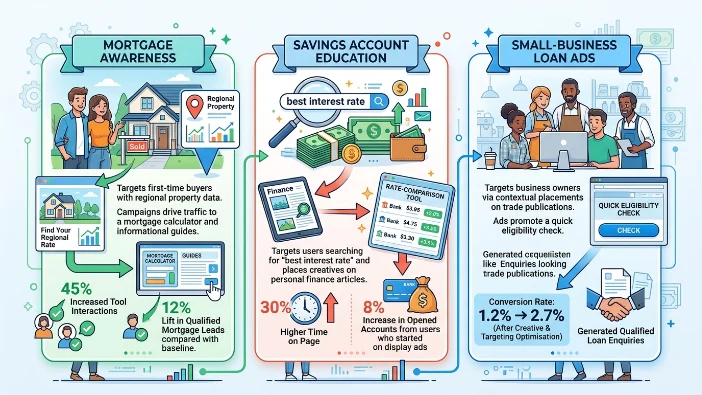
Use cases include mortgage awareness campaigns that drive calculator use, savings account education that increases comparison tool engagement, and small-business loan ads that generate qualified loan enquiries.
Mortgage awareness campaigns target first-time buyers with regional property data. Campaigns drive traffic to a mortgage calculator and informational guides. Result: increased tool interactions by 45% and a 12% lift in qualified mortgage leads compared with baseline.
Savings account education campaigns target users searching for “best interest rate” and place creatives on personal finance articles. Traffic engages a rate-comparison tool. Result: 30% higher time on page and 8% increase in opened accounts from users who started on display ads.
Small-business loan campaigns target business owners via contextual placements on trade publications. Ads promote a quick eligibility check. Conversion rate for eligibility checks increased from 1.2% to 2.7% after creative and targeting optimisation.
Explore the Complete Guide:
Educational Finance Campaign Ads That Turn Users Into Final Conversions
Display ads serve as a scalable educational channel for finance companies. They combine audience targeting, clear creative, measurement rigour, and compliant landing experiences to move users from awareness to measurable actions. Properly defined conversion goals, robust tracking, and continuous optimisation yield consistent improvements in qualified leads and downstream conversions.