
A security-focused finance ad highlights concrete security features and third-party validations to reduce friction, increase click-throughs, and drive qualified leads. These ads use clear trust signals certifications, encryption claims, regulatory references to convert viewers into customers.
Security-focused finance ads identify trust signals as explicit, verifiable statements about data protection, regulatory compliance, and verification. Examples include SSL/TLS padlock icons, FCA or PRA registration numbers (United Kingdom), ISO 27001 certification, and independent audit statements. Ads use these signals in headlines, subheadlines, imagery, and ad extensions to minimise perceived risk. The conversion path links ads to landing pages that mirror the same trust signals and include lead-capture mechanisms such as application forms, phone-booking widgets, or account-opening flows.
How do financial marketers design security-focused ads that increase lead conversion?
Headline with a trust signal, brief supporting detail, visual cue (badge or padlock), and a direct conversion path. Each element reduces cognitive load and shortens time-to-action.
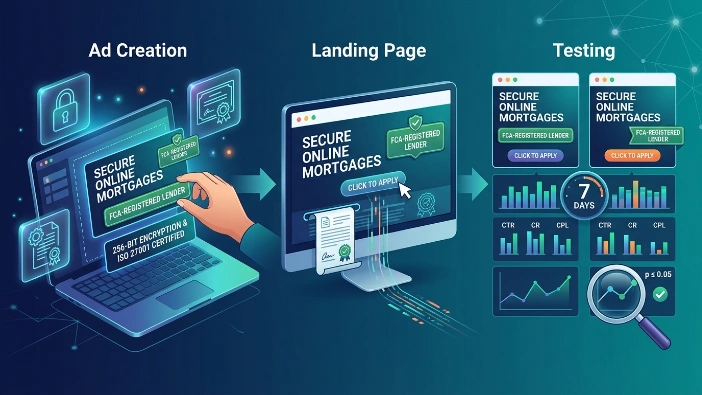
Design begins with a clear headline that includes a primary benefit plus a trust signal, for example: “Secure Online Mortgages FCA‑Registered Lender.” Secondary text provides a one-line proof: “256‑bit encryption and ISO 27001 certified.” Visuals show recognisable badges or simplified illustrations of certificates. Landing links go to pages that replicate the ad’s wording and display full documentation. Ad sizes follow platform standards: banner 728×90, leaderboard 300×250, mobile 320×50, and responsive native sizes. For display networks, include alt text and ensure badges are readable at common pixel densities.
Headline, trust badge, or CTA wording. Track metrics: click-through rate (CTR), landing-page conversion rate (CR), cost per lead (CPL). Use minimum sample sizes of 1,000 impressions per variant and statistical significance threshold p ≤ 0.05 before declaring a winner. Run tests for at least 7 days to account for weekday cycles.
What core trust signals should appear in security-focused finance ads?
Include verifiable regulatory IDs, security certification names, encryption claims, and third-party audit mentions as primary trust signals. These signals provide objective evidence for security and compliance.
Show FCA reference numbers or PRA information for UK-targeted ads. Certification names: use ISO 27001 or SOC 2 Type II. Encryption claims: “256‑bit AES encryption” or “TLS 1.3 secure connection.” Third-party audits and partnerships: “Pen-tested by [auditor name]” or “Verified by [security provider].” Display visual badges for each signal and provide a way to access documentation on the landing page.
Validate claims with published documents. Provide links to certification PDFs, FCA register entries, or audit summaries. Remove any claims lacking evidence. Verification reduces legal risk and prevents ad disapproval on regulated platforms.
How does the ad-to-landing-page flow convert trust signals into captured leads?
The flow mirrors ad claims on the landing page, presents full evidence, and uses a single, focused conversion action to capture lead details. Consistency reduces drop-off and increases trust.
Start with header copy that repeats the exact trust signal language from the ad. Place badges and links to certifications near the lead form. Name, email, phone number, postcode, and preferred contact time. Use progressive profiling to gather additional data in later communications. Include a visible privacy statement that references data handling and regulatory storage location (for UK: data stored within the UK or EU). Add a secondary proof section: client logos, anonymised audit excerpts, or regulator confirmation. Show contact numbers and live chat options to accommodate users who want immediate reassurance.
Measure landing performance via heatmaps and session recordings to identify friction. If users abandon the form at field 3, shorten the form or move optional fields to step two. Use server-side validation and fast form submission to prevent client-side failures that reduce trust.
Which metrics prove that security-focused ads drive qualified leads?
Track acquisition and quality metrics: CTR, landing CR, CPL, lead-to-customer conversion rate, and fraud/rejection rate. Use baseline comparisons to quantify improvements.
Display 0.15–0.3%, native 0.4–1.0%, search remarketing 2–6%. Landing CR measures how many clicks become captured leads; aim for 8–15% for finance landing pages that include trust signals. CPL equals total ad spend divided by number of leads. Lead-to-customer conversion rate tracks downstream value; finance campaigns should measure conversion across a 90‑day window due to application processes. Fraud/rejection rate monitors lead quality keep under 5% for secured offers. Monitor time-to-conversion and average deal size to calculate customer acquisition cost (CAC) and lifetime value (LTV). Use these metrics to optimise bidding and creative allocation.
How do compliance and advertising policies affect security-focused finance ads in the UK?
Ads must present accurate, provable security claims and comply with FCA marketing rules, ASA guidance, and platform advertising policies. Misleading statements cause penalties and ad rejection.
FCA rules require fair, clear, and not misleading communications. The ASA enforces truthfulness in advertising; avoid absolute terms without evidence, such as “unbreakable security,” unless supported by third-party audit. Platform policies (Google, Meta) restrict financial advertising where proof or pre-approval is required provide necessary certifications during ad account review. Keep data-processing disclosures visible on landing pages and use lawful bases for processing under UK GDPR. Maintain records of consent and processing logs for 6 years to support regulatory inquiries.
Explore More Useful Information:
How Financial Institutions Drive Awareness Using Banner Campaigns
What creative examples demonstrate successful security-focused finance ads?
Examples use concise claims, visible badges, and direct conversion actions; each example pairs the ad with its landing page trust elements.
A banner reads “Open a Secure Savings Account — FCA Reg. 123456.” Subtext: “Protected with 256‑bit AES, ISO 27001.” Landing page repeats FCA number, shows certification PDF, and uses a two-step application form that captures contact details first. Result: CTR 0.42%, landing CR 12%, CPL reduced 28% versus control.
A native ad for a business loan shows “Encrypted Applications SOC 2 Type II.” Subtext: “Independent audit available.” Landing page displays audit summary and provides a phone-booking widget. Result: 18% increase in qualified applications and 15% lower fraud rate.
Include measurable evidence on the landing page. Present short testimonials with verification statements such as “Approved by independent auditor X.” Do not use anonymous or unverifiable quotes.
How do finance teams implement an effective testing and rollout process?
Implement iterative testing with clear hypotheses, controlled samples, and documented outcomes; scale winners across audiences and placements. Use pre-defined success criteria and rollback triggers.
Including FCA ID in headline increases landing CR by 10%. Run A/B test across 50% traffic split, minimum 1,000 impressions per variation, duration 14 days. Track primary KPI: landing CR. Secondary KPIs: CTR and CPL. If test meets statistical significance at p ≤ 0.05 and improves primary KPI by ≥10%, promote creative to 100% for that audience segment. Use feature flags or campaign segmentation to control rollout. Maintain rollback triggers: if fraud/rejection rate increases >5% absolute, pause and review claims and landing verification.
Document tests in a central repository with creative assets, audience definitions, and performance results. Use the repository to fast-track compliant creatives into seasonal or product-specific campaigns.
Explore More Expert Insights:
Loan Funnel Ads That Turn Applicants Into Completed Submissions
Credit Card Banner Ads That Convert Consideration Into Approved Card Requests
What are common pitfalls that reduce trust signal effectiveness?
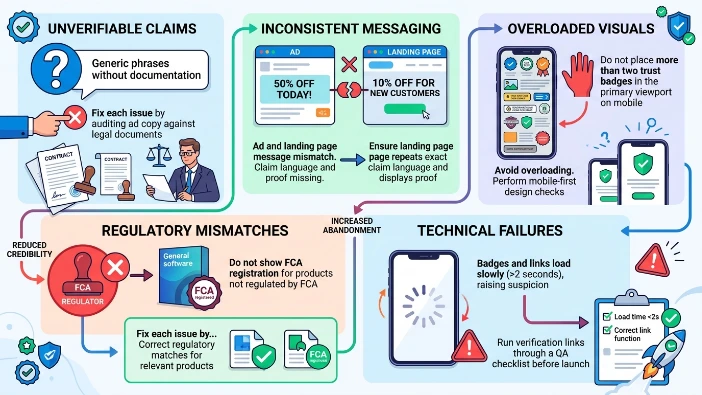
Common pitfalls include unverifiable claims, inconsistent messaging between ad and landing page, and overloaded visuals that obscure badges. Each reduces perceived credibility and increases abandonment.
Avoid generic phrases without documentation. Inconsistent messaging: ensure the landing page repeats exact claim language and displays proof. Overloaded visuals: do not place more than two trust badges in the primary viewport on mobile. Regulatory mismatches: do not show FCA registration for products not regulated by FCA. Technical failures: ensure badges and links load under 2 seconds; slow loading raises suspicion.
Fix each issue by auditing ad copy against legal documents, performing mobile-first design checks, and running verification links through a QA checklist before launch.
What specific CTAs and post-click actions close leads in finance campaigns?
Use direct CTAs tied to a measurable action and follow with immediate, secure next steps: “Apply Now Secure Form,” “Book a Compliance Call,” or “Get Verified Quote.” Provide instant verification after submission.
CTAs must match the landing action. For an application CTA, use a secure multi-step form that confirms encryption and shows a progress bar. For a booking CTA, send immediate calendar confirmation and offer a recorded proof of identity step. After lead capture, send a confirmation email with links to certification documents and a summary of data handling. Use secure communications channels and two-factor authentication for account access.
Read the Full Blog Here:
How Finance Companies Build Trust Using Security-Focused Banner Ads
Security-focused finance ads convert trust signals into leads by combining verifiable claims, consistent ad-to-landing flows, focused CTAs, and rigorous testing. Implement clear regulatory references, display audit evidence, and measure both acquisition and quality metrics to optimise campaigns. For teams making purchase decisions, integrate evidence-first creative with compliance checks and progressive rollouts to scale effective creatives and reduce CPL while improving lead quality.