
A security-focused banner ad highlights specific safety features, compliance claims, and trust signals to reassure users during initial engagement. A security-focused banner ad is a display advertisement that communicates measurable security attributes. Entities defined: finance companies (banks, lenders, payment platforms, investment firms). Trust signals defined: encryption badges, regulatory references, authentication methods, third-party certifications, and customer-review metrics. Security features defined: TLS/SSL indicators, multi-factor authentication (MFA), fraud-detection systems, data-minimisation practices, and secure API usage.
Security-focused banners use clear text, icons, and data points. Examples: “256-bit encryption,” “Regulated by FCA” (UK context), “Verified reviews: 4.7/5 from 12,000 users,” or “MFA enabled.” The ad creative ties one or two concrete security claims to a simple call-to-action that directs to landing pages with full compliance documentation. Design elements include contrast for readability, accessible font sizes, and accessible colour contrast ratios to meet UK accessibility standards.
How do security-focused banner ads build trust?
These ads increase perceived safety by presenting factual security claims and verifiable references that reduce cognitive friction during initial interactions. Trust arises from credible, verifiable statements. Users assess risk quickly. Banners reduce perceived risk by offering immediate, specific evidence. Specific evidence increases likelihood of click and subsequent engagement. Use of regulated authority names, certification logos, and measurable figures anchors claims. For example, citing “FCA registration number 123456” links the banner content to a public record. Including auditable metrics such as encryption strength (e.g., “AES-256”) provides technical clarity for security-aware audiences.
A/B tests show banners with explicit trust signals produce higher click-through rates than purely promotional creative. Security-focused messages perform strongly in retargeting and contextual placements where users already display intent. Measurement uses metrics: click-through rate (CTR), view-through conversions, time-on-site, and bounce rate reduction.
What processes ensure ad security claims are credible?
Teams verify claims through documentation, legal review, and automated asset checks before deployment. Verification requires cross-functional steps. Legal validates regulatory claims against registration databases. Security and compliance teams confirm technical claims encryption standards, authentication methods, and data-handling policies match public documentation. Creative and product teams map claims to landing pages with matching, verifiable details. Quality assurance runs automated checks for correct logos, updated certification numbers, and accurate metrics.
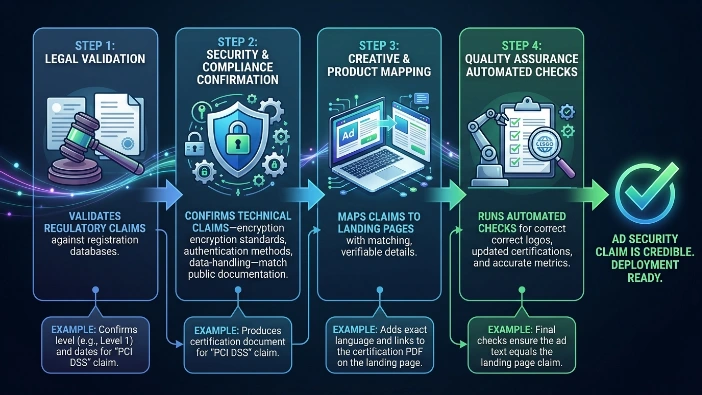
Payments provider drafts an ad claiming “PCI DSS compliant.” Legal confirms level (e.g., Level 1 or Level 2) and dates. Security produces certification document. Creative adds exact language and links to the certification PDF on the landing page. Final checks ensure the ad text equals the landing page claim.
Which components should a finance security banner include?
Every banner must include a concise security claim, a verifiable reference, and accessible design elements for clear visibility. Essential components defined: concise security claim (one sentence), verifiable reference (regulator name, certification number, or review metric), readable typography (minimum 14px body equivalent), high-contrast colours, and a clear action indicator. Microcopy describing what the security claim means, country-specific compliance markers (FCA for UK), and links to detailed security pages.
“FCA-authorised (Reg. 123456)” for regulatory reference; “AES-256 encryption” for technical claim; “4.6/5 from 25,000 reviews” for social proof. Use icons for quick scanning: padlock for encryption, shield for compliance, and star for reviews. Ensure icons are licensed or created in-house to avoid copyright issues.
How should claims be phrased to meet legal and UX standards?
Phrases must be specific, factual, and directly link to evidence; avoid superlatives and vague qualifiers. Legal and UX alignment requires precise language. Use exact standards and numbers: “Encrypted using AES-256” rather than “Highly encrypted.” For regulatory claims, include registration numbers or direct references. For customer reviews, provide sample size: “Rated 4.7/5 by 8,912 customers.” Avoid absolute guarantees or future promises. Ensure landing pages present the full documentation for user verification.
Provide alt text for icons and ensure text contrast meets WCAG 2.1 level AA. For responsive design, keep the main security claim visible on mobile banner sizes (e.g., 320×50). Use short microcopy for tooltips that explain technical terms in plain language.
How do targeting and placement influence trust building?
Placement on high-intent contexts and audience segments with security concerns increases message relevance and perceived credibility. Targeting strategies include context targeting (financial news sites, personal finance forums), intent targeting (users searching loan or mortgage terms), and retargeting (users who visited security or privacy pages). Placement near relevant content signals congruence between message and context. For example, a banner on an FCA guidance page demonstrates topical alignment and strengthens perceived credibility.
Use geotargeting for UK audiences to display UK-specific compliance references. Frequency caps prevent overexposure, which can erode trust. Measure post-click behaviour to detect whether users engage with security documentation; high engagement indicates successful trust transfer.
Explore More Expert Insights:
How Financial Institutions Drive Awareness Using Banner Campaigns
What metrics prove security-focused banners work?
Key metrics: higher CTR, lower bounce rate, longer session duration, and increased conversion rates on trust-sensitive flows. CTR measures initial engagement; bounce rate captures immediate rejection after click; session duration indicates content consumption; conversion rate on trust-sensitive flows captures downstream action (e.g., account sign-ups after identity verification). Use control vs. experiment groups in A/B tests. Report absolute numbers and lift percentages: e.g., “Experiment showed CTR +18% and bounce rate -12% versus control.”
Downloads of compliance PDFs, clicks to regulatory pages, and visits to security FAQs. Attribute value through multi-touch models to understand the banner’s role across the funnel.
What creative and technical formats work best?
Combine concise static banners for clarity with rich media that surfaces verification details; ensure secure ad delivery and privacy compliance. Static banners for clarity at small sizes, animated HTML5 for sequential disclosure of claims, and expandable units that reveal certification documents. Technical requirements: serve ads via secure HTTPS-only providers, use Content Security Policy (CSP) to prevent injection, and avoid third-party trackers that conflict with data-minimisation practices.
Follow UK data-protection law (Data Protection Act 2018) and ePrivacy principles for cookie usage. For behavioural targeting, obtain consent and document lawful basis if processing personal data. Ensure ad tags do not leak sensitive information.
Explore More Expert Insights:
How Loan Providers Nurture Applicants Using Mid-Funnel Display Ads
How Banks Increase Credit Card Consideration Using Banner Advertising
What benefits do finance companies gain from security-focused banners?
Benefits include increased initial engagement, higher downstream conversions in trust-sensitive flows, and stronger brand credibility in regulated markets. Quantified benefits often show higher CTR and reduced abandonment where identity verification is required. Security-focused banners reduce friction in sign-up processes because users arrive already primed with trust signals. In UK markets, explicit regulatory claims often accelerate KYC completion and reduce customer support contacts related to security concerns.
Operational benefits include clearer compliance audit trails: archived creatives linked to corresponding certification documents. This reduces risk during regulatory reviews and improves transparency in marketing audits.
What use cases fit security-focused banner campaigns?
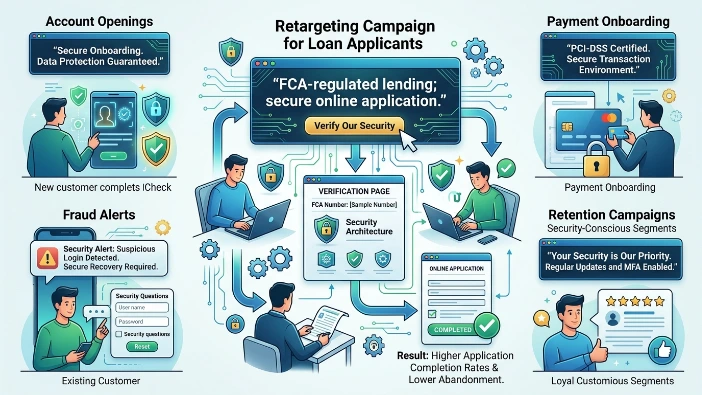
Use cases include account openings, loan applications, payment onboarding, fraud alerts, and retention campaigns aimed at security-conscious segments. Account opening campaigns benefit when banners highlight secure onboarding and data protection. Loan or mortgage prospecting banners that state regulatory oversight increase lead quality. Payment provider banners that list PCI-DSS levels reduce hesitation for high-value transactions. Fraud alert banners inform existing customers of protection measures and drive engagement with secure recovery flows.
Retargeting campaign for loan applicants uses a banner stating “FCA-regulated lending; secure online application” and links to a verification page listing the firm’s FCA number and security architecture. The campaign yields higher application completion rates and lower verification abandonment.
Must-Read Detailed Guide:
Security-Focused Finance Ads That Convert Trust Signals Into Customer Leads
Security-focused banner ads use specific, verifiable claims and accessible design to reduce perceived risk and improve engagement. Finance companies follow cross-functional verification processes, precise phrasing, secure technical delivery, and targeted placement to build measurable trust. Metrics and use cases show clear gains for trust-sensitive conversion events in UK markets.