
A banner campaign is a digital display advertising effort that uses static or animated images to deliver targeted messages across websites and apps. A banner campaign serves as a visual touchpoint that introduces a financial institution’s value proposition to an audience. Banners appear on publishers’ sites, ad exchanges, and within mobile apps. Formats include leaderboard (728×90), medium rectangle (300×250), wide skyscraper (160×600), and mobile banner (320×50). Demand-side platforms (DSPs) and ad servers deliver creative based on audience criteria and inventory availability.
How do banner campaigns create initial awareness?
Banner campaigns create awareness by delivering repeated, visible impressions to defined audiences across the open web and private marketplaces. Campaigns start with audience definition: demographics, geolocation, device type, browsing behaviour, and contextual topics. Financial institutions select targeting parameters to prioritise reach across channels.
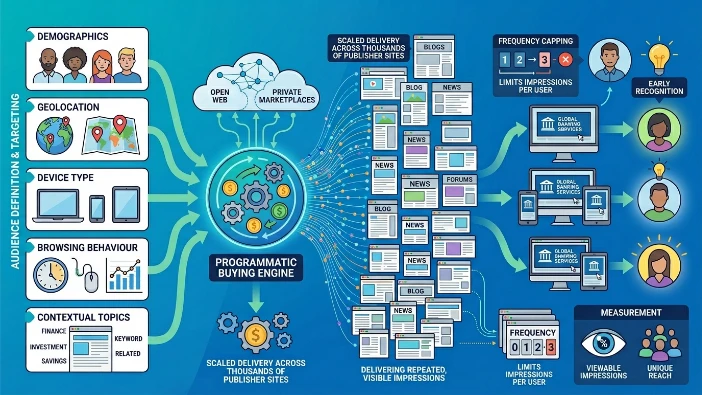
Frequency capping limits impressions per user to avoid oversaturation. Measurement uses viewable impressions and unique reach metrics. Programmatic buying enables scaled delivery across thousands of publisher sites, increasing the probability of early recognition among target users.
What targeting methods do finance ad teams use?
Ad teams use demographic, contextual, behavioural, geo-targeting, and lookalike audience methods to reach relevant prospects. Demographic targeting includes age bands, income brackets, and household composition when available. Contextual targeting places banners next to finance-related editorial content such as savings guides or mortgage articles. Behavioural targeting uses browsing signals like visits to comparison sites or calculator tools. Geo-targeting narrows delivery to postcode areas, cities, or regions such as the United Kingdom. Lookalike modelling expands reach by matching new users to high-value audience profiles derived from first-party data.
What role does creative design play in banner effectiveness?
Creative design determines initial engagement by communicating a clear message, readable typography, and a concise value proposition in 2–3 seconds. Effective banners use a single visual focal point, a short headline, and contrast that supports legibility. Use of microcopy such as numeric offers (e.g., “1.2% savings rate”) increases information clarity. Mobile-optimised creatives use larger text and simplified layouts. Animated creatives use controlled motion for emphasis and must respect file size limits (commonly 150 KB for standard display) to preserve load performance. A/B testing of multiple creative variants identifies the best-performing asset for each audience segment.
How do financial teams set campaign objectives and KPIs?
Teams set objectives like awareness, site traffic, or assist metrics, and measure with KPIs such as viewable impressions, reach, CPM, and lift in aided awareness. Top-of-funnel campaigns prioritise reach and frequency metrics. Viewability measures ensure ads are in view at least 50% for one second for display or two seconds for video. CPM (cost per thousand impressions) tracks cost efficiency. Brand lift studies measure change in ad recall, message association, and preference using controlled surveys. Assisted conversions attribute downstream actions like sign-ups to earlier banner impressions within a chosen attribution window.
How is programmatic buying used for banner campaigns?
Programmatic buying automates media purchase using real-time bidding across ad exchanges and private marketplaces to maximise reach and efficiency. Programmatic workflows use demand-side platforms (DSPs) to bid on inventory that matches campaign targeting. Financial advertisers employ private marketplace deals with premium publishers to secure brand-safe placements. Real-time optimisation adjusts bids and targeting based on performance signals such as viewability and engagement. Supply-path optimisation reduces intermediary fees and clarifies inventory provenance. Programmatic guarantees enable reserved impressions at negotiated prices when predictable delivery is required.
What components ensure compliance and brand safety?
Compliance and brand safety use pre-bid filters, manual whitelists/blacklists, regulators’ guidance, and creative approval workflows. Pre-bid brand safety tools block categories such as gambling, adult content, or misinformation. Manual whitelists restrict placements to approved publishers. Regulatory compliance for financial advertising follows the UK Advertising Standards and Financial Conduct Authority guidelines on fair, clear, and not misleading messaging. All creatives typically pass legal review before launch to verify claims, terms, and required disclosures. Third-party verification measures viewability, fraud detection, and domain-level transparency.
Click Here to Explore More:
How Finance Companies Build Trust Using Security-Focused Banner Ads
How do measurement and analytics prove awareness impact?
Measurement uses a mix of impression metrics, viewability, unique reach, brand lift studies, and downstream assisted conversions to quantify awareness. Impression and reach reporting shows how many unique users saw the campaign. Viewable CPM refines cost-efficiency by counting only viewable impressions. Brand lift studies use control and exposed cohorts to measure ad recall and message association. Cross-channel attribution links banner exposure to later site visits or assisted conversions within a 30–90 day window. Data clean rooms enable privacy-safe matching of first-party data for more precise measurement without sharing raw user identifiers.
What creative testing methods improve performance?
Testing methods include A/B tests of headlines and images, multivariate tests of layout and calls-to-action, and sequential testing for message progression. A/B tests compare two creative variants and track differences in view-through rates and click metrics. Multivariate testing evaluates combinations of headline, image, and colour to find the optimal mix. Sequential testing delivers a planned creative sequence to users across multiple impressions, building narrative over successive exposures. Statistical significance thresholds and sufficient sample sizes guide decisions. Results feed iterative creative production to refine messaging and visual elements.
Which frequency and reach strategies work for financial awareness?
Balanced frequency strategies target 3–7 impressions per user per week while maximising unique reach within the target audience. Low frequency fails to produce recall. High frequency leads to irritation and wasted budget. Optimal frequency depends on campaign length and audience size. Short campaigns favour higher weekly frequency; longer campaigns favour broader reach with lower frequency caps. Reach pacing spreads impressions evenly across the campaign period to maintain consistent visibility. Frequency capping prevents disproportionate spend on a small subset of users.
What segmentation and audience sequencing improve relevance?
Segmentation divides audiences by life stage, intent signals, and channel behaviour; sequencing delivers tailored creatives that match audience readiness. Life-stage segments include students, first-time buyers, and retirees. Intent signals include visits to mortgage calculators or savings comparison pages. Channel behaviour segments separate mobile-first users from desktop-heavy users. Sequencing delivers awareness-focused creatives first, then informational creatives, then conversion-focused creatives in later stages. This progression guides users from initial recognition to informed consideration without direct promotion.
Explore More Expert Insights:
How Loan Providers Nurture Applicants Using Mid-Funnel Display Ads
How Banks Increase Credit Card Consideration Using Banner Advertising
What benefits do banner campaigns provide to financial institutions?
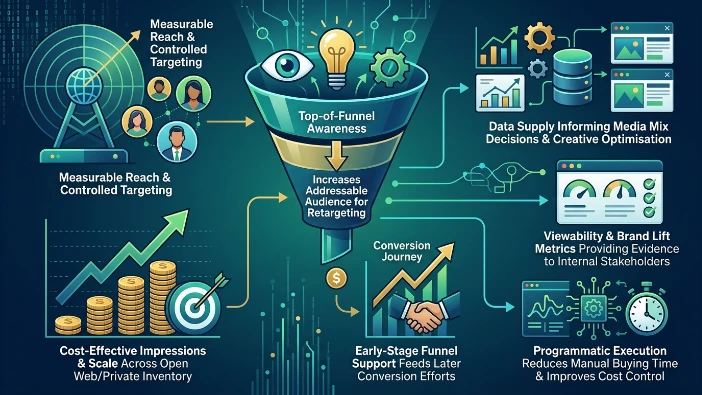
Banner campaigns provide measurable reach, controlled targeting, cost-effective impressions, and early-stage funnel support that feeds later conversion efforts. They deliver scale across the open web and private inventory. They build top-of-funnel awareness that increases the addressable audience for retargeting. They supply data to inform media mix decisions and creative optimisation. Viewability and brand lift metrics provide evidence to internal stakeholders. Programmatic execution reduces manual buying time and improves cost control.
What use cases demonstrate effective banner deployment?
Use cases include product launches, regional awareness drives, educational content promotion, and regulatory announcement communications. For product launches, banners introduce a new product to defined postcode areas with high impression volume. Regional awareness drives concentrate delivery in UK cities to support branch openings. Educational content promotion pushes investment guides or savings explainers to users reading finance news. Regulatory announcement communications broadcast important policy changes to a wide audience to ensure visibility.
Banner campaigns drive early awareness for financial institutions by using targeted impressions, measurable KPIs, and controlled creative strategies. They use programmatic delivery, compliance safeguards, and testing frameworks to maximise viewable reach and brand recall. Proper segmentation, frequency control, and measurement ensure campaigns scale awareness efficiently while producing data for subsequent funnel stages.
For More Details, Explore:
Security-Focused Finance Ads That Convert Trust Signals Into Customer Leads