
Banner ads are digital images or animated advertisements placed on websites and apps to capture attention and drive traffic; financial services use them to present offers, features, and value propositions to defined audiences.
Banner ads are graphic units shown on third-party web pages, mobile apps, and ad networks. Formats include static images, animated GIFs, HTML5 creatives, and rich media with interactive elements. Dimensions follow industry standards such as 300×250, 728×90, and 320×50. Financial entities use demand-side platforms (DSPs) and supply-side platforms (SSPs) to buy and place these ads programmatically. Ad servers deliver creatives and track impressions, clicks, and viewability. Measurement relies on pixels and tags to record user signals and conversions. Regulatory obligations require clear disclosure of financial products, accurate claims, and compliance with regional rules such as UK financial promotions regulations.
How do financial services plan banner ad campaigns?
Campaign planning sets objectives, audience segments, creative formats, budgets, and measurement KPIs before execution.
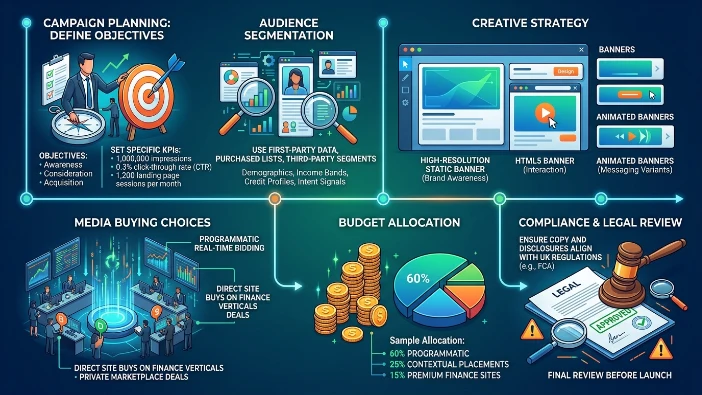
Planning begins with defining a primary objective: awareness, consideration, or acquisition. Teams set specific KPIs such as 1,000,000 impressions, 0.3% click-through rate (CTR), or 1,200 landing page sessions per month. Audience segmentation uses first-party data, purchased lists, or third-party segments categorised by demographics, income bands, credit profiles, and intent signals. Creative strategy selects a format based on objective: high-resolution static banners for brand awareness, HTML5 for interaction, and animated banners for messaging variants. Media buying choices include programmatic real-time bidding, direct site buys on finance verticals, or private marketplace deals. Budgets allocate spend across channels; sample allocation could be 60% programmatic, 25% contextual placements, and 15% premium finance sites. Compliance and legal review occur before launch to ensure copy and disclosures align with UK regulations.
What processes do financial services use to target customers with banner ads?
Targeting combines demographic, behavioral, contextual, and lookalike methods to reach users who match defined financial profiles.
Demographic targeting uses age ranges, gender, and location such as targeting adults aged 25–54 in Greater London or the North West. Behavioral targeting relies on browsing signals and finance-related searches, for example users who visited mortgage comparison pages within 30 days. Contextual targeting places ads on pages about pensions, mortgages, savings, or personal finance articles. Lookalike targeting builds models from high-value customers and finds similar users across networks. Retargeting reconnects with users who interacted with the brand site, app, or specific product pages within a defined window, often 7–90 days. Frequency caps restrict exposure to prevent ad fatigue, commonly set between 3 and 7 impressions per user per week. Geo-targeting narrows delivery by postal districts or metropolitan areas to reflect product availability and regional offers.
What creative components do effective financial banner ads include?
Effective banner creatives contain a clear headline, concise value statement, relevant imagery or iconography, legal disclosures, and a visible call-to-action.
Headlines state the offer or benefit in 3–7 words. Value statements quantify outcomes such as “Rates from 3.2% APR” or “Save £500 annually”. Imagery uses product-relevant visuals like savings icons, calculator graphics, or neutral lifestyle images of adults in target age ranges. Brand identity uses consistent logos, colours, and typography to build recognition. Legal disclosures provide mandatory information such as APR, fees, and eligibility in legible font; regulators often require disclosures within the ad or immediately visible on the landing page. Call-to-action text uses verbs that match the funnel stage: “Learn more” for awareness, “Compare rates” for consideration, and “Apply now” for acquisition. Technical assets include fallback images, click-through URLs with tracking parameters, and creative variations for A/B testing.
How are banner ad campaigns measured in financial services?
Measurement relies on impression, click, view-through conversion, and on-site conversion metrics tracked by analytics and ad platforms.
Primary metrics include impressions, CTR, cost per click (CPC), and cost per mille (CPM). Viewability measures record the percentage of served ads that meet viewability standards, typically 50% of pixels visible for one second for display or two seconds for video. Conversions track micro-conversions such as brochure downloads, quote requests, and account registrations. Macro-conversions record completed applications, funded accounts, or policy purchases. Attribution uses last-click, time-decay, and multi-touch models to distribute credit across touchpoints. Incrementality tests involve holdout groups to measure lift in applications attributable to banner exposure. Return on ad spend (ROAS) and cost per acquisition (CPA) calculate efficiency; example targets include CPA under £80 for basic savings products and ROI thresholds aligned with lifetime value models.
What privacy and compliance considerations affect banner advertising in the UK?
Privacy and compliance require lawful data use, clear consent flows, and adherence to UK financial promotions rules and data protection laws.
Consent frameworks must follow UK GDPR requirements and the Information Commissioner’s Office guidance. Advertisers implement consent management platforms and store consent records. Use of sensitive data such as health or criminal history is prohibited for financial targeting. Financial promotions must be clear, fair, and not misleading. Regulatory bodies expect transparent risk statements and prominent disclosure of representative APR or key product terms. Cookies for personalised advertising require valid consent unless strictly necessary. Data retention policies set maximum storage times; typical retention windows for advertising identifiers range from 30 to 540 days depending on purpose. Advertisers maintain audit trails and legal sign-off before campaign launch.
What testing methods improve banner ad performance?
Testing uses A/B and multivariate tests for creative, copy, targeting, and landing page flows to optimise performance based on defined KPIs.
A/B testing compares two variants, such as different headlines or images, while multivariate testing assesses combinations of multiple elements. Tests run with statistically significant sample sizes determined by baseline CTR and desired minimum detectable effect; for CTR of 0.3% and expected lift of 20%, required sample sizes often exceed 100,000 impressions per variant. Creative rotation ensures even distribution and prevents skewed results. Landing pages use the same UTM parameters to attribute conversions and allow for funnel drop-off analysis. Test results inform iterative creative updates and budget reallocation toward high-performing segments. Use controlled holdouts for incrementality measurement to isolate campaign effects.
What benefits do banner ads provide to financial services?
Banner ads deliver scalable reach, precise audience targeting, measurable performance, and support for multichannel customer journeys.
They provide wide exposure across publisher ecosystems, enabling campaigns to reach millions of impressions monthly. Precise targeting increases relevance and reduces wasted spend. Measurement systems produce actionable data for optimisation and compliance reporting. Banners function at the top of the funnel to introduce financial concepts and products, then feed users into email, search, and social channels for deeper engagement. Programmatic buying allows real-time bid adjustments and budget pacing. Banner ads also support seasonal pushes and regulatory-driven messaging such as pension changes or tax-year reminders.
Explore More Expert Insights:
How Real Estate Firms Drive Buyer Interest Using Display Ads
How Developers Sell Luxury Properties Using Banner Campaigns
What use cases show banner ads acquiring new financial customers?
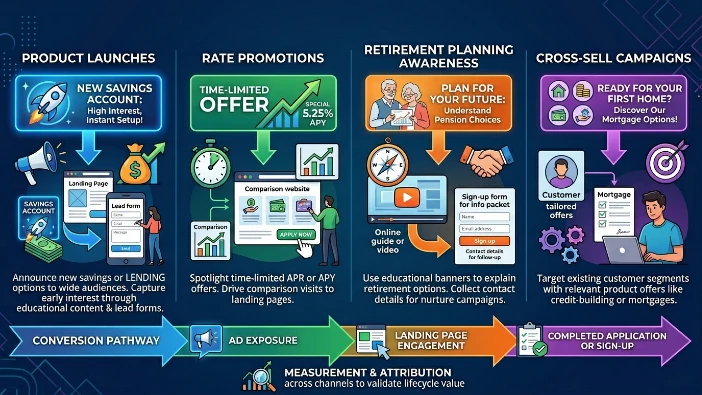
Use cases include product launches, rate promotions, retirement planning awareness, and cross-sell campaigns that guide prospects into application funnels.
For product launches, banners announce new savings accounts or lending options to wide audiences and capture early interest through lead forms or educational content. Rate promotions spotlight time-limited APR offers and drive comparison visits. Retirement planning campaigns use educational banners to explain pension choices and collect contact details for follow-up. Cross-sell campaigns target existing customer segments with tailored offers such as credit-building products for young adults. Each use case defines a conversion pathway: ad exposure, landing page engagement, and completed application or sign-up. Campaigns often integrate measurement across channels to validate attribution and lifecycle value.
How do financial teams optimise budgets and placements for banner campaigns?
Budget optimisation uses performance data, bid strategies, and placement controls to focus spend where CPA and conversion rates meet targets.
Teams allocate budgets to channels with the highest conversion efficiency and pause low-performing placements. Bid strategies include target CPA bidding, enhanced CPC, and manual bidding for premium placements. Placement exclusions remove low-quality or non-compliant sites. Dayparting restricts delivery to high-performance hours, for example weekdays 09:00–18:00 for professional audiences. Frequency and recency controls manage user exposure and budget efficiency. Regular reporting cycles—daily for pacing, weekly for optimisation, and monthly for strategic review—ensure budgets align with performance goals.
Banner ads provide financial services with measurable channels to build awareness, inform potential customers, and drive acquisition. Campaigns follow disciplined planning, precise targeting, compliance checks, continuous testing, and data-driven optimisation to deliver cost-efficient results.