Banner ads are graphical advertisements placed on property portal webpages that display images, text, and links to drive visitor clicks and increased site traffic. They appear in page headers, sidebars, listing pages, and search-results pages and link to landing pages or listings.
Banner ads operate through placement, targeting, creative, and tracking. Placement defines where on the portal the ad appears (homepage, search results, neighbourhood pages). Targeting uses user attributes such as location, search filters, device, and referral source to control which visitors see the ad. Creative includes image size, headline, brief copy, and a clickable URL. Tracking uses click-through rate (CTR), impressions, viewability, and conversion pixels to measure performance.
Banner ad formats follow standard web sizes: leaderboard (728×90), medium rectangle (300×250), wide skyscraper (160×600), and mobile banner (320×50). Programmatic systems deliver ads in real time, matching ad inventory to advertiser bids and targeting rules. Server-side logs and client-side scripts record impressions and clicks for analytics.
How do banner ads increase portal traffic?
Banner ads increase portal traffic by improving ad visibility to targeted visitors, generating clicks that navigate users into the portal, and reinforcing brand recognition across multiple sessions. Higher visibility yields more impressions, and targeted placements yield higher CTRs, which translate into additional site sessions.
Banner ads lift traffic through direct clicks and indirect effects. Direct clicks send users from external ad placements or internal promotional slots into listing pages and search results. Indirect effects arise when repeated exposure to the ad increases organic and navigational visits later. When banners appear on high-traffic pages such as city search results, the incremental clicks scale quickly; for example, a 0.5% CTR on a page with 200,000 monthly impressions equals 1,000 additional sessions per month.
Targeting precision improves traffic efficiency. Geotargeting narrows exposure to specific cities or postcodes, increasing relevance and CTR. Behavioural targeting serves ads to users who previously searched related terms, increasing return visits. Device targeting adapts creative to mobile or desktop to preserve readability and encourage clicks.
Tracking metrics guide optimisation. Impressions measure reach. CTR measures initial engagement. Bounce rate and pages per session measure relevancy after click. Conversion pixels measure downstream events such as enquiry clicks. Using these metrics, portals adjust placement frequency, creative assets, and bidding to increase traffic quality and volume.
What components make an effective banner ad campaign on a property portal?
An effective campaign uses defined objectives, precise audience targeting, optimised creative, suitable placement, and continuous measurement. Define objectives such as visits, listing views, or enquiry clicks, then align targeting, creative, and placement to those goals.
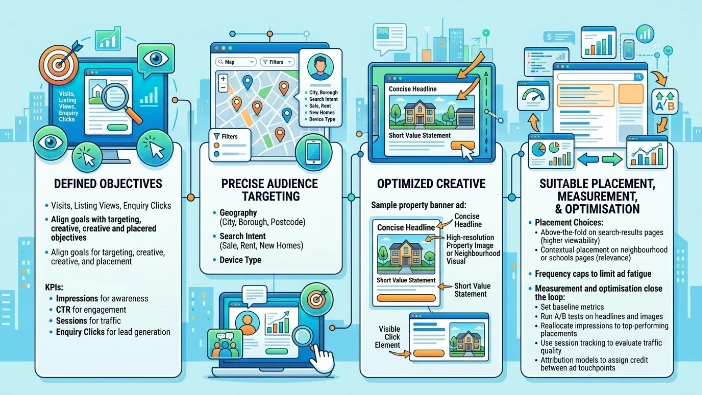
Objectives set the campaign KPIs: impressions for awareness, CTR for engagement, sessions for traffic, and enquiry clicks for lead generation. Audience targeting includes geography (city, borough, postcode), search intent (sale, rent, new homes), and device type. Creative includes a concise headline, a high-resolution property image or neighbourhood visual, a short value statement, and a visible click element.
Placement choices affect performance. Above-the-fold placements on search-results pages yield higher viewability. Contextual placement on neighbourhood or schools pages yields relevance for buyers with specific priorities. Frequency caps limit ad fatigue by controlling how often the same user sees the ad.
Measurement and optimisation close the loop. Set baseline metrics, run A/B tests on headlines and images, and reallocate impressions to top-performing placements. Use session tracking to evaluate traffic quality and attribution models to assign credit between ad touchpoints.
What tracking and analytics prove that banner ads drive traffic?
Tracking relies on impressions, clicks, CTR, session metrics, and conversion tracking to attribute traffic increases to banner ads. Combine ad server logs with web analytics platforms and server-side events to build a complete attribution view.
Impressions count served ad views. Clicks capture immediate navigation events. CTR equals clicks divided by impressions and indicates immediate engagement. Web analytics report sessions, new users, bounce rate, pages per session, and average session duration after the click. Conversion tracking records downstream actions such as contact form submissions, brochure downloads, or viewing a specific listing.
Attribution models clarify how banner ads assist the user journey. First-click attribution credits the banner that initiated the session. Last-click attribution credits the final interaction before conversion. Multi-touch attribution assigns fractional credit across multiple touchpoints. Server-to-server event syncing and UTM tagging ensure reliable session mapping and conversion counts.
Real examples of metrics: a portal running a neighbourhood awareness campaign with 500,000 impressions and a 0.4% CTR generates 2,000 sessions. If those sessions show a 5% enquiry click rate, the campaign yields 100 enquiries. This chain of metrics links banner exposure to measurable traffic and leads.
What benefits do banner ads deliver to property portals?
Banner ads deliver scalable reach, targeted traffic, improved listing visibility, and measurable engagement metrics that support data-driven decisions. Portals use banners to monetise inventory and to promote featured listings or content.
Scalable reach comes from inventory across high-traffic pages. Targeted traffic arrives from geotargeting, behaviour targeting, and contextual placements. Improved listing visibility results when banners highlight specific developments, neighbourhoods, or property types. Measurable engagement supports ROI calculations, enabling budget reallocation to successful campaigns and creative.
Additional operational benefits include flexible pricing models such as CPM (cost per thousand impressions), CPC (cost per click), and fixed-fee sponsorships for homepage slots. Sales teams use performance data to build packages for advertisers and to forecast inventory value based on seasonality and page traffic.
What use cases demonstrate banner ad effectiveness on property portals?
Use cases include market awareness campaigns, neighbourhood promotions, seasonal listing pushes, and event-driven campaigns such as open-house promotions. Each use case targets specific stages of the buyer journey and produces distinct traffic patterns.
Market awareness campaigns run on homepage and city landing pages to drive volume and discovery. Example: a regional campaign running on city landing pages with 1,000,000 impressions and a 0.3% CTR generates 3,000 visits focused on general brand awareness.
Neighbourhood promotions place ads on postcode and schools pages to capture buyers focused on local attributes. Example: an area-focused campaign with 200,000 impressions and a 0.8% CTR yields 1,600 highly localised sessions.
Seasonal listing pushes appear during peak buying months and focus on high-conversion property types. Example: a spring sales push targeting family homes runs on search-results pages and achieves a 0.6% CTR and a 6% enquiry conversion rate from the sessions.
Event-driven campaigns promote open days or limited-time offers. Example: a weekend open-house campaign with concentrated placements for 72 hours increases same-week listing views by 45% and produces measurable spikes in enquiries.
Explore More Expert Insights:
How Realtors Generate Investment Leads Using Banner Advertising
How Real Estate Brands Promote Property Launches Using Banner Ads
How do portals optimise banner ad performance over time?
Portals iterate using A/B testing, placement reallocation, audience refinement, and creative refreshes informed by tracked metrics. Continuous testing and data-driven adjustments improve CTR and downstream conversion metrics.
A/B tests compare headlines, images, and calls-to-action across identical placements. Placement reallocation shifts impressions to pages with higher viewability and stronger session metrics. Audience refinement narrows or expands geotargeting and retargeting windows based on performance. Creative refreshes prevent ad fatigue by rotating images and copy every 7 to 14 days for high-frequency campaigns.
Seasonal and contextual adjustments align ads with market cycles and user intent. For example, increase exposure on school pages during term dates for family-focused campaigns. Adjust mobile creatives when mobile traffic exceeds 60% of impressions to preserve legibility and CTR.
How do banner ads interact with organic search and listing performance?
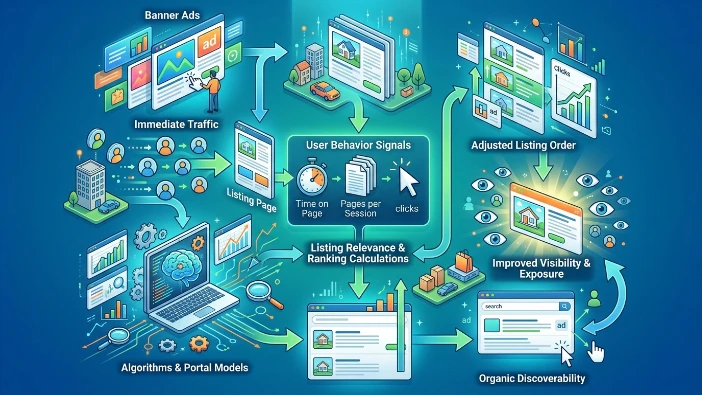
Banner ads complement organic search by increasing direct visits, improving listing exposure, and generating behavioural signals that influence ranking. Ads drive immediate traffic that increases listing views and time on page, which search algorithms can consider in relevance calculations.
Increased traffic from banner ads raises listing impressions and clicks within the portal. High engagement metrics such as pages per session and average session duration demonstrate listing relevance. Portals feed these metrics into internal ranking models, which use engagement signals to adjust listing order. Over time, increased visibility from ads can lead to improved organic discoverability for promoted listings.
For related reading on mid-funnel tactics and how ads convert interest into bookings, see:
How Developers Increase Booking Intent Using Mid-Funnel Banner Ads
and for advanced conversion strategies and booking-stage optimisation, see the following:
Mid-Funnel Property Ads That Turn Intent Into Booking Requests