
Banner advertising is a digital display format that shows a visual ad on web pages to attract clicks and impressions. Publishers host image or HTML5 banners sized to standard dimensions such as 300×250, 728×90, or 160×600. Advertisers buy placements through direct site buys, programmatic ad exchanges, or demand-side platforms to reach target audiences. Banners deliver an immediate visual message, a link to a landing page, and tracking pixels for conversions and view-through metrics.
Banner ads work for realtors by targeting audiences based on geography, interests, browsing behaviour, and past engagement. Real estate advertisers define city-level or postcode-level targeting, set frequency caps to limit daily exposures, and use tracking to measure clicks, view-throughs, and on-site actions such as lead form completions. Campaigns run on desktops, tablets, and mobile devices and include creative optimised for each placement and device size.
How do realtors define and reach investor audiences with banners?
Realtors define investor audiences by selecting demographic, behavioural, and contextual signals that correlate with investment intent. Data segments include age ranges 30–65; household income bands; property ownership; recent mortgage searches; visits to buy-to-let or commercial property pages; and rental-market interest. Real examples of segments include users who searched “buy-to-let London” and users who viewed pages about commercial units in Manchester.
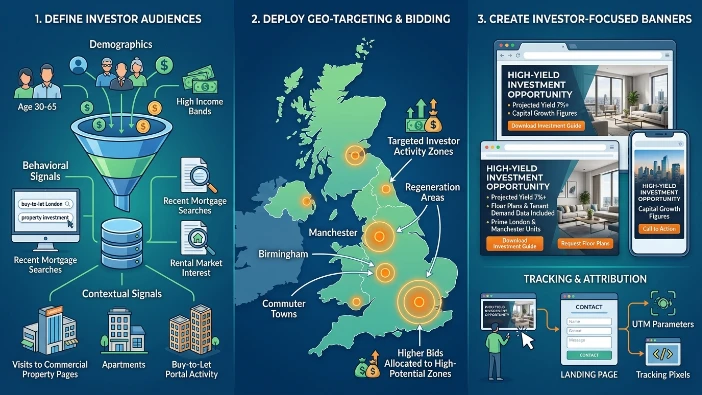
Realtors deploy geo-targeting at the city, county, or postcode level. Campaign budgets allocate higher bids to target areas with known investor activity such as central London boroughs, commuter towns around Manchester, or regeneration zones. Creative reflects investor objectives: projected yields, capital-growth figures, floor plans, and tenant-demand data. Tracking uses UTM parameters and pixels to attribute landing-page visits and form submissions back to specific banner placements.
How do realtors measure and attribute leads from banner ads?
Measure with clear key performance indicators: impressions, click-through rate (CTR), cost per click (CPC), view-through conversions, on-site conversion rate, and cost per lead (CPL). Use server-side conversion events for form submissions, phone-call tracking for inquiry attribution, and event-based analytics for brochure downloads and booked viewings. Attribute with last-click and view-through models to capture both direct clicks and exposures that led to later actions within a defined attribution window, commonly 7 to 30 days.
Implement multi-touch attribution for a fuller view of the path to contact. Real examples of metrics setup include counting a brochure download as a micro-conversion and counting a completed contact form as a macro-conversion. Use unique landing pages or query parameters for each banner placement to reduce cross-source ambiguity. Reconcile ad platform reports with CRM records weekly to validate conversion counts and to calculate an accurate cost per qualified lead.
How do realtors design creative banners that attract investors?
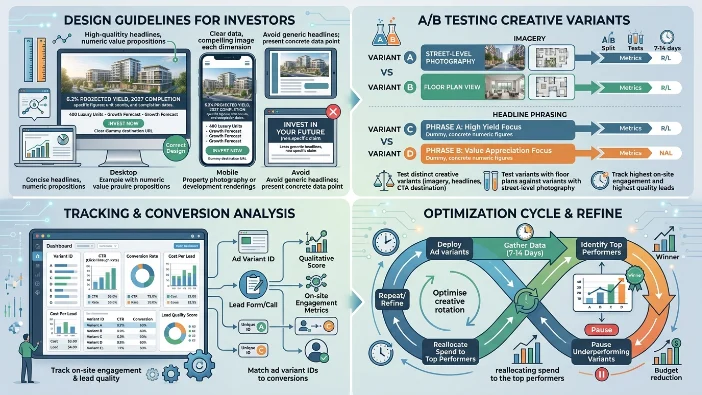
Design banners with concise headlines, numeric value propositions, and a clear destination URL. Use property photography or development renderings sized and cropped for each banner dimension. Include specific figures such as projected gross yields, unit counts, and completion dates to increase informational value. Avoid generic headlines; present a concrete data point like “6.2% projected yield, 2027 completion” rather than non-specific claims.
A/B test creative variants for headline phrasing, imagery, and call destination. Test a version featuring floor plans against a version featuring street-level photography. Track which creative yields the highest on-site engagement and highest quality leads by matching ad variant IDs to conversions. Optimise creative rotation by pausing underperforming variants after 7–14 days and reallocating spend to the top performers.
How do targeting methods and bidding strategies affect investor lead quality?
Targeting narrows the audience while bidding controls exposure. Use layered targeting: combine geographic filters with behavioural segments and time-of-day windows. Bid higher for users within 5 km of a target development, for users who previously viewed investment-centred pages, and for weekday business-hour impressions when professional investors research. Set frequency caps at 3–7 impressions per user per week to reduce ad fatigue.
Use CPA bidding to focus on leads rather than clicks. Set a target cost per lead aligned with acquisition budgets and historical conversion rates. For initial testing phases, use CPC bidding to gather performance signals and then switch to CPA once conversion volume meets statistical thresholds. Monitor bid adjustments daily during launch and weekly thereafter to maintain target CPL while preserving reach.
How do realtors integrate banner efforts with landing pages and CRM?
Connect banners to dedicated landing pages that match the ad message and data points. Landing pages use the same headline, imagery, and numeric detail present in the banner. Include a single primary conversion action: contact form with required fields for name, phone, email, and investment interest; or phone link with click-to-call tracking. Limit required fields to five or fewer to reduce friction.
Automate lead ingestion into a CRM with source and creative identifiers. Tag leads with campaign, placement, and creative IDs. Use automated email confirmations and follow-up sequences prioritising high-value leads with rapid outreach within 24 hours. Real examples of CRM fields include “campaign_id: BNR-SUM-001,” “placement_size: 300×250,” and “lead_score: 8” for investors with specified investment budget and target locations.
Explore More Expert Insights:
How Real Estate Brands Promote Property Launches Using Banner Ads
How Housing Societies Boost Inquiries Using Display Campaigns
How do realtors use retargeting after initial banner exposure?
Retarget users who viewed banners but did not convert by serving follow-up creative that presents deeper information. Use sequential messaging: first exposure focuses on yield and location, second exposure highlights case studies and tenant demand, third exposure provides a downloadable investment pack or invites to a webinar. Set the retargeting window to 14–30 days for transactional investor interest and 90 days for longer-horizon capital-growth messaging.
Exclude converted users from retargeting lists to preserve budget. Segment retargeting audiences by on-site behaviour such as time on page, number of property pages viewed, or interaction with a mortgage calculator. Allocate 20–40% of the display budget to retargeting to balance new prospect discovery and re-engagement of warm audiences.
What are typical campaign budgets, timelines, and expected outcomes for investor-focused banners?
Budgets vary by market but common UK ranges for initial tests are £1,000–£5,000 per month. Expect CTRs between 0.05% and 0.30% for prospecting banners and higher CTRs for retargeting, commonly 0.30%–1.00%. Anticipate CPLs between £30 and £300 depending on targeting precision and asset type. Timelines for measurable results start at 4–8 weeks; statistical significance for optimisations typically requires 4–12 weeks of data.
Set objectives for each phase: awareness phase aims for impressions and site sessions; engagement phase aims for brochure downloads and enquiry forms; conversion phase aims for qualified calls and booked viewings. Monitor conversions weekly and adjust bids, creative, and targeting based on performance signals.
Readers interested in the educational stage of real estate lead quality strategies can explore:
How Real Estate Brands Improve Lead Quality Using Retargeting Campaigns
Readers planning conversion-focused retargeting can explore:
Retargeting Real Estate Campaigns That Convert Warm Leads Into Deal Inquiries