
Retargeting is the practice of showing targeted ads to users who previously engaged with a brand’s digital property, using tracking cookies, mobile IDs, or CRM data to reconnect and move prospects toward conversion.
Retargeting identifies anonymous or known visitors after they leave a website or app. Platforms match those identifiers to ad networks and display tailored creative across websites, social channels, and programmatic inventory. Key entities: pixel (a small tracking code placed on pages), audience segment (grouping by behaviour), ad creative (visual and message), and conversion event (form submit, call, booking). Retargeting enables brands to focus ad spend on users with demonstrated interest, improving signal-to-noise in lead pipelines.
How does the retargeting process work for real estate brands?
The process collects visitor signals, segments those signals by intent, serves sequential ads, and measures conversions to optimise audience and creative.
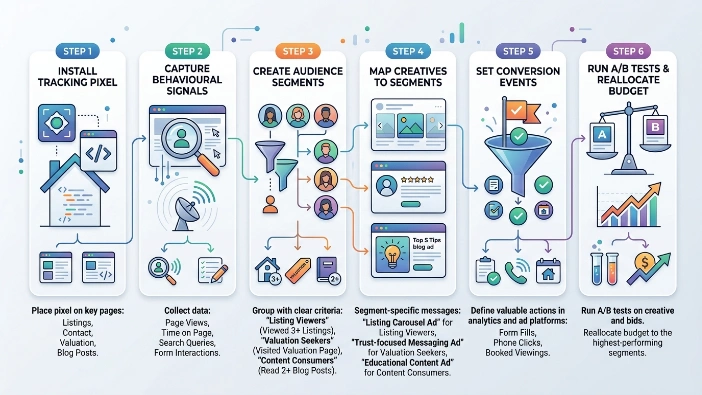
First, install a tracking pixel on key pages: listings, contact, valuation, and blog posts. Second, capture behavioural signals: page views, time on page, search queries, and form interactions. Third, create audience segments with clear criteria: listing viewers (viewed 3+ listings), valuation seekers (visited valuation page), and content consumers (read 2+ blog posts). Fourth, map creatives to segments: listing carousel for listing viewers, trust-focused messaging for valuation seekers, and educational content for content consumers. Fifth, set conversion events in analytics and ad platforms to track form fills, phone clicks, or booked viewings. Finally, run A/B tests on creative and bids, and reallocate budget to the highest-performing segments.
Which retargeting campaign types produce higher-quality leads?
Sequential ads, CRM-based retargeting, and dynamic listing ads each improve lead relevance by matching message to intent and past behaviour.
Sequential ads show a planned series: awareness creative first, property highlights next, and direct inquiry prompts last. CRM-based retargeting uploads known contacts and targets them with personalised messages tied to prior interactions. Dynamic listing ads pull live property data and present the exact listings a user viewed. Each type increases contextual relevance.
For example, CRM uploads convert direct enquiries 20–40% faster in platform reports; dynamic listing ads improve click-through on property pages by measurable margins when feeds update daily.
What audience segments should real estate brands create for retargeting?
Segments should reflect measurable intent: recent listing viewers, high-value property viewers, enquiry initiators, and content engagers. Define recency windows: 0–7 days for hot prospects, 8–30 days for warm prospects, and 31–90 days for long-term nurture. Tag high-value behaviours: viewed properties priced over £500,000, viewed floorplans, or requested virtual tours. Combine signals: users who viewed multiple listings and visited the contact page become a high-intent segment.
Use CRM data to form a VIP list of prior clients and high-net-worth leads. Manage frequency caps and exclude converted users to avoid wasted spend. Real examples: a London agency created a 0–7 day high-intent segment for prime central listings and doubled booking rates within three weeks.
How do creative and messaging improve lead quality in retargeting ads?
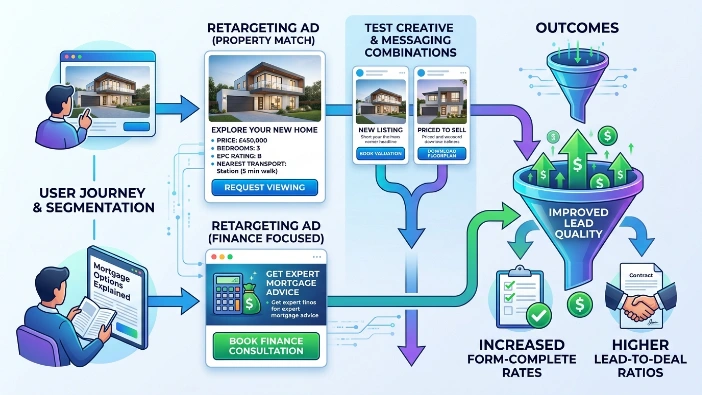
Creative that matches the user’s last interaction and highlights a clear next step increases inquiry relevance and reduces unqualified clicks. If a user viewed a specific property, serve the same property image with a short headline and a direct inquiry button. If a user read a financing article, present mortgage-focused content with a booking link for a finance consultation.
Use concise facts: price, number of bedrooms, EPC rating, and nearest transport links. Use explicit calls to action aligned to intent: “Request viewing,” “Book valuation,” or “Download floorplan.” Test image types, headlines, and CTA text to measure which combination yields higher form-complete rates and higher lead-to-deal ratios.
What measurement and attribution methods prove retargeting improves lead quality?
Use event-level tracking, multi-touch attribution, and lead scoring to isolate retargeting impact on qualification, contact rate, and deal progression. Track click-to-form completion, phone call duration, and booked viewing as distinct conversion events. Attribute conversions with a multi-touch model to capture retargeting’s assist role across 7-, 14-, and 30-day windows. Implement lead scoring that weights behaviour: repeated listing views score higher than a single blog read.
Compare cohorts exposed to retargeting versus a control group to measure lift in contact rate and qualified leads. Example metrics: a campaign where retargeted cohorts had a 35% higher contact rate and 22% higher qualified-lead rate across a 30-day period.
Which privacy and compliance steps must UK real estate brands follow for retargeting?
Comply with UK GDPR by obtaining lawful basis for processing, providing clear cookie consent, and allowing easy opt-out from targeted advertising.
Record consent for non-essential cookies before firing tracking pixels. Provide a transparent privacy notice that lists data controllers, processing purposes, retention periods, and third-party recipients. Honour Do Not Track signals and user opt-outs from ad networks.
For CRM-based retargeting, ensure lawful basis exists: legitimate interest with a documented balancing test or explicit consent for marketing. Retain data according to stated periods and implement secure transfers for any cross-border ad platform processing.
How does budget allocation affect lead quality in retargeting?
Allocate higher bids to small, high-intent segments and lower bids to broad nurture audiences to concentrate budget on likely converters.
Use a tiered bidding plan: top-tier bids for 0–7 day high-intent segments; mid-tier bids for 8–30 day warm segments; low bids for 31–90 day nurture groups. Limit spend on broad audiences that show low conversion rates. Set frequency caps to avoid ad fatigue and allocate at least 60% of retargeting budget to high-intent segments for faster lead progression. Monitor cost-per-qualified-lead rather than cost-per-click to prioritise lead quality over volume.
Explore More Expert Insights:
How Realtors Educate Buyers Using Property Comparison Banner Ads
How Housing Projects Build Consideration Using Visual Display Ads
What technology stack components support effective retargeting?
A tracking pixel, a CRM with export capability, an ad platform that supports audience imports, and a dynamic feed or CMS integration form the core stack. Deploy a reliable tag manager to control pixels and events. Integrate CRM to capture offline conversions and enrich audience lists. Use ad platforms that enable lookalike expansion based on high-quality lists.
Maintain a dynamic property feed with up-to-date price, status, and images. Use analytics tools to unify online and offline attribution. Example stack: tag manager for pixel control, CRM for lead data, ad platform for audience targeting, and feed manager for dynamic ads.
Read:
Retargeting Real Estate Campaigns That Convert Warm Leads Into Deal Inquiries
What real estate use cases show improved lead quality from retargeting?
Listing view-to-booking funnels, valuation request nurturing, and investor prospect drip sequences demonstrate measurable uplift in qualified inquiries. In listing view-to-booking funnels, retargeting reduces time-to-booking by serving property details and viewing slots within 7 days. For valuation requests, retargeting prompts users who opened pricing guides to schedule appraisals, increasing booked valuations per campaign by double-digit percentages.
For investor outreach, retargeting to users who downloaded investment guides increases inquiry relevance by surfacing tailored yields and legal considerations. Real examples include local agencies that closed deals faster after adding CRM-based retargeting tied to high-value property categories.
Explore:
How Realtors Generate Investment Leads Using Banner Advertising
Real estate retargeting improves lead quality by focusing spend on users with verifiable intent, matching creative to behaviour, and measuring outcomes with event-level attribution and lead scoring. Implement a pixel, create precise segments with recency windows, align creative to intent, comply with UK GDPR, and allocate budget toward high-intent audiences. Track cost-per-qualified-lead and optimise until conversion rates stabilise.