
A banner ad is a digital graphic placed on web pages to attract attention and deliver a short marketing message; brands use banner ads to announce new property launches, highlight key features, and drive awareness to launch dates. A banner ad is a rectangular digital graphic, created in fixed pixel sizes or responsive formats. It contains an image, headline, value point, and a call-to-action element.
For property launches, brands place banner ads across high-traffic websites, property portals, and local news sites to reach potential buyers in target areas. Banner ads deliver a concise message about the launch date, location, price range, unit types, and booking steps. Creative variations test different headlines, images, and offers to measure which message yields the highest engagement. Standard sizes include 300×250, 728×90, and 160×600 pixels; these sizes align with major display networks and inventory pools.
How do brands plan banner ad campaigns for a property launch?
Brands plan campaigns by defining audience, budget, timeline, placements, and creative themes aligned to a launch schedule and performance goals. Campaign planning starts with audience definition: age range, income bracket, location radius, and purchase intent signals. Brands allocate budget across awareness, consideration, and retargeting phases, with 50–70% of spend often going to awareness in early launch phases. Timelines run from 8 to 16 weeks: pre-launch (4–8 weeks) to announce and generate leads, launch week (1 week) to drive urgency, and post-launch (3–7 weeks) to capture remaining interest.
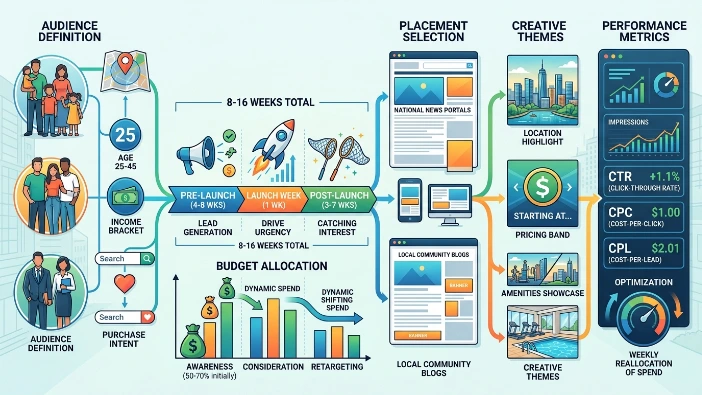
Placement selection targets national sites for broad reach and local publishers for geographic relevance. Creative themes emphasize location, price band, and key amenities to match audience priorities. Performance metrics include impressions, click-through rate (CTR), cost per click (CPC), and cost per lead (CPL). Brands use these metrics to reallocate spend weekly.
What creative elements must banner ads include for effective property launch promotion?
Effective banner ads include a clear headline, property image or render, price range or starting price, launch date or phase, and a visible action prompt. A headline summarises the launch message in 3–6 words. Images show exterior renders, show flats, or neighbourhood vistas. Price signals show a starting price or price band in local currency.
The launch date or phase indicates availability, e.g., “Launch 12 June 2026” or “Phase 1 Now Open.” Action prompts use concise text such as “Register Interest” or “View Floorplans.” Visual hierarchy places the headline and image at the top, price or date in the middle, and the prompt as a contrasting button. Colour contrast follows accessibility standards: text contrast ratio at least 4.5:1 for body copy. Animation is limited to 15 seconds and uses looping that pauses on hover. File formats for web delivery include JPEG, PNG, and GIF for simple banners, plus HTML5 for rich, responsive creatives
How do brands target audiences for banner ad exposure?
Brands target using demographics, geography, behavioural signals, and contextual placements to deliver ads to users most likely to respond to a property launch. Demographic targeting includes age ranges such as 25–45 and household income bands relevant to the property price. Geographic targeting narrows to city, borough, or postcode radius up to 30 kilometres from the development.
Behavioural targeting uses online actions: property searches, mortgage calculator visits, and site visits to competing developments. Contextual targeting places ads on property news pages, lifestyle sections, and local business websites. Time targeting schedules heavier delivery during evenings and weekends when users research property. Frequency caps limit exposures to 5–10 impressions per user over 14 days to avoid fatigue. Third-party data providers supply audience segments when first-party data is limited.
What technical standards and ad networks support banner ad delivery?
Delivery relies on ad servers, demand-side platforms (DSPs), programmatic exchanges, and publisher ad slots that support standard ad sizes and tracking pixels. Ad servers host creative files and record impressions and clicks. DSPs enable audience bidding across multiple inventory sources in real time. Programmatic exchanges match bids to publisher slots using real-time bidding (RTB) protocols.
Tracking uses pixels or first-party tracking to record conversions and viewability tags to confirm that the ad was seen for a minimum duration, typically one second for display and two seconds for video. Creative must meet file-size limits, usually 150 KB for static images and up to 200 KB for HTML5, though publishers vary. Safe ad practices include malware scanning, content compliance checks, and brand-safety filters that block placements on objectionable pages.
What legal and compliance issues affect banner ad property launches in the UK?
Ads must include transparent pricing or payment terms when presented; they must follow advertising codes and avoid misleading claims about availability or returns. UK property advertising falls under the Committee of Advertising Practice (CAP) rules. Ads must not mislead on price, availability, or energy performance. If a price is featured, the ad must explain the basis, such as “from £350,000” and link to fuller pricing information on the landing page.
Financial claims, such as mortgage estimates or rental yields, require clear assumptions and must follow Financial Conduct Authority guidelines if they constitute regulated financial promotions. Location claims must be accurate; distance and transport times should not overstate convenience. Recordkeeping preserves creative approvals and supporting evidence for claims for at least 24 months.
Explore More Expert Insights:
How Housing Societies Boost Inquiries Using Display Campaigns
How Real Estate Agencies Attract Buyers Using Banner Ads
What benefits do banner ads deliver for property launches?
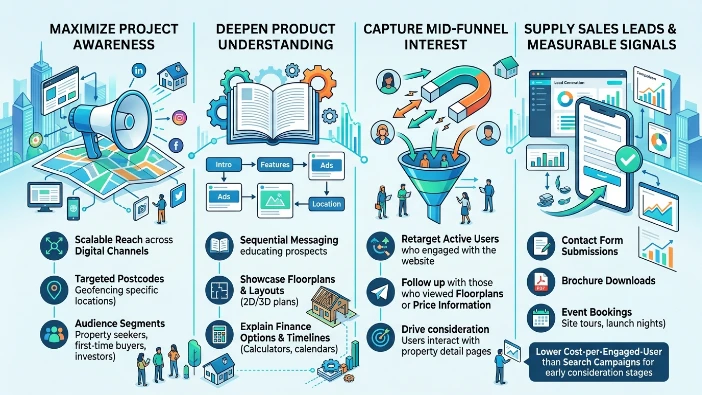
Banner ads deliver broad awareness, controlled geographic reach, measurable engagement, and the ability to test creative messages before the launch. Awareness scales quickly through programmatic buys. Geographic precision targets buyers within commuting distance or investment catchment areas.
Measurable engagement helps teams optimise performance by creative variant. A/B testing identifies the highest-performing headline or image within days. Retargeting captures users who showed initial interest and moves them toward registration. Banner ads integrate with other channels: email, search, and social, to form a multi-touch launch presence.
What use cases show banner ads working for property launches?
Common use cases include announcing launch dates, promoting exclusive preview events, showcasing starting prices, and retargeting users who viewed property details. A pre-launch banner promotes an exclusive preview date and gathers registrations. A launch-week banner highlights limited units and starting prices to create urgency. A price-band banner promotes affordability to specific income cohorts.
Retargeting banners remind visitors who opened the brochure to book a viewing. Localised banners on commuter news sites reach buyers commuting into a city. Each use case uses tailored creative and tailored placement to match user intent signals.
Property comparison banners educate buyers and help move them toward decisions; for deeper reading on comparison-focused ads, see the following:
How Realtors Educate Buyers Using Property Comparison Banner Ads
For solution-oriented guidance on turning comparison engagement into leads, see:
Property Comparison Ads That Turn Browsers Into Serious Buyers